
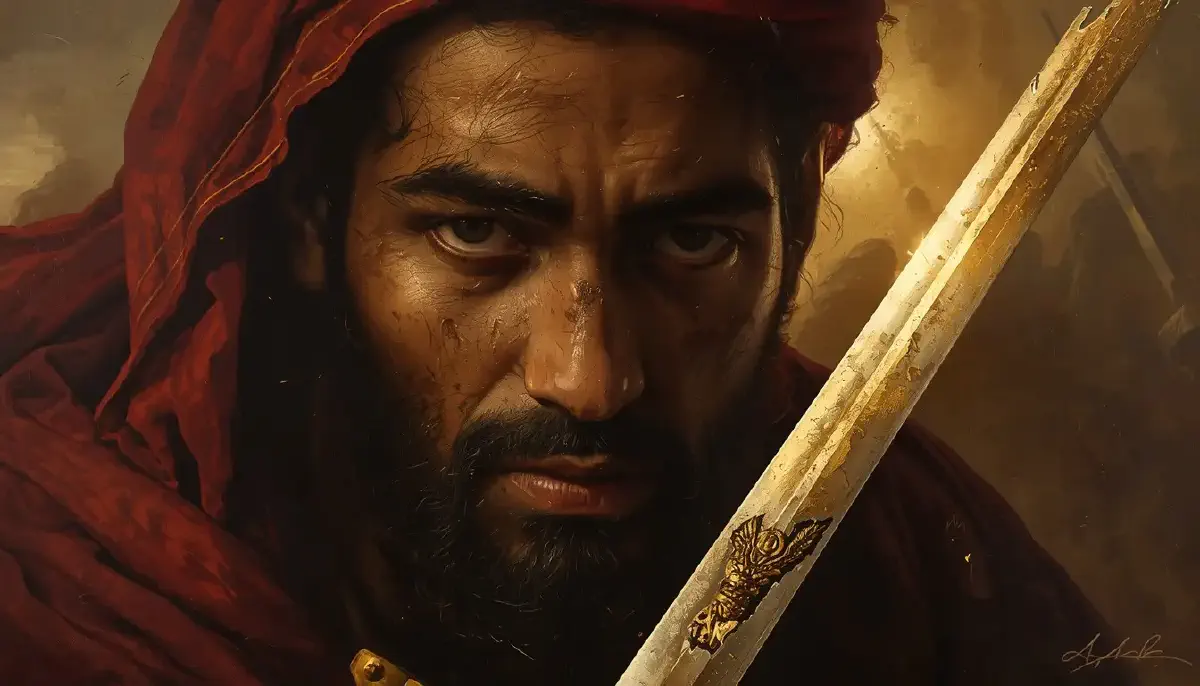
This article examines the third pillar of Khalid’s military genius: his leadership. We shall dissect its components—charismatic authority, the calculated risks of leading from the front, the delicate art of commanding a fractious tribal coalition, the psychological warfare that magnified his reputation, and the political subordination that kept him alive in a court where his fame invited envy.
The Warrior-Commander#
Khalid belonged to an era when the line between general and soldier was often blurred, but he took the blurring to an extreme. Arab tradition, as the historian Hugh Kennedy (2001, p. 68) notes, “expected a commander to fight in person, but few did so as consistently and effectively as Khalid.” At the Battle of the Trench, before his conversion, he led cavalry probes. After Islam, he personally fought champions in single combat—a practice that risked decapitation of the army’s brain for a momentary morale boost. Why did he persist in it? The answer lies in the psychology of his troops.
A 2023 study of his tactics observes that “Khalid’s personal bravery served a calculated function: it built an aura of invincibility that made his soldiers fight beyond normal endurance” (Gök & Zeybek, 2023, p. 51). When a man sees his commander slicing through enemy ranks, the possibility of defeat recedes in his mind. This was not mere bravado; it was a force multiplier in an army that lacked formal discipline and relied on esprit de corps. Khalid understood, intuitively, that the morale of a tribal levy could be transformed into the cohesion of a professional force if the leader became a totem of victory. And he understood its limits: by the time of Yarmouk, he had evolved into a director of reserves, only fighting personally at critical junctures. The warrior-commander had become the strategic commander.
Forging One Army from Many Tribes#
The Arab forces that conquered two empires were a coalition of Bedouin clans, Medinan emigrants, and recent converts. Their loyalties were local and personal, not institutional. Keeping this coalition from fracturing required a leader who could balance honour, reward, and discipline. Khalid’s solution was to embed tribal units under their own chiefs but to weld them together with a common doctrine and a shared myth of invincibility. The U.S. Army monograph notes that “he secured the allegiance of local tribes, which was a key tenet of his operational approach, and integrated them into his force without losing offensive momentum” (U.S. Army, 2012, p. 31).
Crucially, he led by example in subordinating his own ego to the larger cause. The most powerful illustration is his reaction to his demotion.
The Test of the Demotion#
In 634 CE, shortly after the victory at Yarmouk, Caliph Umar ibn al-Khattab removed Khalid from supreme command and appointed Abu Ubayda in his place. The reasons remain debated—some sources cite Umar’s concern that the Muslims were attributing victory to Khalid rather than God, others point to a personal dispute, and still others to fears of excessive centralisation of power. Whatever the motive, the order reached Khalid at the height of his fame. A lesser man might have resisted, or at least sulked. Khalid’s response, recorded by al-Baladhuri (2022, p. 210), was immediate and public: he handed over command without a murmur and fought under Abu Ubayda as a subordinate officer for the rest of the Syrian campaign.
This act of political subordination is as instructive as any battlefield manoeuvre. It demonstrated to the troops that the army was not Khalid’s private fiefdom; it was the caliph’s instrument. It neutralised the factionalism that could have torn the conquest movement apart. It also preserved Khalid’s life: a general who sets himself above the state’s authority rarely survives his victories. In a world where successful commanders often became usurpers, Khalid’s disciplined acceptance of Umar’s authority was a strategic decision of the highest order.
Psychological Warfare: The Weapon of Reputation#
A commander’s reputation can be a weapon that disarms enemies before the first arrow flies. Khalid cultivated this weapon with deliberate care. The most famous anecdote, found in the works of al-Tabari and later chroniclers, involves a Persian governor who challenged him before a siege: if Khalid could drink a cup of poison and survive, the town would surrender. Khalid, reportedly, seized the cup, declared “In the name of God,” and drank. He survived—either through divine protection, an emetic, or the poison being less potent than feared—and the town capitulated without further resistance.
Whether this story is literal truth or hagiography is immaterial; its circulation on the eve of battle was itself a weapon. “His reputation alone could be a weapon,” Gök and Zeybek note. “The very mention of his approach could induce fear and prompt surrenders” (2023, p. 55). Psychological warfare in the 7th century was not a poor substitute for firepower; it was an economy-of-force measure that saved thousands of lives on both sides. Khalid’s legend preceded him, and he stoked it with theatrical acts of courage that echoed through the oral culture of Arabia faster than any dispatch rider could ride.
Charisma as a System Component#
Charisma is an overused word in leadership studies, but in Khalid’s case it has a specific, measurable dimension: it translated into the capacity to demand and receive extraordinary effort from his soldiers. The same warriors who had been raiding for spoils under other commanders became, under his banner, an army that could endure a six-day battle at Yarmouk with heavy casualties and no retreat. The U.S. Army monograph describes this transformation as “a case study in leadership-driven cohesion” (U.S. Army, 2012, p. 41).
His charisma was not of the oratorical kind—no stirring pre-battle speeches are reliably recorded. It was the charisma of deeds. It said: I will do what I ask of you, and more. When his army crossed the Syrian Desert in five days, the men were sustained by the knowledge that their commander was enduring the same thirst, the same fear, the same physical ordeal. This is leadership as symbiosis, and it built bonds that neither gold nor titles could replicate.
Conclusion: The Human Factor#
Military history is replete with brilliant strategists who failed as leaders, and with inspirational leaders who lacked strategic sense. Khalid ibn al-Walid was that rarest of figures: a general who could conceive a campaign of annihilation and then lead his men through its execution with a sword in his hand and a political sixth sense that kept him on the right side of power. His leadership was not an accessory to his tactical genius; it was the engine that made his tactics possible.
In the final article of this series, we will step back from the man to examine the system. By comparing Khalid’s methods with those of Hannibal and Guderian, we shall identify the universal principles of manoeuvre warfare that transcend time, technology, and culture—and ask whether the “first Blitzkrieg” was fought not with panzers, but with camels and a commander who understood that the ultimate weapon is the human will.
Next: Article IV — The First Blitzkrieg? A Systems Analysis of 7th-Century Warfare in Light of Hannibal and Guderian.