
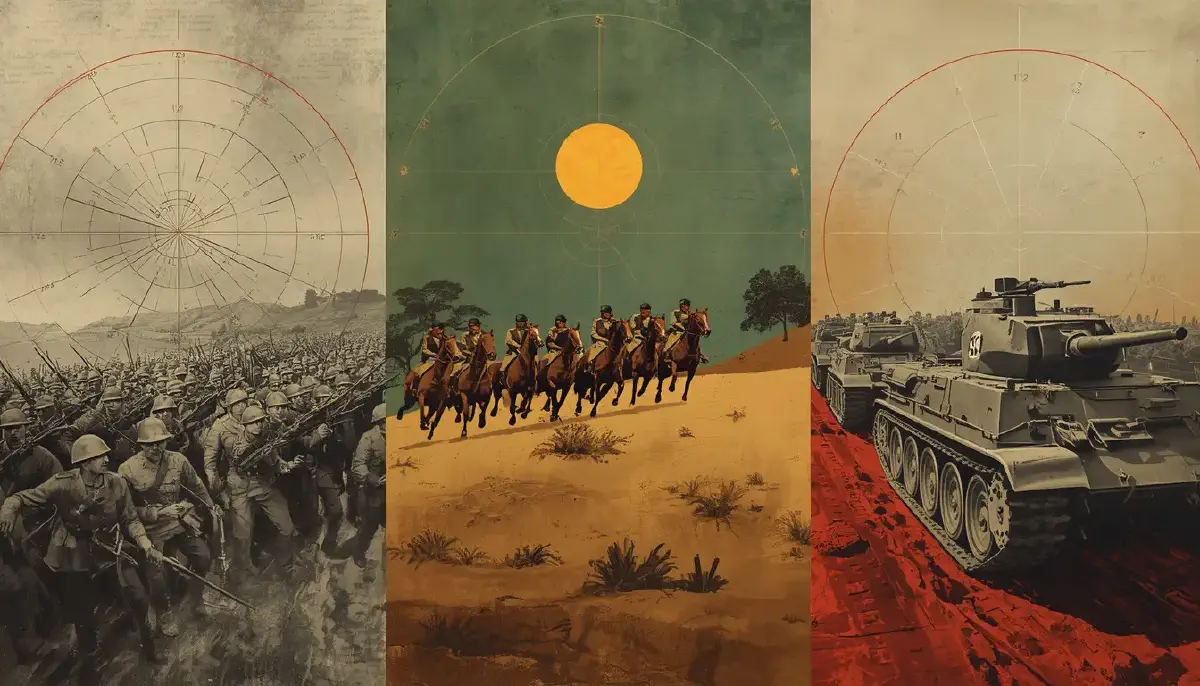
Any military system can be analysed as a set of inputs (the resources at a commander’s disposal), a processing engine (doctrine, command and control, logistics), and outputs (battlefield results and strategic outcomes). The method is crude but illuminating. When applied to three commanders separated by centuries, it reveals that the gulf between a Carthaginian mercenary army, a Nazi Panzer corps, and a Bedouin raiding force is narrower than it appears.
Hannibal Barca: The Tactical Genius Without a Strategic Engine#
Hannibal’s system at Cannae (216 BCE) was one of the most refined tactical machines ever built. He took a polyglot army of Africans, Spaniards, Gauls, and Numidians and welded it into an instrument that executed the double envelopment with clockwork precision. His inputs were superior cavalry and the loyalty of his men. His processing engine was a doctrine of tactical annihilation, enabled by his own genius. The output was the destruction of a Roman army twice his size.
Yet Hannibal’s system failed at the strategic level. He could win battles but could not convert them into the collapse of the Roman state. His logistics depended on plunder and precarious supply lines; his political base in Carthage was divided. The Roman system absorbed defeat and kept fighting. Hannibal’s war-making machine, for all its brilliance, lacked the operational and strategic depth to achieve its ultimate objective. It was a scalpel without a body to sustain it.
Heinz Guderian: The Industrial-Age Application of Ancient Principles#
Guderian’s Blitzkrieg of 1939-40 applied the principles of speed, concentration, and dislocation with industrial-age tools. His inputs were the Panzer divisions and the Luftwaffe. His system—Bewegungskrieg—was a doctrine of decentralised, mission-type orders (Auftragstaktik) that empowered subordinate commanders to exploit opportunities without waiting for permission. Logistically, it was a hungry beast that required a continent-wide industrial base and constant resupply. Its outputs were the swift conquest of Poland and the shocking collapse of France in six weeks.
The system’s weaknesses were also industrial: it was oil-dependent, vulnerable to stretched supply lines, and ultimately unsustainable against a fully mobilised great power coalition. Yet at the operational level, Guderian achieved what Hannibal could not: the complete and rapid collapse of an enemy state through a series of sequential and simultaneous operations.
Khalid ibn al-Walid: The Resource-Minimalist’s Masterpiece#
Khalid’s system must be understood in the context of his extreme resource constraints. He commanded armies that were almost always outnumbered, operating far from their base in Medina, with no state logistical apparatus and no industrial base at all. The table below sets the three systems alongside one another.
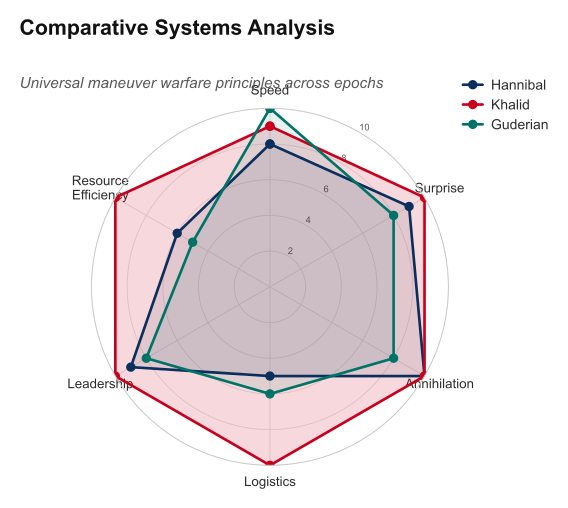
Table 4: Comparative Systems Analysis — Hannibal, Khalid, Guderian
| Variable | Hannibal Barca (Cannae, 216 BCE) | Khalid ibn al-Walid (Yarmouk, 636 CE) | Heinz Guderian (France, 1940) |
|---|---|---|---|
| Input (Resources) | ~50,000 men; heterogeneous mercenaries; superb Numidian cavalry; elephants. | ~24,000–40,000 men; homogeneous Bedouin core; camels and horses; no siege equipment of note. | Panzer divisions, Luftwaffe, motorised infantry; industrial-era fuel, ammunition, and communication systems. |
| System (Doctrine & C2) | Set-piece tactical annihilation; centralised command reliant on Hannibal's personal genius. | Mobile warfare doctrine; delegated command with operational objectives; "desert power" logistics; cavalry reserve as decisive arm. | Bewegungskrieg; mission-type orders (Auftragstaktik); combined arms; deep strategic penetration. |
| Key Enabler | Cavalry superiority. | Desert mobility and intelligence; psychological warfare; leadership cohesion. | Radio communications; internal combustion engine; dive-bombers as flying artillery. |
| Output (Battlefield) | Annihilation of a Roman army; 50,000-70,000 killed. | Annihilation of the Byzantine field army in Syria; enemy commander killed. | Encirclement and capitulation of the French army; capture of Paris. |
| Output (Strategic) | Tactical masterpiece; strategic stalemate; Rome eventually wins the war. | Decisive strategic victory; permanent loss of Syria for Byzantium; rapid territorial expansion of the Caliphate. | Decisive operational victory; strategic gamble that succeeded in six weeks; eventual strategic overreach. |
| Resource Efficiency | High: defeated a force nearly twice its size. | Extraordinary: defeated forces often three or more times larger, using minimal material resources. | Moderate: achieved swift victory but at enormous material cost relative to available resources. |
Sources: U.S. Army (2012), pp. 18-31; Kennedy (2001), pp. 55-68; Akram (1970), pp. 401-425; Gök & Zeybek (2023), pp. 45-55.
The most striking feature of Khalid’s system is its resource efficiency. He achieved annihilation victories not through superior technology or mass, but through a near-perfect alignment of the human and environmental factors at his disposal. The desert, as argued in Article II, became a secure line of communication and a weapon of surprise. His intelligence network allowed him to dictate the tempo. His leadership, detailed in Article III, turned a tribal levy into a cohesive force capable of complex operational manoeuvres. And his tactical flexibility, explored in Article I, ensured that each battle was fought on terms of his choosing.
Universal Principles of Maneuver Warfare#
From this comparative analysis, five principles emerge that transcend time and technology. They form a skeleton key to understanding successful military systems across the ages.
First, speed and surprise are multipliers. Guderian’s panzers achieved it with engines; Khalid with camels; Hannibal with the forced march across the Alps. In all three cases, the enemy’s decision cycle was broken before the first major engagement. A force that appears where it is not expected and does so faster than the opponent can react gains a decisive advantage that numbers alone cannot offset.
Second, annihilation trumps attrition. All three commanders sought the complete destruction of the enemy’s field army, not incremental gains. This is the most demanding form of warfare, but also the most decisive. The U.S. Army monograph notes that Khalid’s objective was “not simply to defeat the enemy but to destroy his ability to wage war” (2012, p. 12)—a formulation that could apply equally to Guderian’s doctrine of the Kesselschlacht (cauldron battle).
Third, mission-type command unlocks initiative. Guderian’s Auftragstaktik was not an invention of the Prussian General Staff but a rediscovery of a principle that Khalid practised. His subordinates were given objectives and the freedom to achieve them, a necessity born of the desert’s vast distances and the absence of instantaneous communication. When junior commanders are empowered to exploit fleeting opportunities, the tempo of operations accelerates beyond the enemy’s capacity to respond.
Fourth, logistics is an operational weapon, not a burden. Hannibal was crippled by his supply lines; Guderian’s advance was repeatedly halted by fuel shortages. Khalid turned logistics on its head by making self-sufficiency a core competency. His army carried its sustainment with it, freeing it from the umbilical cord that tethered other armies to depots and roads. This converted the desert from a barrier into a manoeuvre space.
Fifth, the human will is the ultimate force multiplier. All three systems depended on exceptional leadership that inspired soldiers to endure privation and risk. Khalid’s warrior-commander model, Guderian’s personal direction of the armoured spearheads, and Hannibal’s legendary presence among his mercenaries all served the same end: cohesion under extreme stress.
A System for the Ages#
Was Khalid’s war-making a 7th-century Blitzkrieg? The analogy is suggestive but imperfect. He lacked the industrial means and the state machinery of the Third Reich; his wars were not total wars of ideology but campaigns of expansion fought by a community still defining itself. Yet the effects he achieved—the rapid, sequential destruction of enemy field armies, the paralysis of command, the psychological collapse of imperial garrisons—are precisely those sought by modern manoeuvre theorists. The U.S. Army’s decision to study him as a case in operational art is not a historical curiosity; it is a recognition that a Bedouin commander, without maps or radio, solved problems that still bedevil modern staff colleges.
His system, finally, was a product of its environment. Just as Guderian’s Blitzkrieg was the marriage of the tank and the radio to Prussian doctrine, Khalid’s method was the marriage of the camel and the desert to the Arab tradition of the raid. Both were expressions of a unique cultural and material context, yet both validated the same timeless truth: the side that can move faster, think more clearly, and endure more hardship will prevail, no matter the century.