
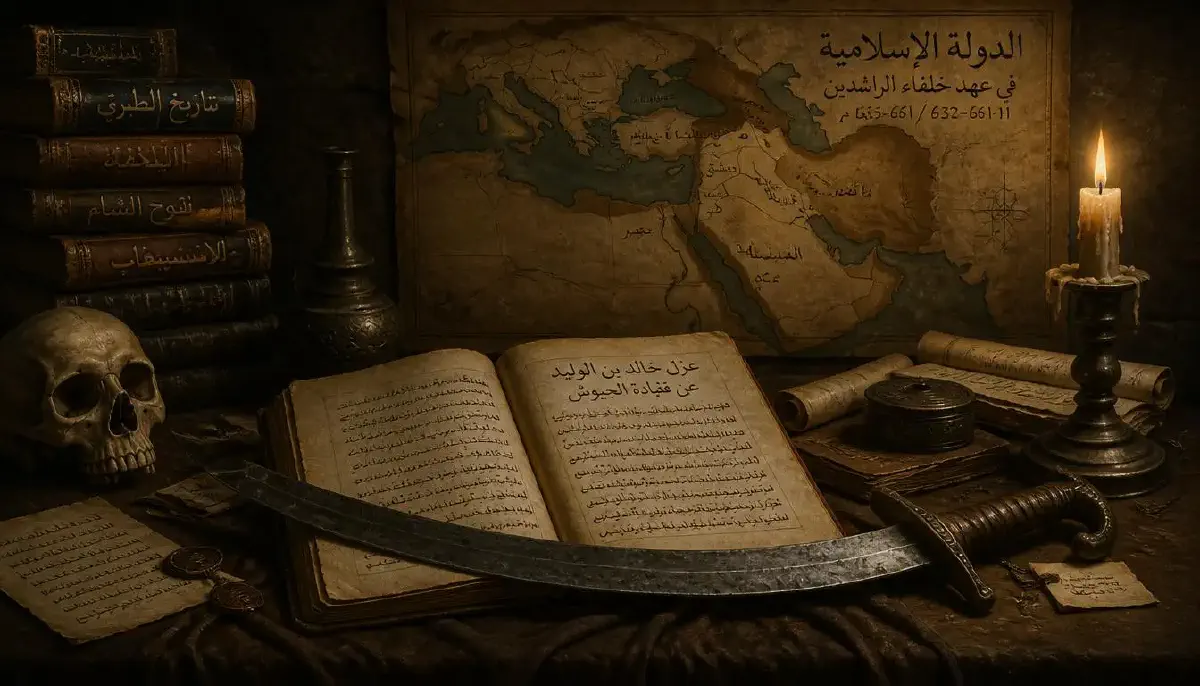
Part I: The Sources — A Critical Appraisal#
No serious assessment of Khalid's career can proceed without acknowledging the nature of the evidence on which it rests. The earliest surviving Arabic accounts—al-Baladhuri's Futūḥ al-Buldān, al-Azdi's Futūḥ al-Shām, and the monumental History of al-Tabari—were compiled between the mid-9th and early 10th centuries, roughly 150 to 250 years after the events they describe. This temporal gap is not, in itself, disqualifying; Thucydides wrote decades after the Peloponnesian War, and modern historians still rely on him. But the gap must be understood.
The Problem of Late Compilation#
The interval between action and inscription meant that accounts passed through multiple generations of oral transmission. The isnad system—chains of named transmitters—was designed to preserve reliability, but it could not eliminate embellishment, conflation, or the reshaping of events to serve contemporary concerns. The Abbasid caliphs under whom many histories were written had their own legitimising interests in how the conquest era was remembered. Victories were magnified; inconvenient episodes were softened or omitted.
The Problem of Numbers#
Nowhere is the literary character of the sources more evident than in the force estimates they provide. Al-Tabari claims the Byzantine army at Yarmouk numbered over 100,000; other sources push the figure to 200,000. Modern scholarship, led by Hugh Kennedy (2001) and Walter Kaegi (1992), regards these figures as symbolic rather than statistical. Kennedy estimates the Byzantine field army in Syria at perhaps 40,000 to 80,000, and the Muslim force at 24,000 to 40,000—still a significant numerical disadvantage, but not the fantastic odds of legend. The table below illustrates the discrepancy between traditional and critical estimates.
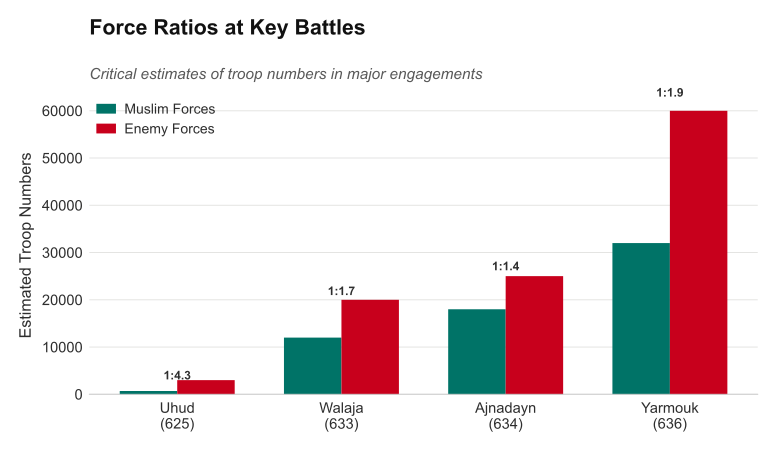
Table 5: Traditional vs. Critical Force Estimates — Major Battles
| Battle | Traditional Estimate (Muslim Sources) | Critical Scholarly Estimate | Source for Critical Estimate |
|---|---|---|---|
| Yarmouk (636) | Muslims: 24,000–40,000; Byzantines: 100,000–200,000 | Muslims: ~24,000–40,000; Byzantines: ~40,000–80,000 | Kennedy (2001, p. 56); Kaegi (1992, p. 131) |
| Walaja (633) | Muslims: ~15,000; Persians: ~30,000–50,000 | Muslims: ~10,000–15,000; Persians: ~15,000–25,000 | Akram (1970, p. 185) |
| Ajnadayn (634) | Muslims: ~32,000; Byzantines: ~90,000 | Muslims: ~15,000–20,000; Byzantines: ~20,000–30,000 | Kennedy (2001, p. 62) |
The critical estimates remain impressive; an army of 30,000 defeating one of 60,000 in open battle is no small feat. But acknowledging the uncertainty protects the historian from the charge of credulity.
The Problem of the "Undefeated" Narrative#
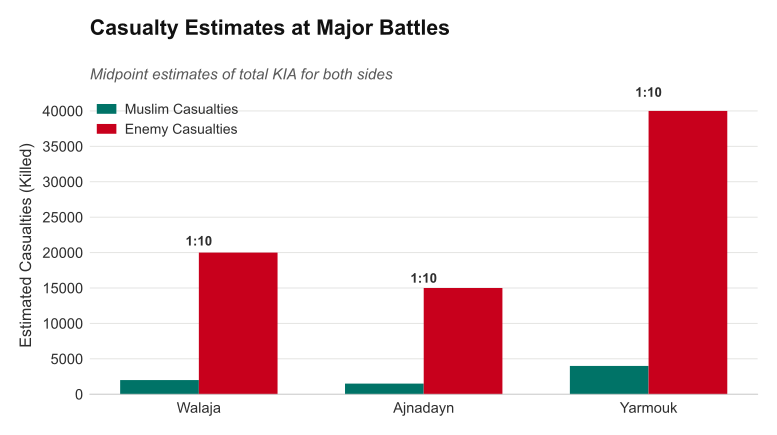
The assertion that Khalid was never defeated requires careful definition. What constitutes defeat? If the standard is the annihilation of his army and the loss of a campaign, then the claim holds: he never suffered a Cannae in reverse. But if defeat includes tactical withdrawals, pyrrhic victories, or engagements where his forces failed to achieve their objective, the picture is more complex.
At Mu'tah (629 CE), Khalid extracted his army from encirclement—a tactical masterstroke—but the expedition's strategic goal, a punitive raid into Byzantine territory, was abandoned. At Yamama (632 CE), the victory was so costly that some sources record 1,200 Muslim dead, including a disproportionate number of Quran memorisers. The battle was won, but the army was temporarily shattered. These are not defeats in the conventional sense, but they reveal that Khalid's career was not the unblemished string of effortless triumphs that later tradition sometimes presents.
A responsible series must present the evidence for Khalid's record while acknowledging the interpretative framework that shapes it.
Part II: The Adversary Context — Why the Empires Fell#
A general's greatness is measured not only by his own qualities but by the obstacles he overcomes. The Sassanid and Byzantine empires of the early 7th century were not the formidable powers they had been a generation earlier. Khalid's genius lay partly in recognising and ruthlessly exploiting weaknesses that already existed.
The Sassanid Empire
When Khalid crossed the Euphrates in 633, the Sassanid state was a hollow shell. The catastrophic war with Byzantium (602–628 CE) had ended only five years earlier. Emperor Khusrow II had been overthrown and executed in 628, and a succession of short-lived rulers—ten in five years—had reduced the empire to chaos. The army, once built around the heavy cavalry of the aswaran elite, was demoralised and poorly mobilised. Local governors on the frontier were left to fend for themselves, without coherent strategic direction.
Khalid's sequential victories in Iraq were possible because no central authority could coordinate a response. Each Persian force he encountered was defeated before the next could arrive. By the time the Sassanid court grasped the scale of the threat, the damage was done.
The Byzantine Empire
Heraclius had won his war against Persia, but at a ruinous cost. The treasury was empty, the field army exhausted, and the Syrian provinces—predominantly Monophysite Christian—were alienated from the Chalcedonian orthodoxy imposed by Constantinople. When Muslim forces appeared, many Syrian cities negotiated surrenders that preserved local autonomy. The imperial army, reliant on Armenian and Ghassanid mercenaries, suffered from divided command and poor intelligence. The desert, which Khalid weaponised, was a domain the Byzantines had never learned to master.
Table 6: Comparative Adversary Weaknesses
| Factor | Sassanid Empire (633–637) | Byzantine Empire (634–638) |
|---|---|---|
| State of Army | Exhausted from war with Byzantium; elite heavy cavalry depleted; slow mobilisation | Exhausted from war with Persia; reliance on mercenaries; divided command structure |
| Internal Stability | Court intrigue; ten rulers in five years after Khusrow II's fall | Religious schism (Monophysitism vs. Chalcedonian orthodoxy); resentment of imperial taxation in Syria |
| Intelligence Failure | No desert intelligence network; underestimated the Arab threat entirely | Dismissed Arab raiders as a policing problem; no anticipation of the desert crossing |
| Key Vulnerability | Cumbersome logistics; inability to cope with mobile, decentralised warfare | Divided civilian loyalties in the Levant; slow strategic decision-making in Constantinople |
| Leadership Quality | Fragmented; provincial governors fighting isolated campaigns | Heraclius, once brilliant, was aging and ill; field commanders lacked coordination |
Sources: Kennedy (2001), pp. 45–72; Kaegi (1992), pp. 26–55; Donner (1981), pp. 91–155.
Part III: The Political Cage — Umar, Khalid, and the Limits of Military Autonomy#
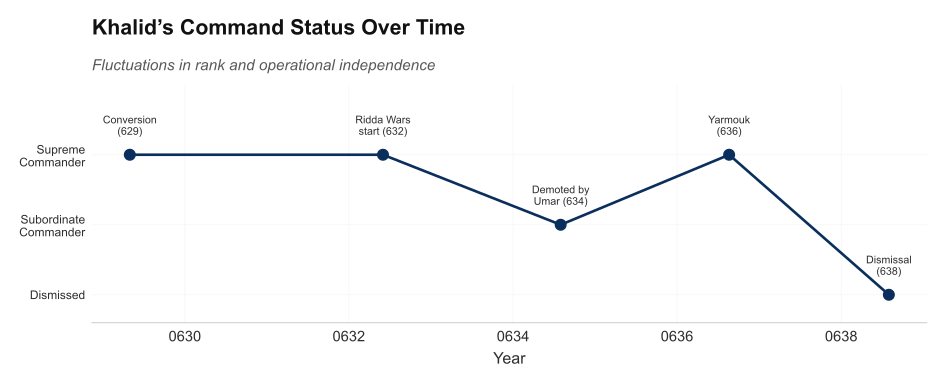
A recurring theme in military history is the tension between the victorious general and the political authority he serves. The early caliphate was no exception. The series has touched on Khalid's demotion by Caliph Umar in 634 and his final dismissal in 638, but a deeper examination of the political dynamics is essential.
The Belisarius Parallel
The Byzantine general Belisarius, who served Justinian a century before Khalid, offers a striking parallel. He won spectacular victories against the Vandals in North Africa and the Goths in Italy. He accepted demotions and political suspicion without rebellion. Justinian, like Umar, feared a general who became too popular and repeatedly undercut him. Both Khalid and Belisarius subordinated personal ambition to the stability of the state—a choice that preserved the political order but denied them the final glory their military achievements merited.
The Religious Dimension
Some sources suggest that Umar's unease with Khalid had a theological component. A commander whose victories were so complete risked becoming an idol. The caliphate was a theocracy; victory belonged to God, not to any human instrument. Whether this reflects Umar's genuine conviction or a later pietistic gloss, it points to a structural tension: how does a religious state manage a charismatic general without diminishing either the faith or the commander?
Part IV: Expanded Comparisons — The Universal Brotherhood of Great Captains#
The comparisons with Hannibal and Guderian have illuminated Khalid's tactical and operational methods. But the roster of history's great captains includes others whose careers offer instructive parallels.
Subutai (Mongol Empire, 1175–1248 CE)
No commander offers a closer systemic parallel to Khalid than Subutai, the Mongol strategist who planned campaigns across Eurasia. Both commanded mobile, self-sufficient forces that treated harsh terrain—steppe and desert—as manoeuvre space. Both relied on deep intelligence networks to plan operations years in advance. Both practised a form of mission-type command that gave subordinates operational freedom. Both were ultimately subordinated to a political authority—the Great Khan and the caliph—that they never challenged. Subutai's feigned-retreat tactics, which drew enemies into encirclement, echo Khalid's use of deception at Ajnadayn and Firaz.
Napoleon Bonaparte (France, 1769–1821 CE)
Napoleon's operational method—the rapid concentration of force at the decisive point, the pursuit of the decisive battle, the corps system that allowed independent manoeuvre—is a modern incarnation of principles Khalid practised. The Ulm campaign of 1805, in which Napoleon destroyed an Austrian army through marching rather than fighting, is an operational parallel to Khalid's Iraq campaign of 633. Both commanders understood that the enemy's psychology could be shattered by manoeuvre as effectively as by massacre.
Table 7: Expanded Comparative Analysis
| Commander | Era | Key Systemic Feature | Parallel to Khalid |
|---|---|---|---|
| Hannibal | 218–202 BCE | Tactical annihilation; double envelopment | Walaja and Cannae compared in detail |
| Subutai | 1206–1248 CE | Steppe mobility; deep intelligence; feigned retreat | Desert mobility; scout networks; deception tactics |
| Napoleon | 1796–1815 CE | Corps system; strategic concentration; decisive battle | Operational art in Iraq; pursuit of annihilation |
| Belisarius | 527–565 CE | Resource-limited campaigns; political subordination | Loyalty under demotion; Umar-Caliph dynamics |
| Guderian | 1939–1945 CE | Industrial-age Bewegungskrieg; Auftragstaktik | Speed, dislocation, mission-type command |
Part V: The Contexts of Conquest — Plague and Providence#
The Plague of Amwas (638–639 CE)
In the aftermath of Yarmouk and the conquest of Jerusalem, the Muslim army was struck by a catastrophe that no general could defeat. The Plague of Amwas, an outbreak of bubonic plague named after the Palestinian town where it first appeared among Muslim forces, swept through Syria and Iraq. Among the dead was Abu Ubayda ibn al-Jarrah, Khalid's successor as supreme commander, along with some 25,000 other soldiers and civilians. Khalid survived—some sources say he had been removed from the region on Umar's orders—but the demographic devastation reshaped the strategic environment. The plague, as much as any Byzantine counterstroke, determined the limits of the conquest for a generation.
The Archaeological Record
Until recently, the material record of the conquests was almost nonexistent. The 2024 discovery by Al-Jallad and Sidky of a Paleo-Arabic inscription near Taif, Saudi Arabia, attributed to Khalid ibn al-Walid, marks a significant addition. The inscription, carved on a rock face and dated to the early 7th century, does not describe a battle, but its existence provides a tangible link to the man beyond the textual tradition. Such evidence, while fragmentary, reminds us that Khalid was not a literary invention but a historical actor who left traces in stone as well as story.
Conclusion: The Unsheathed Sword in Full Light#
This series began with a bold assertion: that Khalid ibn al-Walid ranks among the greatest military commanders in history. The evidence assembled across five articles supports that claim—but in a manner more nuanced and therefore more credible than hagiography allows. His tactical brilliance at Walaja and Yarmouk, his operational mastery in the Iraq campaign and the desert crossing, his leadership forged in combat and tested by politics, and the system of war he built from scarce resources all mark him as a commander of the first rank.
Yet greatness in war is never purely personal. It is shaped by the weaknesses of adversaries, the constraints of politics, the reliability of sources, and the accidents of disease and environment. To acknowledge these dimensions is not to diminish Khalid; it is to see him clearly. The sword was real, and it was unsheathed. But it cut through a world already fractured, and its brilliance is best appreciated against the darkness of the age it helped to close.
The series is now complete. It has moved from the battlefield to the archive, from the desert crossing to the political court, from the legend to the man.