
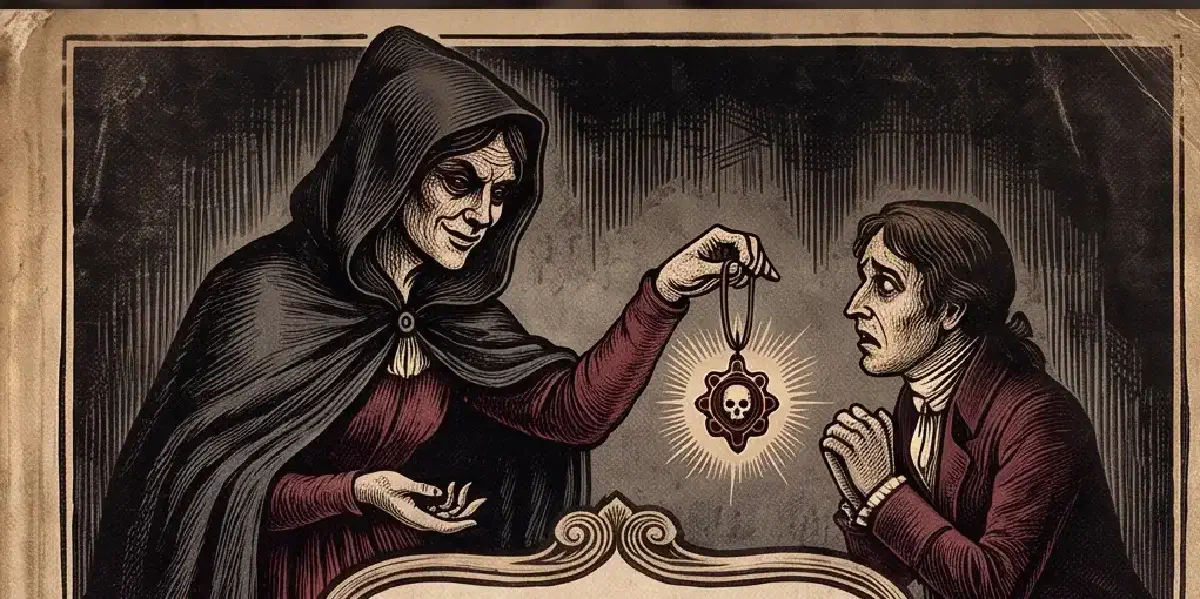
We have all surrendered our agency to an expert when we felt out of our depth. Whether taking a doctor’s prescribed medicine or trusting a legal advisor, modern life runs on delegating specialized knowledge. But what happens when that delegation is intentionally weaponized? In our previous analyses of structural failures, we explored how physical blindspots can cause catastrophic collapses. Today, we step into the narrow, smoke-choked alleyways of late-Georgian Leeds to dissect a different kind of structural failure: the collapse of human reason under the weight of systemic psychological manipulation.
If you’ve been following our series on systemic deceptions, you’ll recognize how structural vulnerabilities in human society are exploited by clever bad actors. If not, no worries—here is what you need to know: in Leeds at the turn of the nineteenth century, rapid industrialization met deep-seated folk belief. Into this fertile ground stepped Mary Bateman, a woman who didn't just practice "witchcraft"—she engineered a modular, scalable system of fraud that eventually escalated to cold-blooded, clinical murder .
This post deconstructs the psychological levers Bateman used to systematically strip her victims of their assets, the physical mechanics of her "prophesying hen" miracle, and the lethal sunk-cost spiral that culminated in the agonizing death of Rebecca Perigo—revealing timeless lessons about the architecture of trust and the vulnerabilities of human belief.
The Exploitation Loop: Mapping the Deception#
Before diving into individual cases, it is instructive to map Bateman's operational framework. Her frauds were not impulsive; they were structured, feedback-driven systems.
flowchart TD
    Node1["1. TARGET IDENTIFICATION
Identifies personal distress (illness, debt, anxiety)"]
    Node2["2. DELEGATION OF AUTHORITY
Creates fictional authority (Miss Blythe, Mrs. Moore)
Shields Mary from accountability for failures"]
    Node3["3. ASSET EXTRACTION
Demands money, clothes, and furniture under 'charms'
Victim pawns or sells belongings to satisfy the authority"]
    Node4["4. COGNITIVE LOCK-IN
Installs 'sunk-cost' logic (violating charm = death/ruin)
Strict secrecy enforced; letters ordered to be burned"]
    Node5["5. SYSTEM TERMINATION
Exposure imminent (e.g., 18-month lock-in period ends)
Eliminates witnesses via clinical poisoning"]

    Node1 --> Node2
    Node2 --> Node3
    Node3 --> Node4
    Node4 --> Node5
Deflect Accountability Through Fictional Authorities#
Bateman’s most brilliant operational innovation was her complete deflection of personal accountability. She rarely claimed to possess supernatural powers herself . Instead, she acted as a humble, soft-spoken intermediary for invisible, distant experts like "Mrs. Moore" or "Miss Blythe" .
By creating these fictional authorities, Bateman established a buffer between herself and her victims:
- Deflecting Failure: If a charm failed or a predicted event did not occur, Bateman was never at fault. It was always because the victim had "broken the charm" by talking too much, or because the unseen authority was angry .
- Escalating Demands: When the victim's money ran low, the fictional authority would demand more. To force a lover's marriage or quiet a creditor, "Mrs. Moore's screws would never drive without money" . Victims were pushed to borrow, steal, or pawn vital household goods to satisfy these distant masters .
- spear-phishing Precursor: This technique is the direct historical ancestor of modern spear-phishing and business email compromise (BEC). In modern scams, an attacker impersonates a distant supervisor or executive, demanding urgent, confidential wire transfers. The victim, awed by authority and isolated by a mandate of "strictest confidentiality," complies without verification.
Manufacture Social Proof via Physical Evidence (The "Crist is Coming" Egg)#
To maintain her reputation as a conduit to the supernatural, Bateman understood that psychological priming required occasional physical verification. Her most famous demonstration of "social proof" took place at the Bank in Leeds .
In 1806, one of Bateman's hens began laying eggs bearing a terrifying inscription: "Crist is coming" . To Georgian onlookers, this was a literal, physical manifestation of the divine.
The mechanics behind this "miracle" were monstrously clinical. Bateman had manually forced inscribed eggs back up into the ovary of the poor hen, ensuring they would be deposited "naturally" in the nest .
- The Power of Social Proof: The physical existence of the inscribed egg acted as overwhelming evidence. People flocked from all quarters to see the miracle, paying a penny each .
- The Suppression of Dissent: Because the crowd was so thoroughly primed, confirmation bias hardened into mob violence. Anyone who dared to suggest a fraud had been practiced "stood as good a chance of being maltreated by a credulous multitude" as a heretic in an inquisition .
- Modern Parallel: We see this same vulnerability today with digital manipulation. A forged video, a doctored screenshot, or a falsified data sheet can be disseminated instantly. Because it is a "physical" artifact that can be seen, it bypasses logical skepticism and is reinforced by the "social proof" of online sharing, while critics are drowned out by the crowd.
Leverage Terror and Intergenerational Anxiety#
While Bateman used soft, insinuating manners to charm her victims , her primary engine of compliance was absolute terror . She systematically identified the deepest anxieties of her victims—typically maternal fear or family ruin—and turned them into psychological levers .
- The Cryer Gallows Letter: When Judith Cryer, a poor, widowed washer-woman, sought help for her troubled 11-year-old grandson, Bateman produced a letter from "Miss Blythe" . The letter featured a crude drawing of a gallows and a rope, stating the boy would be executed before age 14 unless Cryer raised four guineas . The impoverished widow scraped the money together with "the most extreme difficulty" .
- The Stead Threat: Bateman convinced the wife of soldier Barzillai Stead that her 8-year-old daughter was destined to become pregnant out of wedlock at age 14 and would either commit suicide or be murdered by her seducer . To "prevent" this, Stead was forced to hand over 17 shillings to buy a "silver charm" (which later transpired to be cheap pewter) .
- Intergenerational Exploitation: By projecting threats into the distant future and targeting children, Bateman guaranteed a long-term dependency. The victims were trapped in a state of perpetual anxiety, rendering them entirely obedient to their "protector."
The Sunk-Cost Fallacy and the Lethal Logic of Exposure#
The tragedy of William and Rebecca Perigo represents the ultimate expression of Bateman's system. It illustrates the classic psychological trap of the sunk-cost fallacy—where individuals continue investing in a losing or destructive proposition because of how much they have already committed.
In 1806, Rebecca Perigo, suffering from a minor physical flutter, was referred to Bateman . Over the next eighteen months, Mary systematically stripped the couple of their life savings and household comfort :
- The Extraction: They paid nearly £70 in cash (a staggering sum for a Georgian clothier) and surrendered a vast array of goods, including a camp bed, china, a tea caddy, clothing, 60 pounds of butter, and their family bible .
- The Illusion of Return: Bateman maintained the illusion of safety by "sewing" equivalent sums of money into silk bags and depositing them in the Perigos' bed . They were strictly forbidden from opening the bags until the 18-month period had expired, under pain of sudden death .
- The Trap: The Perigos were trapped. To doubt Mary meant admitting they had ruined themselves for nothing; to stop meant risking the terrible curse Miss Blythe warned of. They chose to believe.
The Clinical Exit Strategy#
As the 18-month deadline approached in mid-1807, Bateman realized exposure was mathematically certain . The silk bags in the bed contained nothing but waste paper, lead, and bad halfpennies .
Her response was chillingly logical. To prevent certain exposure, she decided to eliminate the only two witnesses to her fraud . As Leeds Recorder John Hardy noted during her trial, her policy was to trade a certain exposure for a risky, but potentially undetectable, murder :
"Her policy, therefore, undoubtedly was to avoid the exposure and punishment which were certain, by incurring a risk in which the probabilities of detection were infinitely more remote..."
To execute this, Bateman sent the Perigos a letter from "Miss Blythe" predicting they would fall ill in May 1807, but promising they would "escape the chambers of the grave" . They were instructed to bring Mary a jar of honey, in which she mixed "such like stuff" sent from Scarborough . They were also ordered to eat pudding for six days, mixing in powders provided by Mary .
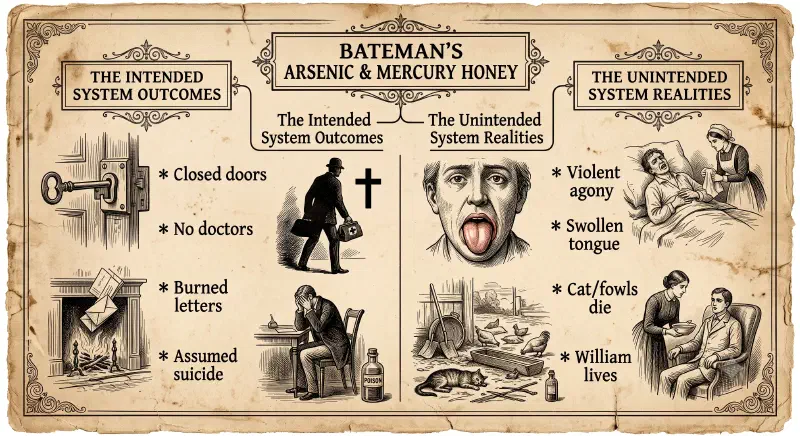
On Saturday, May 16, 1807, Rebecca mixed the final, massive powder into the pudding . It was incredibly nauseous . When they became violently ill, they turned to the poisoned honey for relief, as instructed by the "expert" .
Bateman’s clinical design was nearly perfect:
- Isolation: The letters ordered them to keep their doors fast to avoid "enemies" (preventing neighbors from seeing their distress or offering help) .
- Deflection of Medical Aid: They were strictly forbidden from calling a doctor .
- Evidence Destruction: The letters containing the instructions were ordered to be burned immediately on the hearth .
- Plausible Deniability: Had both died with locked doors, report and conjecture would have naturally imputed the sudden tragedy to suicide, leaving Mary in possession of their plundered home .
But the system failed. Rebecca died in unspeakable agony on May 24, her body covered in black and white spots . However, William ate less of the pudding . He survived "by hair breadths," carrying the lingering effects of the corrosive sublimate of mercury in his body for the rest of his life .
The Anatomy of a Collapse#
When William Perigo finally unripped his bed in October 1808 and found nothing but trash and a lump of coal, the scales fell from his eyes . Mary Bateman was arrested the next day . On her person, Constable William Duffield found a vial of rum saturated with arsenic—she had planned to finish the job during their final, private meeting on the canal bank .
At her trial in York Castle, the full weight of early forensic science was brought to bear. Surgeon Thomas Chorley demonstrated through chemical tests that the honey was saturated with corrosive sublimate of mercury .
Mary Bateman was convicted of wilful murder and sentenced to death . On March 20, 1809, she was hanged at the New Drop . Yet, in a final testament to the durability of her psychological hold, she spent her last days in prison executing one final fraud on a fellow inmate and went to the gallows declaring her entire innocence .
So, Mary Bateman’s system of psychological leverage was dismantled by a surviving victim and a courageous constable, and she paid the ultimate price at the York Castle gallows . But as we close the ledger on the "Yorkshire Witch," we are left with a deeper, more unsettling question. Bateman succeeded because she operated in an era of hyper-localized information, where folklore filled the gaps left by science. But what happens when mass deception is institutionalized on a global scale, backed by the prestige of modern finance, the press, and international marketing?
In our next post, we will fast-forward to the 1820s to examine the most audacious financial fraud in history: the selling of the entirely fictional country of Poyais to wealthy European investors. We will look at Gregor MacGregor and explore how a lie can grow so large that even the most sophisticated systems of the modern world will conspire to believe it.
References#
- Extraordinary Life and Character of Mary Bateman, 12th Edition (Leeds: Davies and Co., 1811).
- The invention of Mrs. Moore and early witchcraft experiments.
- The "Crist is Coming" egg hoax at the Bank in Leeds.
- The suspicious deaths and subsequent plundering of the Quaker Kitchin family (1803).
- The gallows threat letter sent to Judith Cryer.
- Mr. Recorder John Hardy's prosecution opening address on Bateman's criminal policies and survival math.
- Complete inventory of goods and cash extorted from William Perigo.
- Detailed accounts of the Saturday pudding poisoning and subsequent symptoms.
- Mr. Thomas Chorley's chemical analysis and forensic testimony of corrosive sublimate of mercury and arsenic.
- The empanelling of the Jury of Matrons regarding Bateman's pregnancy plea.
- The final "sweetheart charm" fraud in York Castle prison.
- Execution, crowd reaction, and Leeds General Infirmary public dissection viewing.