
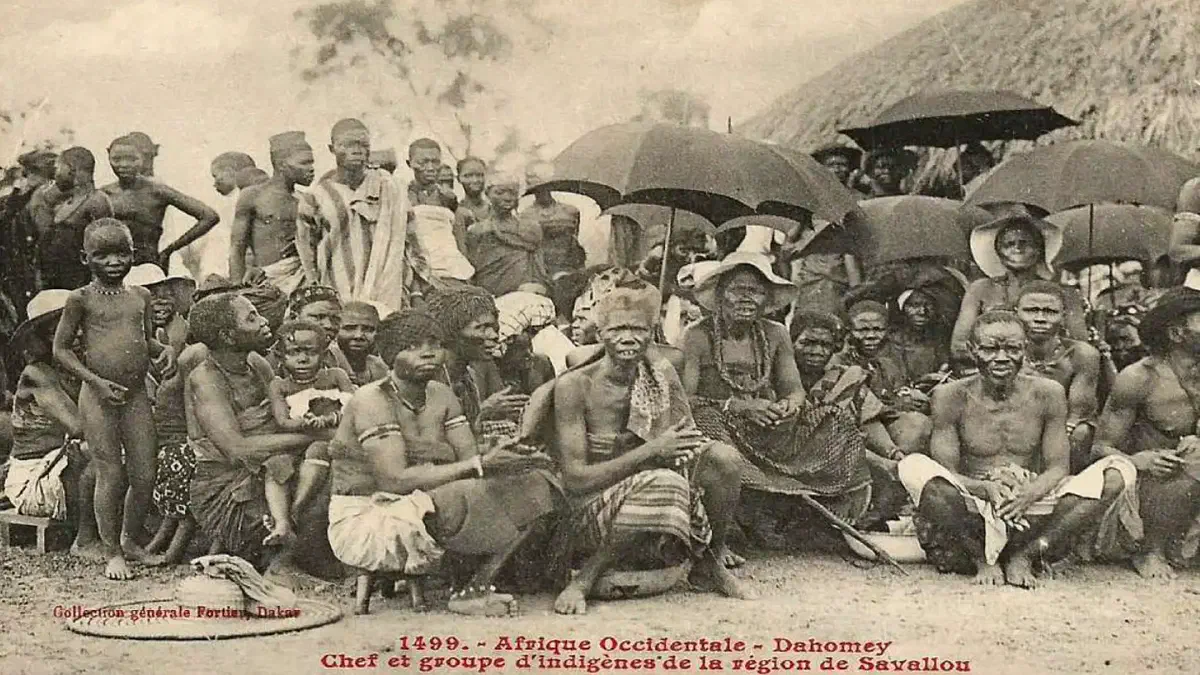
The Demographic Drain#
The emergence of the all-female regiment was a direct consequence of Dahomey's male population suffering "high casualties in the increasingly frequent violence and warfare with neighbouring West African states". The kingdom, founded in the early 17th century by the Fon people, was engaged in near-perpetual conflict with its neighbours—the Mahi, the Ouémé, and most formidably, the Oyo Empire to the east. Warfare in the region was not episodic; it was structural. Dahomey's expansionist ambitions, coupled with the need to secure access to the Atlantic coast for European trade, ensured that conflict was a constant. The result was a steady depletion of the kingdom's most vital military resource: fighting-age males.
This was not a temporary imbalance but a sustained demographic crisis. The slave trade exacerbated the problem. Dahomey was not merely a victim of the Atlantic slave trade; it was one of its leading perpetrators. From 1640 to 1860, much of the kingdom's wealth derived from raiding rival kingdoms and selling captives to European traders. The scale was staggering: Dahomey was responsible for capturing and selling an estimated 7,000 to 15,000 individuals annually. The victims were overwhelmingly male, as slave raiders preferentially targeted young men for their labour value and docility in transit. Every slave exported was a potential soldier lost. Every raid that captured slaves for sale removed men from the demographic pool of Dahomey's rivals—but also fed a system that commodified human life on a continental scale.
The Tribute System#
The demographic pressure was compounded by Dahomey's tributary relationship with the Oyo Empire. For much of the 18th century, Dahomey was a vassal state of Oyo, forced to pay an annual tribute that included "young men and women destined for Slavery or death in ceremonies, as well as cloth, guns, animals and pearls". The tribute of male slaves was particularly onerous. Each year, Dahomey was compelled to deliver a quota of young men to Oyo, further depleting its already strained male population. The formation of a female-only army unit was, in this context, "a retaliation and manoeuvre around the forced tribute of male slaves to Oyo each year".
This was not a gesture of defiance but a calculation of survival. By recruiting women into the army, Dahomey's kings could maintain military strength without sacrificing the male captives and subjects required to satisfy Oyo's demands. The tribute system thus created a perverse incentive: the more men Dahomey lost to Oyo, the more it needed to recruit women. The female regiment was a demographic hedge, a way to preserve the kingdom's fighting capacity while complying with the extractive demands of its imperial overlord. It was, in systems terms, a feedback loop. Tribute removed men. Men were needed for war. Women filled the gap. The gap grew. More women were recruited.
From Bodyguards to Infantry#
The transformation of women from palace attendants to front-line infantry was gradual. According to tradition, King Houegbadja (ruled 1645–1685), the third monarch of Dahomey, originally established the group that would become the Mino as a corps of elephant hunters called the gbeto. The gbeto may have predated Houegbadja; some traditions hold that he merely organised pre-existing groups into a formal corps, while others suggest the hunters offered their services to the king. Elephant hunting was dangerous work, requiring physical strength, courage, and skill with weapons—qualities that translated directly to military utility.
The next phase came under Houegbadja's daughter, Queen Hangbe (ruling approximately 1716–1718), who established a female bodyguard. European merchants recorded their presence, indicating that by the early 18th century, armed women were a visible feature of Dahomean court life. The logic was partly practical: no man except eunuchs was allowed in the royal palace after dark, and few entered during the day. Armed women were thus the only viable option for palace security. But the bodyguard role also conferred status. These women were among the king's "wives" (ahosi), a designation that signified their exclusive loyalty to the monarch and their privileged position within the state hierarchy.
The transition from bodyguard to battlefield unit occurred under Hangbe's successor, King Agaja (ruled 1718–1740). According to tradition, Agaja successfully used female warriors in Dahomey's defeat of the neighbouring kingdom of Savi in 1727. This was the first recorded instance of the Mino being deployed as an offensive military force. The battle was significant not only for the victory it secured—Dahomey gained direct access to the Atlantic coast and took over the lucrative slave trade with Europeans—but for what it signalled: women were no longer confined to ceremonial or defensive roles. They were now warriors.
The Name and the Naming#
The regiment was known by several names, each revealing something about its function and status. The Fon male army referred to them as Mino—"Our Mothers". The term was not merely honorific; it denoted a relationship of respect and perhaps fear. These women were the symbolic mothers of the nation, protectors of the kingdom in a way that transcended gender. The French and other European observers, encountering them in the 18th and 19th centuries, called them "Amazons," drawing a parallel with the mythical female warriors of Greek antiquity. The name stuck, though it obscured as much as it revealed. The Greek Amazons were a legend; the Dahomey Amazons were a documented military institution, the only all-female army in modern history.
The women themselves used different terms. They called themselves ahosi ("king's wives") or Mino ("our mothers"). The ahosi designation was crucial: it placed them within the king's household, subject to his authority and entitled to his protection. It also carried implications of celibacy—the ahosi were wives of the king and could not marry or bear children. This was not a punishment but a status marker. To be the king's wife was to be elevated above ordinary women, to be bound to the state in a way that conferred both privilege and obligation. The celibacy requirement, which later became a defining feature of the regiment, was likely a mechanism to ensure undivided loyalty. A woman with a husband and children might have competing allegiances; a woman whose only allegiance was to the king was a more reliable soldier.
The Slave Trade Paradox#
Any account of the Mino's origins must confront the uncomfortable fact that their existence was inextricably linked to the slave trade. Dahomey's wealth derived from the sale of human beings. The kingdom's wars were fought, in large part, to capture slaves for export. The annual tribute to Oyo was paid in slaves. The very shortage of men that necessitated the recruitment of women was caused, in significant measure, by the export of male captives. The Mino were, in this sense, a product of the slave economy. They were not its opponents but its beneficiaries.
This is not to diminish their military achievements or their historical significance. It is to insist on a systems-level analysis. The Mino did not emerge because Dahomey was progressive or because its kings believed in gender equality. They emerged because the kingdom faced a structural crisis—a shortage of men—and women were the available substitute. The slave trade was not an external force acting upon Dahomey; it was the engine of the kingdom's political economy. The Mino were one of its by-products.
The scale of Dahomey's involvement in the slave trade is difficult to overstate. The kingdom was one of the leading states in the Atlantic slave trade, using slaves as the primary commodity for exchange with European merchants. The trade continued, clandestinely, well past the mid-19th century, long after Britain had formally outlawed the transatlantic traffic. Dahomey's kings were reluctant to relinquish the trade because it was the foundation of their power. The guns acquired through the slave trade enabled further conquests, which produced more slaves, which bought more guns. The Mino were part of this cycle. They were the instruments of conquest, the enforcers of a system that commodified human life.
The Size and Scope#
By the mid-19th century, under King Ghezo (ruled 1818–1858), the regiment had grown to between 1,000 and 6,000 women, constituting roughly a third of the entire Dahomey army. This was not a token force or a ceremonial unit. It was a substantial portion of the kingdom's fighting strength, deployed in front-line combat alongside male troops. The regiment had three main wings—right, left, and an elite centre wing called the Fanti—each with five subgroups: artillery, elephant huntresses, musket-bearing infantry, razor-wielders, and archers. This organisational complexity suggests a professional military apparatus, not a haphazard collection of palace guards.
Foreign observers consistently judged the women to be superior to their male counterparts in both bravery and combat effectiveness. This was not mere flattery. European missionaries who witnessed the Dahomey attacks on Abeokuta in 1851 and 1864 reported that the female contingents fought fiercely and bravely; although Dahomey lost both battles, the only troops to breach the defences of Abeokuta were the Amazons. The French colonial military, which defeated Dahomey in the Second Franco-Dahomean War of 1892, similarly noted the ferocity and capability of the women warriors. Their effectiveness was not a myth; it was a matter of record.
The Mechanisms of Recruitment#
The recruitment process reflected the regiment's dual nature as both a military unit and a royal household. Women were recruited from foreign captives, as well as from free Dahomean women, some enrolled as young as eight years old. The recruitment was not voluntary in any modern sense; it was a form of state conscription, enforced by royal authority. Once recruited, the women were subjected to rigorous physical training, designed to prepare them for the demands of combat. According to some traditional accounts, recruits were required to undergo excision (clitoridectomy) as a means of diminishing their sexual drive. This practice, if accurately reported, underscores the extent to which the regiment was designed to control and regulate the bodies of its members. The women were not merely soldiers; they were the king's property, subject to his will in every aspect of their lives.
The Celibacy Requirement#
The celibacy requirement, mentioned by multiple sources, reinforced this control. Under pain of death, the Amazons could not marry or have children. This was not merely a practical measure to prevent pregnancy during campaigns; it was a symbolic assertion of the king's exclusive claim over their persons. They were his wives, and no other man could touch them. In a society where lineage and inheritance were patrilineal, the celibacy requirement also served to sever the women from their families of origin, ensuring that their loyalty was to the state alone.
The Annual Customs#
The Mino's role extended beyond the battlefield. They were central to Dahomey's political and ceremonial life, particularly during the Annual Customs—a series of rituals that reaffirmed the king's authority and the state's power. During these ceremonies, troops swore oaths to the king and performed mock battles, "capturing" slaves from a constructed "fort". The performances were not mere entertainment; they were a form of political theatre, demonstrating the king's control over life and death, his ability to command violence, and his monopoly on the means of coercion. The Mino were the stars of this spectacle, their presence a reminder that the king commanded not only men but also women—and that his authority extended to every corner of the kingdom.
Conclusion#
The origins of the Dahomey Amazons lie not in a progressive vision of gender equality but in a brutal calculus of survival. The kingdom faced a demographic crisis caused by endemic warfare and the extractive demands of the Oyo Empire. The slave trade, which was the foundation of Dahomey's economy, exacerbated the shortage of men by exporting male captives to European merchants. The recruitment of women into the army was a strategic response to this constraint—a way to maintain military strength without sacrificing the male population to tribute or export. The regiment evolved from elephant hunters to palace guards to front-line infantry, driven by the logic of necessity rather than ideology. Its members were the king's wives, bound to him by oath and by the threat of death, their bodies and loyalties subject to his control.
The Mino were, in the most literal sense, a product of the system that created them. They were not rebels against the slave trade but its instruments. They were not liberators but enforcers. They were formidable warriors, skilled and brave, but their bravery was deployed in the service of a kingdom built on human bondage. To understand them is to understand the system that produced them: a system of violence, extraction, and demographic pressure, in which women were recruited to fight because men were too valuable—or too scarce—to spare. The Mino were not an exception to the logic of the slave trade; they were one of its most remarkable expressions.
Next in the series: “The Architecture of the Regiment”—how the Mino were trained, organized, and elevated within Dahomean society.