
Recruitment: The King's Property#
The recruitment of the Mino was a form of state conscription that recognised no distinction between volunteer and captive. King Ghezo (ruled 1818–1858), who formalised the regiment into a professional force, recruited both men and women soldiers from foreign captives, though women soldiers were also recruited from free Dahomean women, some enrolled as young as eight years old. The dual source of recruitment—captives and freeborn—created a regiment that was ethnically diverse and socially stratified. Captives from conquered kingdoms, brought into the regiment as children, had no ties to Dahomean society beyond the king; their loyalty was absolute because it had no alternative. Freeborn women, by contrast, entered the regiment with existing kin networks, though the celibacy requirement and the severance from family life gradually eroded those connections.
The recruitment process was not a gentle induction but a brutal trial. One recruitment ceremony involved testing whether potential soldiers were ruthless enough to throw bound human prisoners of war to their deaths from a fatal height. The test was not merely about cruelty; it was about obedience. The king demanded that his soldiers be capable of any act he commanded, no matter how horrific. The women who passed this test—and presumably many did not—were admitted to the regiment, their initiation marked by symbolic scarring and oaths of obedience that forbade retreat or capture.
Celibacy and the King's Wives#
The most distinctive feature of the Mino's social architecture was their status as the king's wives. They called themselves ahosi ("king's wives") or Mino ("our mothers"). The designation was not metaphorical. All Mino were officially married to the king and lived in a reserved area of the palace. This arrangement served multiple functions. First, it ensured that the women's loyalty was to the king alone; they were his property, and no other man could claim them. Second, it elevated their status within Dahomean society. To be the king's wife was to be wealthy, privileged, and immune from the ordinary constraints of female life. Third, it provided a mechanism of control: the king could select wives from their ranks, and the threat of being chosen—or not chosen—was a constant incentive for good behaviour.
The celibacy requirement, enforced under pain of death, was the corollary of this arrangement. Mino could not marry, nor could they have children. The prohibition was not merely practical—pregnancy would have rendered them useless in combat—but symbolic. It signified that their bodies belonged to the king and to the state, not to themselves or to any family. In a society where lineage and inheritance were patrilineal, the celibacy requirement also served to sever the women from their families of origin, ensuring that their loyalty was to the state alone. The Mino were, in this sense, a kind of monastic order: celibate, disciplined, and utterly devoted to a transcendent authority.
Some accounts report that recruits were required to undergo excision (clitoridectomy) as a means of diminishing their sexual drive. The practice, if accurately reported, underscores the extent to which the regiment was designed to control and regulate the bodies of its members. The Mino were not merely soldiers; they were the king's property, subject to his will in every aspect of their lives. The celibacy requirement and the associated rituals were mechanisms of state control, designed to produce soldiers who had no competing loyalties and no private lives.
Training: The Forging of Fanatics#
The training of the Mino was designed to produce soldiers who were indifferent to pain, fearless in the face of death, and utterly obedient to command. The women trained with intense physical exercise, learning survival skills and indifference to pain and death. The training included storming acacia-thorn defences in military exercises—a brutal form of live-fire training that simulated the conditions of battle and inflicted real wounds. The women also executed prisoners as part of their training, a practice that inured them to killing and demonstrated their loyalty to the king.
The training regimen was not merely physical but psychological. The Mino were taught to consider themselves superior to men—not in the abstract, but in the concrete terms of military effectiveness. They considered themselves to be "men" and derided defeated male opponents as "women". This gender inversion was not a proto-feminist ideology but a military doctrine. The Mino were expected to outperform men on the battlefield, and they did. Foreign observers consistently judged them to be superior to their male counterparts in both bravery and combat effectiveness. The superiority was not innate; it was drilled into them through years of relentless training.
The discipline was severe. The Mino were trained "for war and, in principle, were dedicated to it for life". There was no retirement, no discharge, no escape. Once a woman entered the regiment, she remained in it until death or until the regiment was disbanded. The commitment was total, and the consequences of desertion or disobedience were fatal. The Mino were not volunteers in any modern sense; they were conscripts, bound to the king by oath and by the threat of death.
Structure: The Three Wings#
By the mid-19th century, the Mino had evolved into a sophisticated military organisation with a formal structure. The regiment had three main wings: the left wing, the right wing, and an elite centre wing called the Fanti. Each wing was divided into five subgroups, each with its own weapons and tactical role.
The first subgroup was the Gbeto, or Huntresses—the original elephant hunters from whom the regiment descended. The second was the Gulohento, or Riflewomen, armed with long rifles and short swords and skilled in close combat. The third was the Nyekplohento, or Reapers, a small but feared unit armed with razor-sharp knives believed capable of slicing a man in two in a single stroke. The fourth was the Gohento, or Archers, deadly with bows and arrows tipped with hooks and poison. The fifth was the Agbalya, or Gunners, who operated the army's artillery, including German Krupp guns and old iron guns acquired from European traders.
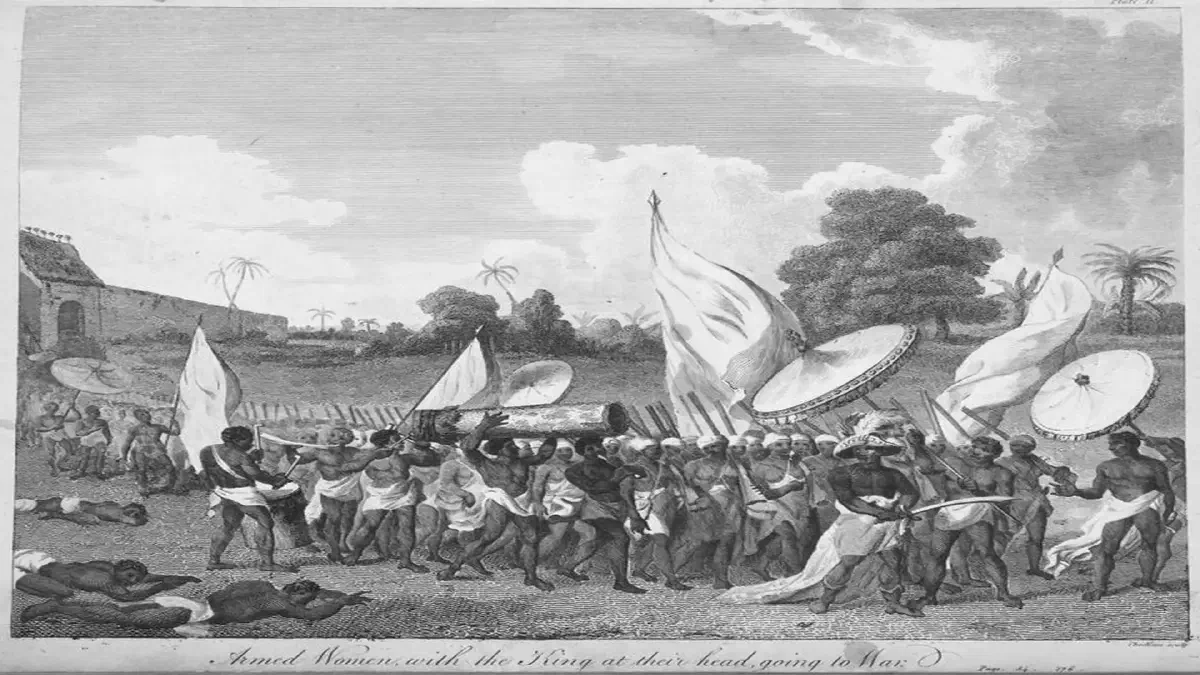
Each of the three brigades was divided into four classes, with a captain and "numberless lieutenants" to each. The Mino served under female officers and had their own bands, flags, and insignia. The organisational complexity suggests a professional military apparatus, not a haphazard collection of palace guards. The Mino were not a token force or a ceremonial unit; they were a substantial portion of the kingdom's fighting strength, deployed in front-line combat alongside male troops.
Scale: A Third of the Army#
The size of the regiment grew steadily over the course of the 18th and 19th centuries. Originally palace guards, the Amazons had evolved by the 1760s into professional troops. By the 1840s, their numbers had grown to 6,000. The peak strength of the regiment is estimated at between 1,000 and 6,000 women, constituting roughly a third of the entire Dahomey army. This was not a small force; it was a major component of the kingdom's military power.
The growth of the regiment reflected the increasing militarisation of Dahomey under King Ghezo. Ghezo placed great importance on the army, increasing its budget and formalising its structure from ceremonial to a serious military. The Mino were the beneficiaries of this militarisation. Their numbers grew, their training intensified, and their role in the kingdom's military strategy expanded. By the time of Ghezo's death in 1858, the Mino were no longer a novelty or a curiosity; they were an essential part of Dahomey's military machine.
Status: Wealth and Privilege#
The Mino were not merely soldiers; they were an elite. They were wealthy and held high status within Dahomean society. The king kept them well supplied with tobacco, alcohol, and slaves—as many as 50 slaves per warrior, according to Burton. The slaves were not merely servants; they were a form of wealth, a marker of status, and a labour force that freed the Mino from domestic duties. The Mino did not cook, clean, or farm; they trained, fought, and paraded.
The wealth and status of the Mino were not accidental; they were deliberate incentives. The king needed his soldiers to be loyal, and loyalty was purchased with privilege. The Mino were given the best food, the best weapons, and the best quarters. They were treated as the king's wives, which meant they were treated as royalty. In a society where most women were subordinate to men, the Mino were an exception: they were subordinate only to the king, and even that subordination was framed as marriage rather than servitude.
The status of the Mino extended beyond material wealth. In Dahomey's dualistic system, royal protocol gave precedence to women officials over their male opposite numbers, and likewise to Amazons over men soldiers. The Mino marched ahead of male troops in parades, received the best weapons, and were consulted on military matters. Their superiority was not merely a matter of opinion; it was institutionalised. The Mino were the king's elite, and everyone knew it.
The Annual Customs: Political Theatre#
The Mino were central to Dahomey's political and ceremonial life, particularly during the Annual Customs—a series of rituals that reaffirmed the king's authority and the state's power. During these ceremonies, troops swore oaths to the king and performed mock battles, "capturing" slaves from a constructed "fort". The performances were not mere entertainment; they were a form of political theatre, demonstrating the king's control over life and death, his ability to command violence, and his monopoly on the means of coercion.
The Annual Customs also served a military purpose. They were a form of training and a test of discipline. The Mino were carefully trained for these manoeuvres, and the king was in the habit of holding "autumn manoeuvres" for the benefit of foreigners. The manoeuvres were a demonstration of Dahomey's military power, a warning to neighbouring states, and a reassurance to the king's subjects. The Mino were the stars of this spectacle, their presence a reminder that the king commanded not only men but also women—and that his authority extended to every corner of the kingdom.
The ceremonies also involved human sacrifices, estimated at 100–300 victims yearly, typically criminals or war captives. The Mino participated in these sacrifices, executing prisoners as part of the ritual. The practice served multiple functions: it demonstrated the king's power over life and death, it reinforced the Mino's status as instruments of state violence, and it inured them to killing. The Mino were not merely soldiers; they were executioners, and their willingness to kill—anyone, anytime, on command—was a measure of their loyalty.
Esprit de Corps: "Our Mothers"#
The Mino developed a powerful esprit de corps, reinforced by their shared experience of training, combat, and privilege. They called themselves "Our Mothers"—a name given to them by the male army, but one they embraced. The name signified their role as protectors of the nation, their status as the king's wives, and their superiority to ordinary women. The Mino were not merely soldiers; they were the symbolic mothers of the nation, the guardians of the kingdom's honour.
The esprit de corps was reinforced by the regiment's own bands, flags, and insignia. The Mino had their own music, their own banners, and their own symbols of identity. These were not mere decorations; they were markers of belonging, symbols of a shared identity that transcended the individual. The Mino were a regiment, but they were also a sisterhood, bound together by oath, by training, and by the shared experience of violence.
The esprit de corps was also reinforced by the Mino's contempt for their enemies. They derided defeated male opponents as "women". The insult was not merely a rhetorical flourish; it was a statement of identity. The Mino were not women in the ordinary sense; they were warriors, and warriors were superior to non-warriors, regardless of gender. The gender inversion was a source of pride and a measure of their exceptionalism.
Conclusion#
The architecture of the Mino regiment was a masterpiece of statecraft. It solved a demographic problem—the shortage of men—by recruiting women. It ensured loyalty by making the women the king's wives, bound to him by oath and by the threat of death. It ensured effectiveness through relentless training, brutal discipline, and the inculcation of contempt for pain and death. It ensured status through wealth, privilege, and institutionalised superiority over male troops. It ensured cohesion through shared experience, shared symbols, and a powerful esprit de corps.
The Mino were not a feminist experiment; they were a military necessity. They were not liberators; they were enforcers. They were not rebels against the system; they were its most loyal servants. The system that produced them was brutal, extractive, and violent—but it was also remarkably effective. The Mino were the product of that system, and they embodied its contradictions: they were both victims and perpetrators, both privileged and subjugated, both revered and feared. Theirs was a world of absolute loyalty and absolute violence, a world in which the king's will was law and the only escape was death. It was a world that produced some of the most formidable soldiers in modern history—and one that, in the end, could not survive the arrival of the French.
Next in the series: “The Final Stand”—how the Agojie fought against French colonization and their ultimate disbandment.