
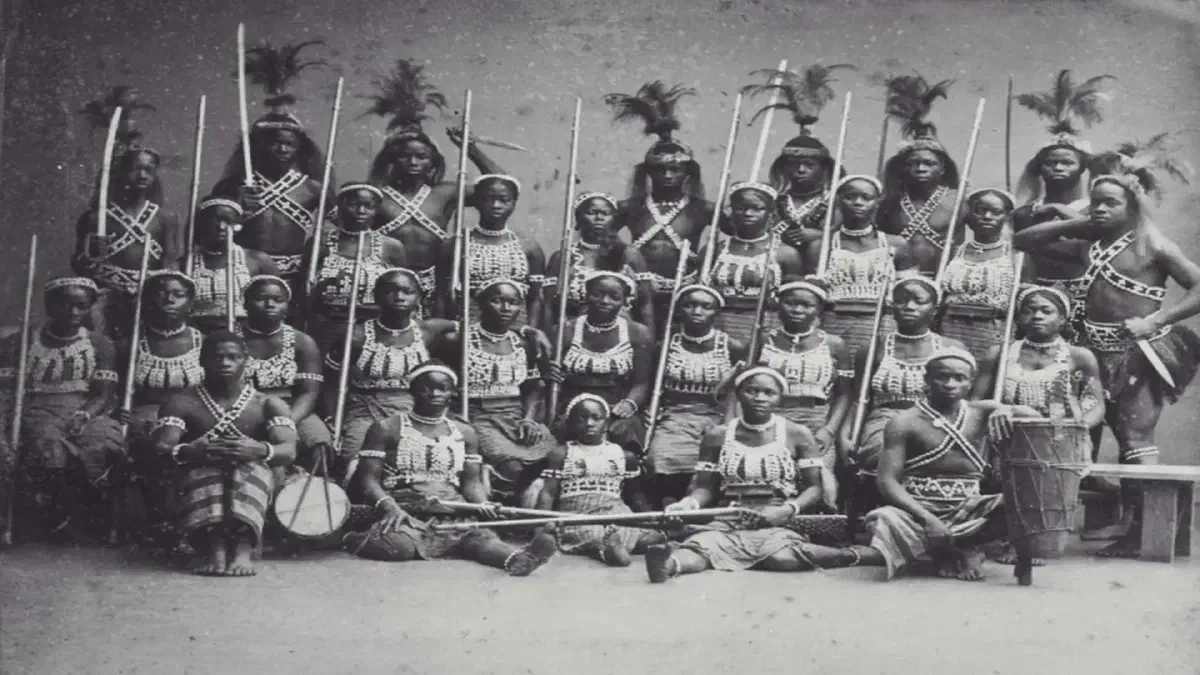
The Arsenal of the Mino#
The Mino were not a primitive force. By the latter half of the 19th century, they were equipped with some of the most advanced small arms available in West Africa. Their primary firearm was the Winchester rifle, a lever-action repeating carbine that gave them a significant rate-of-fire advantage over many of their regional adversaries. The Winchesters were supplemented by muskets, clubs, and the distinctive reapers—short swords with heavy-backed blades, described by one contemporary observer as "very much like a South American machete". The same observer noted that the Mino "made much better use of them than the men made of their rifles".
The regiment's organisation reflected a division of labour by weapon system. The women's army consisted of five distinct regiments: huntresses (Gbeto), riflewomen (Gulohento), reapers (Nyekplohento), archers (Gohento), and gunners (Agbalya). Each regiment had different uniforms, weapons, and commanders. The gunners operated the army's artillery, which included German Krupp guns and older iron pieces acquired from European traders. This was not a rabble; it was a professional military organisation with specialised branches, female officers, and its own bands and insignia.
But the arsenal had a critical weakness: supply. Dahomey had no domestic arms industry. Every rifle, every cartridge, every cannon had to be acquired through trade—and trade meant European intermediaries. The kingdom's ability to re-arm after the First Franco-Dahomean War was constrained by the very powers it sought to resist. The French, like other European colonial states, understood that controlling the flow of weapons was a form of strategic leverage. By the time of the second war, the Mino were outgunned not because they lacked courage but because they lacked logistics.
The Battle of Abeokuta: A Warning Unheeded#
The Mino had already tasted defeat before the French arrived. In 1851 and again in 1864, Dahomey attacked the Egba capital of Abeokuta, a fortified city in present-day Nigeria. The first attack was led by Seh-Dong-Hong-Beh, a commander who led an all-female army of 6,000 warriors against the Egba fortress. The objective was slaves—the lifeblood of Dahomey's economy. The women fought fiercely and bravely, and by some accounts they were the only troops to breach the defences. But Dahomey lost both times.
The battles of Abeokuta were a warning. The Egba, like the French later, fought from behind fortifications. The Mino were trained for shock assault—massed charges, close-quarters combat, psychological intimidation. They were less effective against prepared defences, particularly when the defenders had superior firepower. The defeats at Abeokuta exposed a structural weakness: the Mino's tactics had been optimised for slave-raiding, not for siege warfare against a determined and well-entrenched enemy. The lesson was not learned, or perhaps it could not be. The kingdom's political economy—slave-raiding, royal absolutism, annual ceremonies that required human sacrifices—depended on the maintenance of a certain kind of military force. Adapting to new tactical realities would have required adapting the system itself. Dahomey's kings chose not to.
The First Franco-Dahomean War: A Warning Heeded Too Late#
The First Franco-Dahomean War erupted in 1890 over competing claims to the coastal kingdom of Porto-Novo, a tributary state that had been at odds with Dahomey since the mid-18th century. The French, who had established commercial ties with the area and ratified a friendship treaty with Dahomey in 1851, viewed Porto-Novo as a French protectorate. King Béhanzin, who had ascended to the throne in January 1890, saw it differently. He committed over 8,000 Fon troops—including the Mino—to the campaign. The French mustered between 709 and 759 soldiers, supported by 500 Porto-Novo auxiliaries.
The Battle of Cotonou on March 4, 1890, was the decisive engagement. The Dahomey army charged the French stockade at dawn. The Mino were in the vanguard, as they always were. The French, equipped with modern breech-loading rifles and supported by naval gunfire from warships offshore, repulsed the attack with heavy losses. Dahomey casualties were estimated at between 1,000 and 2,000 killed. French losses: 16 killed, 83 wounded. The ratio was almost exactly 100 to 1.
The war ended on October 3, 1890, with a treaty that recognised Porto-Novo as a French protectorate and ceded customs rights at Cotonou to the French in exchange for an annual payment. Béhanzin had conceded, but he had not surrendered. He re-armed his forces with modern weapons and prepared for a second, decisive conflict. The French, for their part, understood that the treaty was merely a pause. They began planning for a full-scale invasion.
The Second Franco-Dahomean War: The End of an Era#
The Second Franco-Dahomean War began on July 4, 1892, and lasted until January 15, 1894. The French, again led by General Alfred-Amédée Dodds—a Senegalese-born officer of mixed-race heritage who understood African warfare better than most European commanders—fielded 2,164 soldiers supported by 2,600 Porto-Novo porters. Béhanzin committed 8,800 regulars and 1,200 Mino. On paper, the Fon still had numerical superiority. In practice, the French had artillery, machine guns, and a logistics chain that could sustain operations far from the coast. Dahomey had none of these.
The campaign was methodical. The French advanced inland along the Ouémé River, constructing fortified positions as they went. The Fon attacked repeatedly, using the same shock tactics that had served them so well against other African states. The results were catastrophic. At the village of Adégon on October 6, the Fon lost 86 regulars and 417 Mino. Nearly all of those deaths were inflicted by French bayonets during close-quarters combat after the Mino had been driven back by rifle fire. French losses: six soldiers. The ratio was 84 to 1.
The Mino fought with the ferocity for which they were renowned. French soldiers who attempted to sleep with captured Mino fighters were found dead the next morning. The women preferred death to surrender, and they inflicted it on their captors when they could. But courage was not a substitute for firepower. The Mino were not defeated because they were less brave than the French; they were defeated because they were less well-armed, less well-supplied, and less well-organised. The French had a system—a colonial system—that could project force, sustain logistics, and replace casualties. Dahomey had a king, a palace, and a tradition of annual ceremonies. The asymmetry was not merely military; it was structural.
The Disbandment: 1894#
King Béhanzin was captured and exiled to Martinique, then later to Algeria, where he died in 1906. The kingdom of Dahomey was incorporated as a French protectorate. The Mino were formally disbanded in 1894. The regiment that had existed for over two centuries, that had numbered as many as 6,000 women at its peak, that had constituted a third of the kingdom's army, ceased to exist.
But the end was not quite clean. Oral tradition holds that some surviving Mino secretly remained in Abomey after the disbandment, where they quietly assassinated a number of French officers. The assassinations were not a campaign of resistance—there was no organised resistance left to fight—but acts of individual vengeance, the last flickers of a dying system. The final veterans of the regiment survived until at least 1904. By then, the kingdom was gone, the slave trade was abolished, and the Mino were a memory.
The Mechanics of Defeat#
The defeat of the Mino was overdetermined. It was not a failure of courage or skill; it was a failure of systems. Dahomey's military system was designed for a particular set of tasks: slave-raiding, territorial expansion against neighbouring African states, and the ceremonial projection of royal power. It was not designed for industrial warfare. The French, by contrast, had a military system that was the product of decades of European competition, technological innovation, and colonial experience. They had breech-loading rifles, machine guns, artillery, and—crucially—the logistical capacity to sustain operations far from home.
The demographic logic that had created the Mino in the first place also contributed to their defeat. Dahomey's male population had been depleted by centuries of warfare and slave export. The kingdom could not replace its losses. The Mino were a substitute for men, but they were not a substitute for a modern military-industrial complex. When the French killed 417 Mino at Adégon, those women could not be replaced. When the French lost six soldiers, those men could be—and were—reinforced from metropolitan France.
The political economy of Dahomey also constrained its military options. The kingdom's wealth depended on the slave trade, which had been under increasing pressure from British naval patrols and international abolitionist movements. By the 1890s, the slave trade was in terminal decline. Dahomey's kings had few alternative sources of revenue. They could not afford to purchase the modern weapons and ammunition that would have been necessary to match French firepower. They could not afford to build the fortifications that might have slowed the French advance. They could not afford to pay the mercenaries who might have supplemented their forces. The system that had made Dahomey wealthy had also made it vulnerable.
The Legacy of Defeat#
The disbandment of the Mino was not merely the end of a regiment; it was the end of a world. The kingdom of Dahomey had been built on violence—the violence of slave-raiding, the violence of human sacrifice, the violence of annual ceremonies that commemorated the king's power over life and death. The Mino were the most visible expression of that violence, the embodiment of the state's capacity to coerce and destroy. When they were disbanded, the state that had created them was also destroyed.
But the Mino did not disappear entirely. They entered the collective memory of Benin as symbols of resistance, courage, and national pride. Their memory was kept alive by the women soldiers who later served in the modern Benin Armed Forces. They became the subject of songs, legends, and dances that are still performed today in Abomey. And in the 21st century, they became global pop-culture icons—the subject of Hollywood films, television series, and video games.
The irony is inescapable. The Mino were created by a system built on slavery and human sacrifice. They fought to preserve that system. They were defeated by a colonial power that was, in many ways, even more brutal and extractive than the kingdom it replaced. And yet, in the popular imagination, they have been transformed into symbols of female empowerment and anti-colonial resistance. The transformation is not entirely false—the Mino were formidable warriors, and they did resist European imperialism—but it is incomplete. To understand the Mino is to understand the system that produced them: a system of violence, extraction, and demographic pressure, in which women were recruited to fight because men were too valuable—or too scarce—to spare. Their defeat was not a tragedy; it was an inevitability. The only surprise is that they lasted as long as they did.
Next in the series: “Myth, Memory, and Modern Pop Culture”—how the Dahomey Amazons were reclaimed as national and global icons.