
Global Fame and Rebranding#
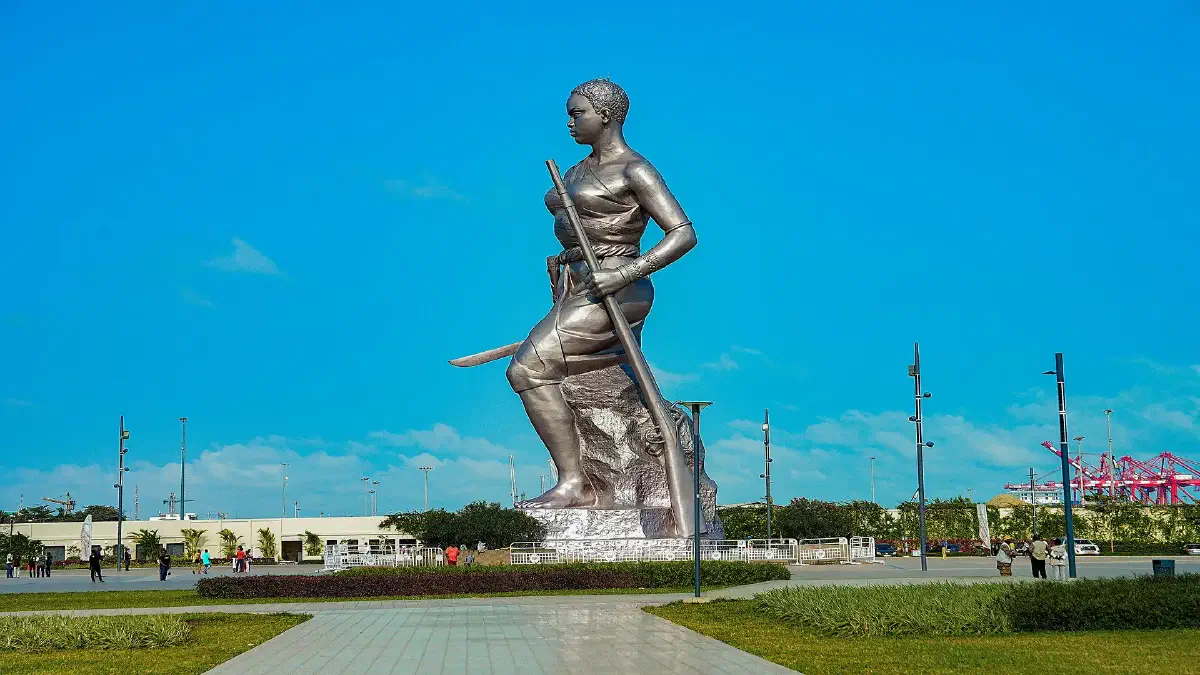
But the statue was only part of a broader phenomenon. In the same month, The Woman King—a $50m Hollywood epic starring Viola Davis—premiered in Cotonou to packed cinemas. A descendant of King Ghezo wept during the screening. A 15-year-old girl told reporters the film gave her “shivers”. The film went on to gross nearly $100m worldwide. Meanwhile, UNESCO had published a comic book, The Women Soldiers of Dahomey, as part of its educational series on women in African history. The Mino appeared in the HBO series Lovecraft Country, in the video game Mortal Kombat 1, and in numerous graphic novels. They had inspired the Dora Milaje in Black Panther, Marvel’s $1.3bn blockbuster. From a disbanded regiment of the 19th century, the Dahomey Amazons had become a global cultural commodity.
The afterlife of the Mino is a case study in how history is remembered, repackaged, and contested. It reveals three distinct but overlapping processes: the institutionalisation of memory by the postcolonial state; the commodification of that memory by global entertainment industries; and the unresolved tension between celebration and critique, between the Amazons as feminist icons and the Amazons as agents of the slave trade. Each process operates according to its own logic. Each produces its own distortions. Together, they have transformed a brutal military institution into a symbol of female empowerment—a transformation that tells us more about the present than about the past.
Living Memory in Benin: The Institutionalisation of the Amazons#
The memory of the Mino never entirely disappeared from Benin. Oral traditions, songs, and dances kept their story alive in Abomey, the former capital of Dahomey. But the French colonial administration had little interest in commemorating the women who had fought against them. As Beninese economist Leonard Wantchekon, a professor at Princeton, told the Washington Post: “The French made sure this history wasn't known. They said we were backward, that they needed to 'civilize us,' but they destroyed opportunities for women that existed nowhere else in the world”. The independence of Benin in 1960 did not immediately change this. The country's first decades were marked by political instability, military coups, and economic stagnation. The Amazons were a curiosity, not a national project.
That began to change in the 21st century. The Royal Palaces of Abomey, a UNESCO World Heritage Site since 1985, became a focal point for heritage tourism. In 2018, an exhibition on the Amazons was held in Cotonou. In 2022, alongside the statue, Benin announced the creation of the Museum of the Epic of the Amazons and Kings of Dahomey in Abomey, a project expected to cost £29m. The museum, currently under construction on the palatial site, will include 12 bronze statues of Amazons and a large landscaped garden. The goal, according to the government, is to “reaffirm the national heritage and its attractiveness to tourists”. The Amazons are being institutionalised as a symbol of Beninese identity—a source of pride, a draw for visitors, a rebuke to the colonial narrative that African societies were primitive and patriarchal.
There is a certain irony in this. The Mino were not democrats or liberators. They were the instruments of an absolutist monarchy, a regime built on slavery and human sacrifice. They fought to preserve that regime. They were not proto-feminists; they were royal bodyguards, bound to the king by oath and celibacy. But the postcolonial state is not interested in these nuances. It needs symbols of national unity and resistance, and the Amazons fit the bill. They are formidable, visually striking, and uniquely Beninese. They are also safely dead. The living women of Benin—who face high rates of gender-based violence, limited political representation, and entrenched patriarchy—are a more complicated subject. The Amazons, by contrast, are a monument. And monuments, as the statue in Cotonou demonstrates, are not history. They are politics cast in bronze.
Global Popular Culture: The Commodification of the Amazons#
If the Beninese state has institutionalised the Amazons as national symbols, the global entertainment industry has commodified them as intellectual property. The process began decades ago. The 1987 film Cobra Verde, directed by Werner Herzog, featured the Amazons in a minor role. George MacDonald Fraser's 1969 novel Flash for Freedom! included them as characters. But the real breakthrough came with Black Panther in 2018. The Dora Milaje—Wakanda's all-female special forces—were explicitly modelled on the Dahomey Amazons. The film was a global phenomenon, grossing over $1.3bn and introducing the concept of African female warriors to a mass audience. The Amazons were no longer a historical footnote; they were a template.
The Woman King took this further. Directed by Gina Prince-Bythewood and starring Viola Davis, the film was a full-budget Hollywood action epic, produced by Davis's own company and sold as a Black female Braveheart. It depicted the Agojie—the Fon name for the Amazons—as noble freedom fighters, protecting Dahomey from the Oyo Empire and European slave traders. The film was praised for its representation of Black women and its action sequences. It was also criticised for historical inaccuracy. The real Dahomey was not a victim of the slave trade; it was one of its leading perpetrators. The Amazons participated in slave raids and helped enslave captives. The film's portrayal of them as opponents of slavery was, at best, a convenient fiction.
The criticism was not confined to academic journals. On Twitter, the hashtag #BoycottWomanKing trended. Critics argued that the film was whitewashing history, turning slave traders into heroes. Some pointed out that the film was shot in South Africa, not Benin, and that the landscapes were digitally altered to erase Black settlements. Others noted that the film's muscular battle scenes had drawn charges of misogyny from within the Black community. The controversy was not a niche debate; it was a mainstream cultural argument, playing out in the New York Times, the Guardian, and on social media.
The commodification of the Amazons extends beyond film. The HBO series Lovecraft Country featured them in an episode where a Black woman in pre-civil rights America experiences a cosmic journey of liberation. The video game Mortal Kombat 1 includes a character inspired by them. UNESCO has published a comic book about them, part of a series on women in African history. Rebecca Hall's graphic novel Wake: The Hidden History of Women-Led Slave Revolts includes them in its exploration of archival silences and female resistance. The Amazons have become a versatile narrative device, adaptable to almost any story about female power, African resistance, or historical rediscovery.
The problem is that commodification has its own logic. It simplifies. It sensationalises. It sells. The Amazons are more useful to Hollywood as symbols than as historical subjects. Their actual history—complex, brutal, ambiguous—does not fit neatly into a two-hour action film. So it is edited, softened, or ignored. The result is a version of the Amazons that is more palatable to modern audiences but less faithful to the historical record. The Mino were not freedom fighters; they were the enforcers of a slave-trading monarchy. They were not feminists; they were celibate wives of the king, subject to his absolute authority. They were not liberators; they were the instruments of a regime that commodified human life. To turn them into heroes is to erase the system that created them.
The Unresolved Tension: Feminist Icons or Slave Traders?#
The tension between celebration and critique is not new. It has been present since the 19th century, when European observers first encountered the Amazons. For some, they were proof of African barbarism—women so degraded that they had been forced to fight like men. For others, they were proof of African civilisation—women who had achieved a level of military prowess that European women could only envy. The debate was always about more than the Amazons. It was about race, gender, and empire. It was about what the Amazons signified for European assumptions about African societies and about women's roles.
The debate continues today, but the terms have shifted. For some African feminists, the Amazons are a source of pride, a rebuttal to the stereotype of the passive African woman. For others, they are a problematic symbol, entangled with the slave trade and royal absolutism. The controversy over The Woman King is the most visible expression of this tension. The film's defenders argue that it is a work of fiction, not a documentary, and that it has inspired young women around the world. Its critics argue that inspiration should not come at the cost of historical accuracy, and that the film's erasure of the slave trade is a form of cultural violence.
Both sides have a point. The film is fiction, and fiction has different obligations than history. But the film also presents itself as history—as a story “inspired by true events”—and it has been received as history by many viewers. The distinction between fiction and history is not as clear as it once was. In a world where most people learn history from films and television, the choices that filmmakers make have real consequences. To portray the Amazons as opponents of slavery is not just a narrative choice; it is a political statement. It shapes how millions of people understand the past.
The tension is also evident in Benin itself. The state has embraced the Amazons as national symbols, but it has not fully reckoned with their role in the slave trade. The statue in Cotonou does not mention slavery. The museum in Abomey is unlikely to dwell on it. The government's priority is tourism and national pride, not historical reckoning. This is understandable—every country has its uncomfortable histories—but it is also a form of erasure. The Amazons were not just warriors; they were warriors in a slave-trading kingdom. To celebrate them without acknowledging that context is to celebrate a sanitised version of the past.
The Architecture of Memory#
The afterlife of the Mino reveals the architecture of memory in the 21st century. Memory is not a passive recording of the past; it is an active construction, shaped by the needs and desires of the present. In Benin, the Amazons have been institutionalised as symbols of national pride, a rebuke to colonialism and a source of tourist revenue. In Hollywood, they have been commodified as intellectual property, a template for stories about female empowerment and African resistance. In both cases, the historical record has been simplified, softened, or ignored. The Mino were complex and contradictory figures, products of a brutal system. They have been transformed into something simpler: heroes, icons, brands.
The transformation is not entirely without benefit. It has brought attention to a neglected history. It has inspired women and girls in Benin and beyond. It has challenged the stereotype of Africa as a continent of passive victims. But it has also obscured the system that produced the Amazons: a system of slavery, human sacrifice, and royal absolutism. The Mino were not rebels against that system; they were its most loyal servants. To remember them without remembering that is to remember only half the story.
The statue in Cotonou will stand for generations. The films and video games will continue to be made. The Amazons will remain a global cultural phenomenon. But the tension between celebration and critique will not disappear. It is built into the very structure of their memory. The Mino are too useful to be forgotten and too complicated to be fully embraced. They are, in the end, a mirror: they reflect not just the past, but the present—our desires, our anxieties, our need for heroes, and our unease with the compromises that history demands.
This concludes the series “"Our Mothers" in Arms: The Rise, Fall, and Legacy of the Dahomey Amazons”. Previous articles: “Blood and Tribute: The Origins of the Agojie”, “The Architecture of the Regiment: Training, Status, and Structure”, “The Final Stand: Conflict, Colonization, and Disbandment”.