In the first article, we laid out a provocative theory: the Ottoman Empire was fatally trapped in the Mediterranean, cut off from the Atlantic trade winds that filled European sails with silver and spices. The immediate, instinctive response to this theory is a simple question: Why didn't they just sail west? If the Atlantic was the highway to global wealth, why would one of the most powerful empires in the world simply accept being locked out? Were they lazy? Ignorant of the Americas? Too proud to change?
The answer to all of these is a definitive no. The reality is far more compelling and begins with understanding the brutal, unforgiving geography of the Mediterranean Sea itself. The Ottomans were not just facing a hostile fleet; they were facing a wall of physical, logistical, and political barriers that made breaking into the Atlantic a strategic near-impossibility. They were, quite literally, prisoners of their own sea.
The Mediterranean: A Magnificent Cul-de-Sac#
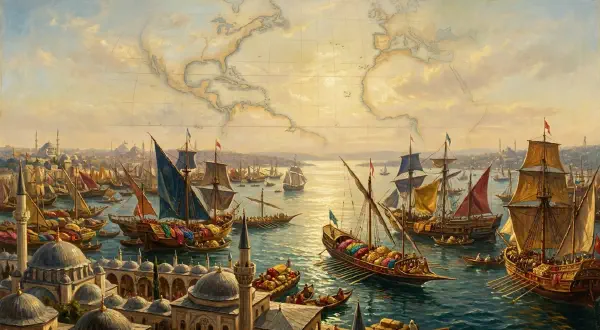
It is easy to look at a map and see the Mediterranean as a great highway connecting three continents. In antiquity, it was exactly that—the Mare Nostrum, the center of the known world. But by the 16th century, when the world expanded into the Atlantic, the Mediterranean was fundamentally redefined. It became what historians call a maritime cul-de-sac: a beautiful, enclosed basin with only one narrow exit to the outer ocean.
First, consider the environment. The Mediterranean is a calm, tideless sea compared to the Atlantic. Its winds are fickle, often dying completely in certain seasons, and its currents are weak. This geography dictated a specific kind of ship and a specific kind of sailing. For millennia, the masters of this sea relied on the galley: a low, long, oar-powered vessel that hugged the coastline, beached at night, and carried a massive crew for short, intense bursts of speed. The entire maritime culture of the Mediterranean—from trade routes to naval warfare—was built on this coastal, galley-based system.
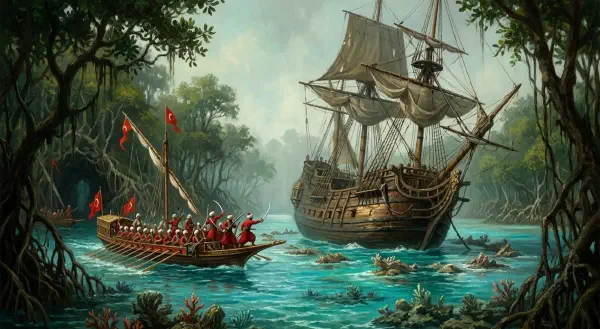
Now, imagine trying to take a fleet designed for this calm, coastal bathtub and thrusting it past the Pillars of Hercules—the Strait of Gibraltar—and into the open Atlantic. The first fresh ocean swell would swamp a galley's low deck. The first Atlantic storm would shatter its long, fragile hull. And the first month-long voyage without a friendly coast to beach on would see its enormous crew of rowers starve and die of thirst. The Ottoman galley was a perfect weapon for its own sea, but it was a coffin in the ocean.
The Strait of Gibraltar: A Gate Slamming Shut#
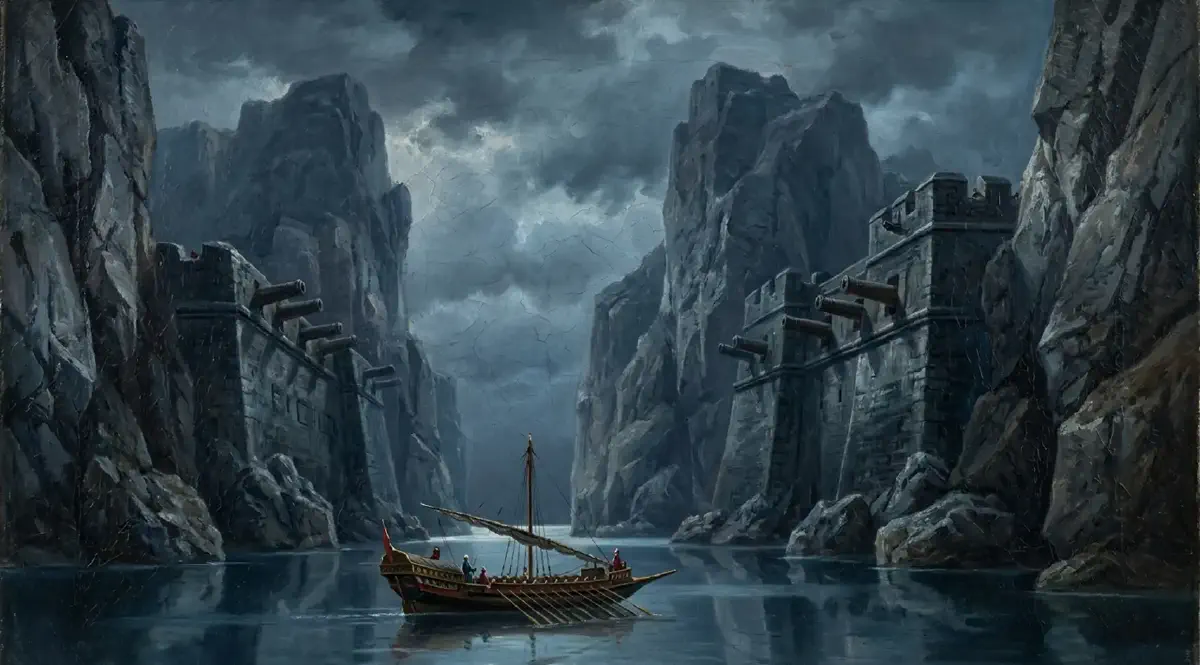
The sole, treacherous exit from this cul-de-sac is the Strait of Gibraltar. At its narrowest point, it is just eight miles wide, with powerful currents and capricious winds. A physical chokepoint on a map, but in the 16th century, it was also a military chokepoint, and the door was not just closed—it was locked, barred, and guarded by the empire’s most implacable enemies.
After the Christian Reconquista of Spain was completed in 1492, the Spanish crown controlled both sides of the strait: the European Pillar at Gibraltar and the African Pillar at Ceuta. They reinforced these positions with powerful fortifications and permanent naval squadrons. Any Ottoman fleet attempting to pass from east to west would have to run a gauntlet of shore-based cannon fire from both continents while simultaneously fighting off a waiting Spanish or Portuguese battle fleet. This was not a secret passage; it was a kill zone.
And the challenge was even worse than a single battle. To even reach Gibraltar, an Ottoman fleet would have to sail the entire length of the Mediterranean—over 2,000 miles from Istanbul—passing by hostile Christian islands and bases like Malta and Sicily that could harass their supply lines. By the time a battered and exhausted fleet reached the strait, it would be low on supplies, ammunition, and fresh water, facing a completely fresh and fortified enemy in its home waters. The logistical math was simply impossible. It is a testament to the barrier's severity that the Ottoman navy, for all its might, never attempted a serious, large-scale breakout into the Atlantic. They understood the calculus of power.
Later, the guard changed but the gate remained shut. When Spain's power waned, Britain took control of Gibraltar in 1704, and they kept the door firmly closed for the same strategic reasons: to bottle up rival naval powers in the Mediterranean, a policy they would later apply with devastating effect against France and Spain as well.
Not Ignorance or Laziness, but Cold Logic#
The accusation that the Ottomans were simply ignorant of the outside world collapses under the slightest historical scrutiny. The most famous example is the admiral and cartographer Piri Reis, whose 1513 world map—drawn just two decades after Columbus—included remarkably accurate depictions of the South American coastline, apparently compiled from captured Portuguese charts and the accounts of sailors. The Ottoman court was deeply interested in the discoveries. They knew about the Americas, the Cape of Good Hope, and the global game being played.
They were also not afraid to project power when it made strategic sense. Ottoman corsairs like the legendary Barbarossa repeatedly raided the coasts of Spain and Italy, and their raiders even ventured into the North Atlantic, sacking the coasts of Ireland and England from bases in North Africa. But these were small, fast, corsair galleys operating on hit-and-run tactics, not a massive imperial fleet aiming for conquest or colonization. Sending a fleet of heavy warships to seize and hold territory across an ocean was an entirely different, and impossible, proposition.
The empire's strategic calculus was therefore a rational one. The potential reward of breaking into the Atlantic—a colonial empire in an unknown land, thousands of miles away, requiring a logistical pipe across an impassable ocean—did not remotely justify the certain catastrophic cost of trying to force the Gibraltar chokepoint. For the same resources, they could consolidate their hold on the land empire they already had and fight for the trade routes that already existed, closer to home.
The Price of the Trap#
The consequences of this geographic confinement, however, were profound and terminal. While the Ottoman sultans were rationally choosing not to commit naval suicide at Gibraltar, their European rivals were free to pour through their own unguarded Atlantic front doors. The Spanish and Portuguese, with no hostile power blocking their coastlines, built vast colonial empires that funneled an unimaginable stream of wealth directly into their treasuries. Later, the Dutch, English, and French did the same, with their merchant fleets sailing the globe unhindered by a narrow chokepoint.
The Ottoman Empire, once the indispensable middleman of world trade, was now a bystander to the greatest economic revolution in history. The American silver that flooded into Europe caused inflation that wrecked the Ottoman currency. The cheap Asian goods that bypassed Ottoman markets impoverished Ottoman merchants. The empire was not defeated in a war; it was slowly starved of relevance in a world that had found a new center.
The "Mediterranean Prisoner" was not a metaphor. It was a relentless geographic and strategic reality that boxed in the empire's ambitions and denied it a seat at the table of global power. The Ottomans could not simply "sail west" because the sea they mastered was a cage, and the gate was held by their rivals.
So, if the western route was sealed, what could the empire do? The answer, as we will see in the next article, was not to give up, but to turn their attention in the only direction that remained open: East. The Ottoman Empire was about to launch its own, forgotten, Age of Exploration.