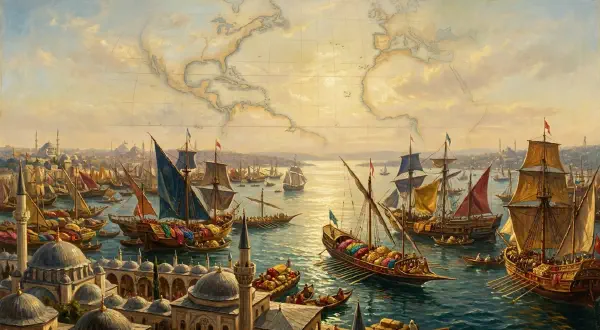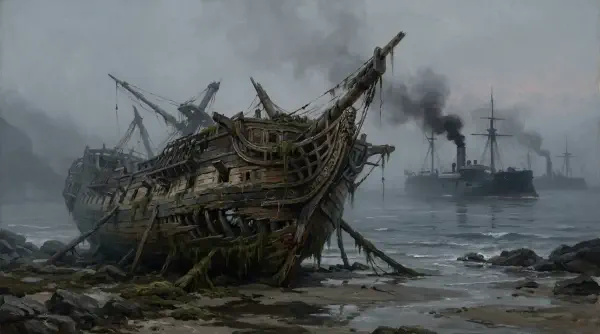
If you had asked a Portuguese chronicler in 1530 to name the greatest threat to his country’s empire, he would not have pointed to a rival European power or a native uprising in Brazil. He would have pointed east—to the Ottomans. While the gates of the Atlantic were sealed shut at Gibraltar, the sultans in Istanbul did not simply resign themselves to irrelevance. Instead, they launched a breathtaking, audacious, and now almost entirely forgotten campaign to seize control of the very heart of the global economy: the Indian Ocean spice trade. The western front was closed, so they opened an eastern one. The Ottoman Age of Exploration had begun.
The Conquest That Changed Everything#
The pivot eastward was made possible by a single, transformative military campaign. In 1516–1517, Sultan Selim I, known to history as Selim the Grim, marched his army south into the lands of the Mamluk Sultanate. In a lightning campaign that stunned the world, he toppled the Mamluks and annexed their entire realm: Syria, Egypt, and the Hejaz, the narrow strip of Arabian coast that housed the holy cities of Mecca and Medina.
This was not merely a land grab. In a single stroke, the Ottoman Empire was transformed from a Mediterranean power into a Red Sea power, and with that, into a direct neighbor of the Indian Ocean. For the first time, the sultan’s ships could be built on the shores of a sea that connected, through the Bab el-Mandeb strait, directly to the markets of India, Indonesia, and East Africa.
The conquest was about more than territory; it was about control of the spice road. The Portuguese had arrived in India in 1498 and had spent the subsequent decades attempting to monopolize the pepper, cinnamon, and clove trade. Their heavily armed caravels were attacking Muslim merchant ships, and their fortified bases strung along the Indian coast threatened to cut off the flow of goods that had enriched Cairo and Istanbul for centuries. Selim’s conquest was the Ottoman answer to this threat: a violent, decisive, and immediate insertion of imperial power directly into Portugal’s new backyard.
Suez: The Desert Shipyard#
The key to the entire eastern strategy was a dusty, sleepy port town on the northern tip of the Red Sea: Suez. Here, far from the lush forests of the Black Sea that supplied the Imperial Arsenal in Istanbul, the Ottomans began the back-breaking work of constructing a new fleet from scratch.
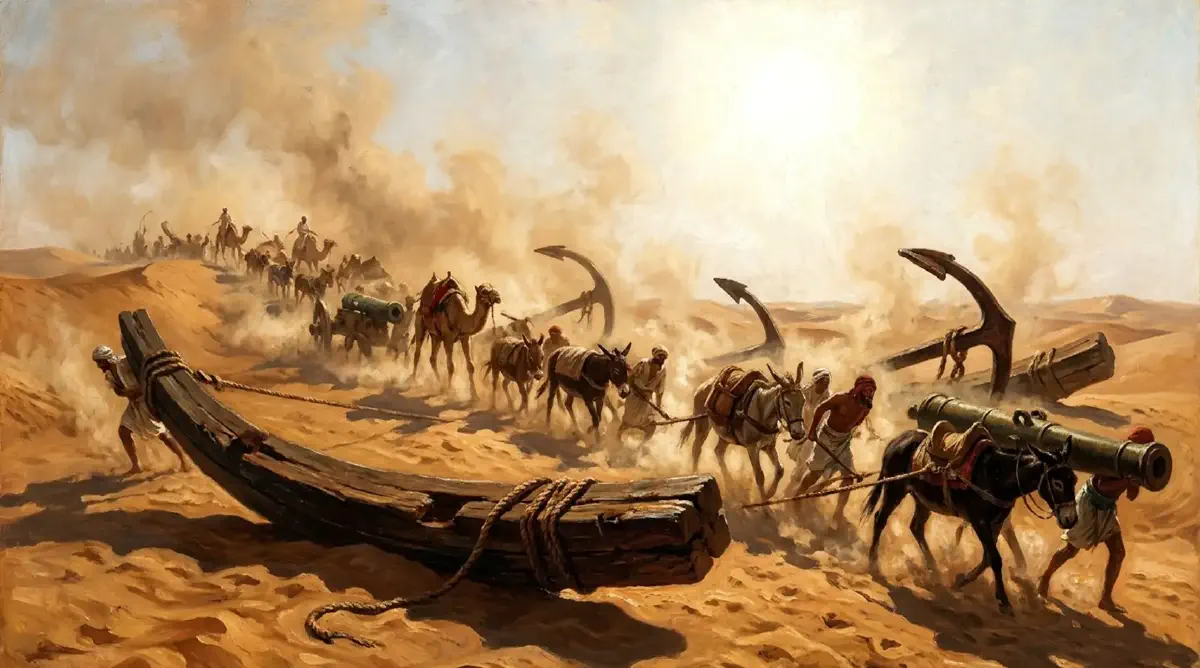
The logistical challenge cannot be overstated. There was no Suez Canal. Every beam of timber, every iron nail, every sack of pitch, and every bronze cannon had to be hauled overland from the Mediterranean coast of Egypt or shipped down the Nile and then laboriously transported across the desert. It was a colossal industrial undertaking, a testament to the empire's ambition and organizational capacity. The Suez shipyard was not a secondary outpost; for a brief, intense century, it was one of the most strategically vital naval bases in the entire Ottoman world, building dozens of galleys and other fighting vessels designed to operate in the tropical waters of the southern seas.
The Forgotten Oceanic War#
From this base, a series of Ottoman admirals launched a century-long maritime campaign that ranged across the entire Indian Ocean basin. Their goals were clear: to break the Portuguese blockade of the spice trade, to secure the sea lanes for Muslim merchants, and to protect the Holy Cities from potential Portuguese assault.
The first major expedition sailed in 1538 under Hadım Suleiman Pasha. The fleet consisted of some 70 ships and was tasked with besieging the Portuguese fortress at Diu, on the coast of Gujarat, India—a key trading hub. The siege ultimately failed due to a combination of fierce Portuguese resistance and friction with local allies, but the sheer audacity of the Ottomans showing up with a war fleet in India sent shockwaves through the Portuguese court. The Indian Ocean was no longer a Portuguese lake.
The campaigns continued under the brilliant and ill-fated Piri Reis, the same cartographer whose world map we encountered earlier. Now an aged admiral, he led a fleet that successfully expelled the Portuguese from Muscat and briefly besieged their base at Hormuz. His eventual execution for political failures highlights the brutal stakes of these distant expeditions. The most epic of all was the voyage of Seydi Ali Reis in 1553. His fleet was battered by a Portuguese ambush and then driven by the monsoon winds all the way across the Indian Ocean to the coast of India. Stranded and with his ships wrecked, he and his surviving men spent years making their way back overland through India, Afghanistan, and Persia, an odyssey he later chronicled in his famous travelogue, Mirat ul Memalik (The Mirror of Countries).
This was not a limited, defensive action. Ottoman ships raided Portuguese settlements along the Swahili coast of East Africa. They sailed to the Sultanate of Aceh, on the island of Sumatra in modern-day Indonesia, providing military advisors, cannon, and engineers to help the local Muslim sultan fight off the Portuguese. In the 1560s, an Ottoman fleet of 15 ships and hundreds of soldiers arrived in Aceh, the furthest reach of this forgotten oceanic empire. For a moment, the Ottoman crescent flew over the waters of Southeast Asia.
Fighting the Right War, With the Wrong Tools?#
The Ottoman Indian Ocean campaign was a remarkable strategic improvisation, but it was also constrained by the same technological and geographical factors that locked them out of the Atlantic. The fleets they built at Suez were not galleons. They were primarily oared vessels: galleys, galleasses, and smaller fustas. Why? Because, as we will explore in detail in the next article, this was the technology the Ottomans knew and could build in the desert.
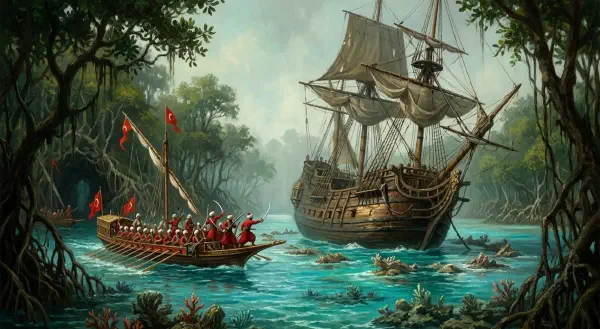
But more importantly, it was a technology that made strategic sense for the war they were fighting. This was not a conflict of broadsides on the high seas. It was a war of coastal raiding, port denial, and rapid strikes. The Ottoman galley fleet could hug the shore, hide in shallow inlets, and attack on a windless day when a Portuguese sailing ship would be left helplessly becalmed. The Portuguese, who had initially sailed into the Indian Ocean expecting to dominate with their heavy galleons, quickly learned to fear the swift Ottoman galleys that could dart out from hidden coves and overwhelm an isolated ship with hundreds of boarding soldiers. In the confined, coastal waters of the Red Sea, the Persian Gulf, and the Indian coast, the galley was not obsolete. It was, in many ways, the perfect asymmetric weapon.
A Stalemate, Not a Defeat#
The Ottoman eastern Age of Exploration did not end with a dramatic, Trafalgar-style defeat. It ended in a strategic stalemate. The Portuguese could never fully conquer the Red Sea or completely cut off the spice trade; the Ottomans successfully defended the sea lanes through the Red Sea and the Holy Cities remained safe. But the Ottomans, in turn, could never permanently break the Portuguese hold on the Indian coast or seize the trans-oceanic trade routes for themselves. The logistical pipe from Istanbul to Suez was just too long, too fragile, and too dependent on overland transport. The vast, deep-water ocean remained a Portuguese domain, while the shallow, coastal seas became a fiercely contested Ottoman-Portuguese battleground.
The result was a world divided. The Ottoman Empire remained a titan of the old overland and coastal trade routes. The Portuguese, and then the Dutch and English, became the titans of the global ocean highways. The empire had found a new arena to fight in, but it had not found a way to win the global economic war.
The story of the eastern campaigns forces us to confront a deeper question. If the Ottomans could build ships in Suez, and if they could fight the Portuguese to a standstill, why couldn't they take the final, seemingly logical step? Why could they not build an Atlantic-style galleon fleet in the Indian Ocean and truly take the fight to the enemy on the open sea? The answer lies not in grand strategy, but in the very planks and nails of the ships themselves. It is time to look at the revolutionary design that was changing the world: the difference between a galley and a galleon.