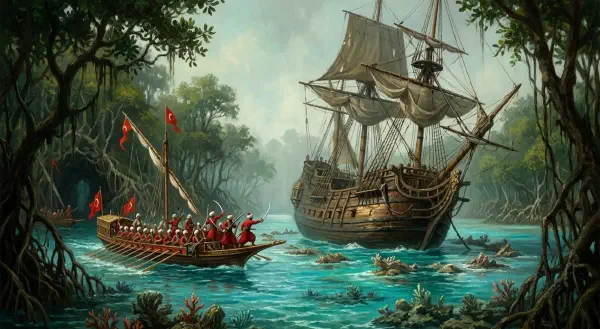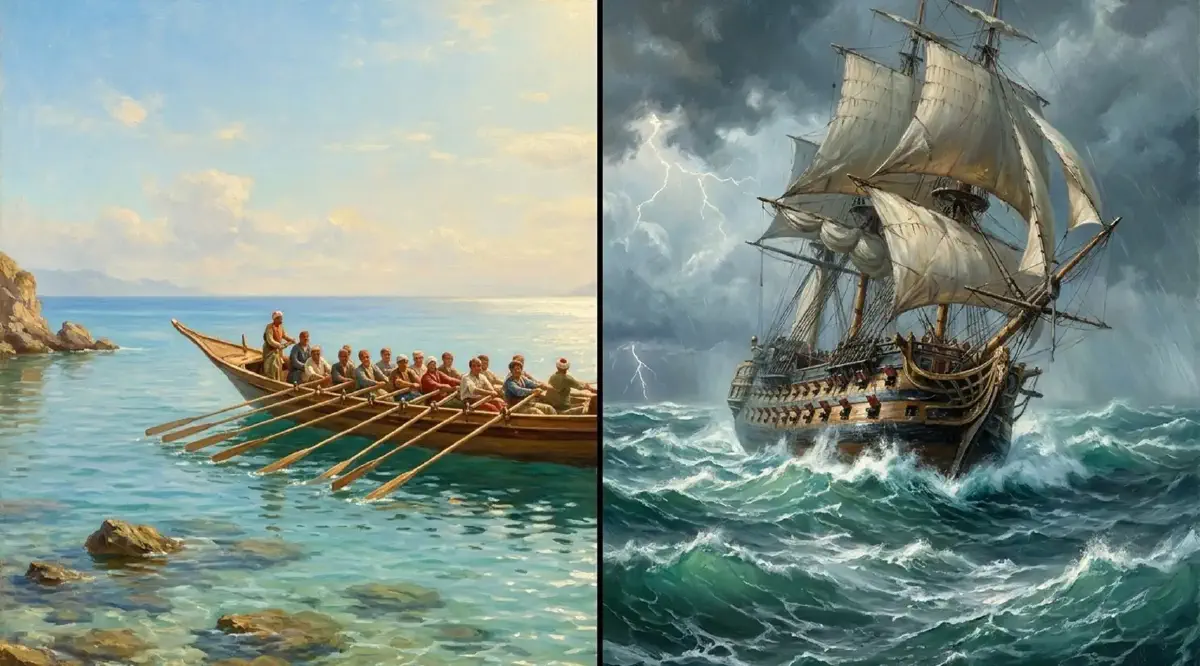
In the previous articles, we established that the Ottoman Empire was a Mediterranean prisoner, barred from the Atlantic by the locked gate of Gibraltar. But this geographic trap was only half the story. The other half was the physical object floating in the water: the ship itself. To truly understand why the Ottomans could not compete in the new global arena, we must look not at admirals or sultans, but at hulls, oars, sails, and cannons. The story of the empire's maritime fate is, in many ways, a tale of two ships: the galley and the galleon.
One was a shark, perfectly evolved for the calm, enclosed waters of the Mediterranean. The other was a whale, built to roam the vast, stormy expanses of the world’s oceans. The tragedy for the Ottomans was that they had mastered the shark, just as the world’s center of gravity shifted to a realm where only whales could survive.
The Galley: Master of the Inland Sea#
For thousands of years, the galley was the undisputed queen of Mediterranean warfare and trade. Its design was so perfectly adapted to its environment that it remained fundamentally unchanged for millennia. It was not a primitive precursor to the sailing ship; it was a specialized, highly sophisticated weapon system for a specific kind of sea.
Propulsion by Muscle, Not Wind The defining feature of a galley was its oars. Rows of oarsmen—often slaves, convicts, or paid professionals—provided the primary motive power. This gave the galley a supreme tactical advantage: it was independent of the wind. In a battle, a galley could accelerate, turn on a dime, and ram an enemy vessel even on a perfectly calm day, when a sailing ship would be dead in the water. Sails were auxiliary, used only for cruising long distances to conserve the rowers’ strength before battle.
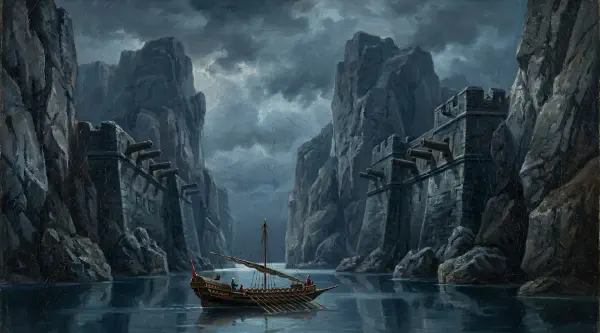
A Hull Built for the Beach The galley’s hull was a study in trade-offs. It was extremely long and narrow—a length-to-beam ratio of about 8:1—to make it as hydrodynamic as possible for rowing. It sat very low in the water with a shallow draft. This was not a design for deep ocean stability, but for coastal agility. A galley could navigate shallow reefs, river deltas, and narrow straits. Crucially, it could be beached almost anywhere at night. This was a non-negotiable requirement because a galley could not carry enough food and fresh water for its enormous crew to sustain long voyages. It had to hug the coast and stop frequently.
A Floating Battlefield for Infantry Naval combat for a galley was essentially a land battle on water. The primary tactic was to ram an enemy ship with the reinforced bronze or iron beak at the bow, then unleash a torrent of soldiers—Janissaries, marines, swordsmen—to board and capture the vessel. Even after cannons were introduced, a galley could only mount a few heavy guns in the bow, facing forward. You didn't aim the cannons; you aimed the entire ship. The galley was a marine infantry platform, an extension of the Ottoman land army.
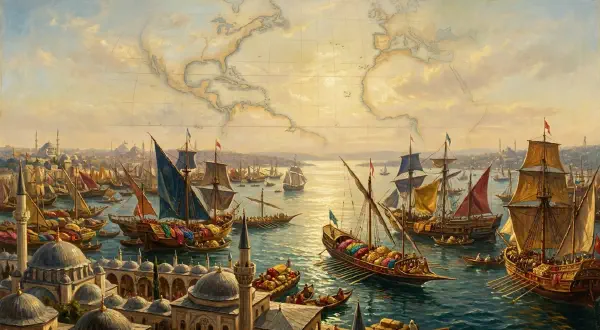
In the tideless, windless, reef-filled Mediterranean, this design was supreme. The Ottomans had perfected it, and their shipyards on the Golden Horn could produce a galley fleet with astonishing speed.
The Galleon: Child of the Ocean#
The galleon was a revolutionary design born in the shipyards of Atlantic Europe. It was not a Mediterranean evolution; it was a completely different animal, answering a completely different set of demands: how to carry vast amounts of cargo across thousands of miles of hostile, storm-wracked ocean and return with a fortune.
The Wind as Engine Unlike the galley, the galleon relied entirely on the wind. Its complex system of multiple masts, carrying a combination of square and triangular (lateen) sails, allowed it to harness the steady trade winds of the open ocean efficiently. A galleon was slow and clumsy in a dead calm, but on the open sea, with the wind on its quarter, it could sail for months. It did not need to stop. It did not need to beach. The ocean was its home.
A Hull of Capacity and Strength The galleon’s hull was its genius. It was much shorter and broader in proportion—a ratio of about 4:1—with a deep, rounded cross-section and a deep keel. This gave it two critical things a galley lacked: enormous internal cargo volume and stability in heavy ocean swells. It could carry not just treasure and trade goods, but also the massive stores of water, hardtack biscuits, salt pork, and cannonballs needed for a crew of a few hundred men to stay at sea for half a year without resupply. Its high, castle-like fore and aft decks made it a veritable fortress, nearly impossible for a low-slung galley to successfully board.
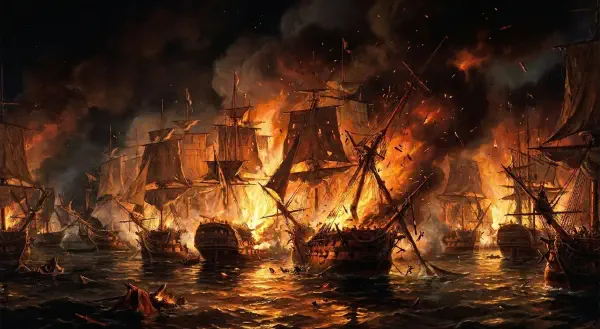
The Age of the Broadside The tactical revolution of the galleon was the broadside. Rows of heavy cannons were mounted along the ship's sides, firing through square gunports cut into the hull. A galleon didn't need to ram or board. It could simply sail parallel to an enemy and deliver a rolling, thunderous barrage that could shatter a ship’s hull, bring down its masts, and decimate its crew from a distance. Naval warfare was no longer a contest of infantry; it was a duel of artillery. The galleon had transformed from a transport for soldiers into a mobile gun battery.
The Fatal Technology Lock-In#
So why didn't the Ottomans simply build galleons? The answer is not incompetence, but a classic case of technology lock-in, compounded by brutal material realities.
The entire Ottoman maritime system was optimized for galleys. Their admirals had fought with galleys for centuries. Their shipwrights knew only the intricate art of galley construction. Their logistics were built around supplying short-range, coastal fleets. Shifting to galleons would require not just new ship designs, but a new industrial base, new training, and a new naval doctrine.
But there was a deeper, more intractable problem. The Ottoman Mediterranean world lacked the very materials needed to build Atlantic-style galleons. The Black Sea coast could provide timber, but the specialized, massive, seasoned oak timbers for a galleon's heavy frames, and the complex ironworks for its huge anchors and chains, were different demands entirely. The geography that made the galley perfect also made the transition to the galleon a monumental, almost impossible industrial challenge.
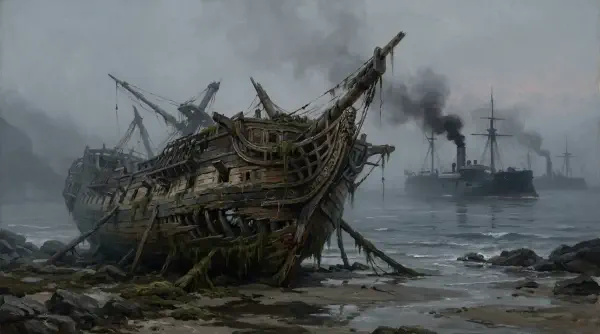
The result was a fatal mismatch. The Ottoman galley fleet could dominate the Mediterranean, but it could not survive the Atlantic. The Atlantic galleon could not only dominate the oceans but could eventually muscle its way into the Mediterranean itself, changing the rules of war in the empire's own home waters. The shark was perfectly evolved for a sea that was rapidly losing its global significance.
This technological lock-in wasn't the end of the story. As we will see, the Ottomans would try to solve this exact problem in the most unlikely of places: the Red Sea and the Indian Ocean. And there, the challenges would multiply exponentially, revealing a paradox that would doom their grandest ambitions.