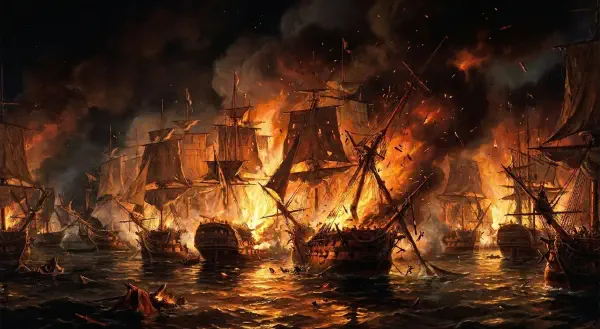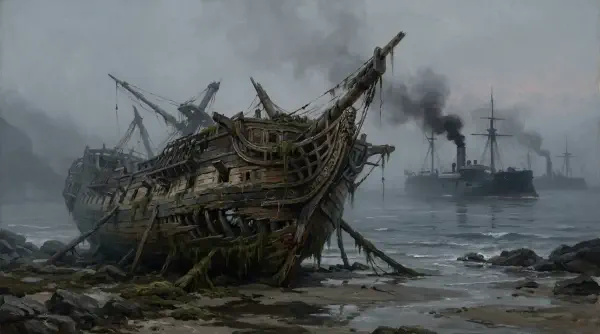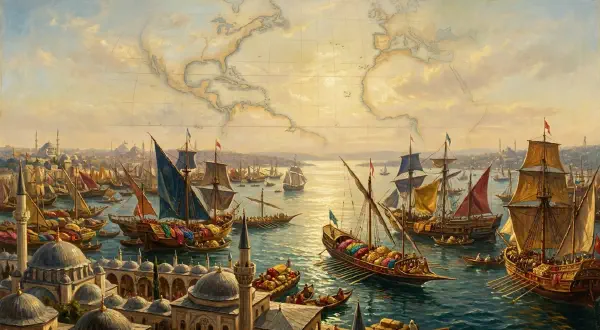
We have now arrived at the most perplexing puzzle in the entire story. The Ottoman Empire, locked out of the Atlantic, conquered Egypt and burst into the Indian Ocean. They fought the Portuguese from the coasts of Africa to the islands of Indonesia. They had a shipyard at Suez, a fleet of war galleys, and a burning desire to protect the spice trade. So why, with all this ambition and activity, did they never build a true ocean-going fleet of galleons in the east? Why did they not match the Portuguese with their own broadside-firing, ocean-conquering sailing ships?
The answer is a paradox. The very geography that granted them access to the Indian Ocean also made it impossible to build the ships that could command it. The Red Sea was their gateway, but it was also their trap. And their failure was not technological ignorance—it was a rational, strategic calculation made in the face of impossible logistical odds.
The Red Sea: A Nightmare to Navigate#
First, we must dispel the image of the Red Sea as a friendly, open highway. It is, in fact, one of the most difficult bodies of water on the planet for large sailing ships.
The Red Sea is a narrow, deep rift valley filled with treacherous coral reefs and hundreds of uncharted islands, especially along its southern approaches. The prevailing wind system is a sailor's curse. In the northern half, the wind blows predominantly from the north, while in the southern half, it blows from the south. In the middle, there is a belt of maddening calms. A large, deep-draft sailing ship like a galleon, entirely dependent on the wind, would be helpless in these conditions, at constant risk of drifting onto a reef or being stranded for days in a dead zone.
Ironically, the Ottoman war galley was far better suited for this environment. Its shallow draft let it slip over reefs and navigate narrow channels. Its oars gave it the power to move regardless of wind, precisely the advantage needed in the Red Sea's calms. The very technology that locked them out of the Atlantic was the only viable technology for operating in their eastern gateway. The Red Sea was not a launchpad for galleons; it was a gauntlet only galleys could reliably run.
Building a Shipyard in a Desert#
Even if the sea itself had been calm and deep, the problem of building a galleon in Suez was, for all practical purposes, unsolvable with 16th-century technology.
A galleon was a massive, complex machine built from specific, high-quality materials. Its hull required enormous, seasoned oak timbers, carefully shaped and joined. It needed tons of iron for nails, bolts, anchors, and chains. It required miles of specialized rope, vast quantities of pitch and tar for caulking, and heavy bronze or iron cannons. In Atlantic Europe—in Lisbon, Amsterdam, or London—these materials were readily available. Shipyards were built at the mouths of rivers that flowed from vast, oak-covered forests, and iron foundries were a short barge-ride away.
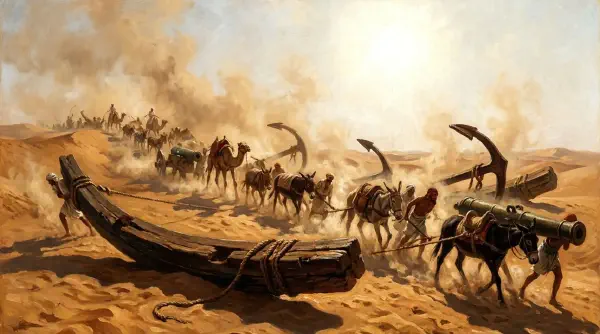
Suez had none of this. The coast is barren desert. There are no forests, no iron mines, no ropewalks. Every single plank, every iron nail, every cannon, every coil of rope had to be transported overland from the Mediterranean. The materials were hauled across Egypt from the Nile Delta, a journey of over 100 miles through scorching desert, by camel, mule, and human labor. The cost in time, money, and sheer human suffering to build just one oceangoing ship in Suez was astronomical compared to building the same ship in a European Atlantic port.
This logistical impossibility meant the Suez shipyard could only realistically produce relatively small, oared vessels—galleys and fustas—which required significantly less timber and iron than a multi-decked galleon. The Ottoman Empire made a pragmatic choice: build what was possible, not what was ideal. The galleon fleet they dreamed of was a material impossibility.
The Bab el-Mandeb: The Second Gate#
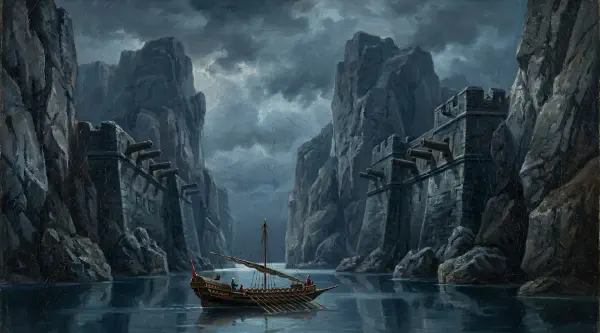
And there was yet another chokepoint, one that mirrored Gibraltar in its strategic cruelty. To enter the Indian Ocean from the Red Sea, you must pass through the Bab el-Mandeb, the "Gate of Tears," a narrow strait at the southern tip of the Arabian Peninsula. The Portuguese knew this. They established a base on the nearby island of Socotra and sought to blockade this chokepoint.
Imagine the Ottoman dilemma. Even if they had, by some superhuman effort and eye-watering expense, painstakingly assembled a small squadron of galleons inside the Red Sea, they would then have to sail those ships, single-file, through the Bab el-Mandeb, directly into the cannon-fire of a waiting Portuguese blockading fleet. They would be fighting their way out of a trap, in ships they were not yet expert at sailing, against an enemy who had mastered the art of oceanic warfare. It was a recipe for annihilation.
The Rational Choice: Asymmetric Warfare#
So, what did the Ottomans do? They made the intelligent, rational, asymmetric choice. They did not try to beat the Portuguese at their own game on the open ocean. Instead, they changed the game.
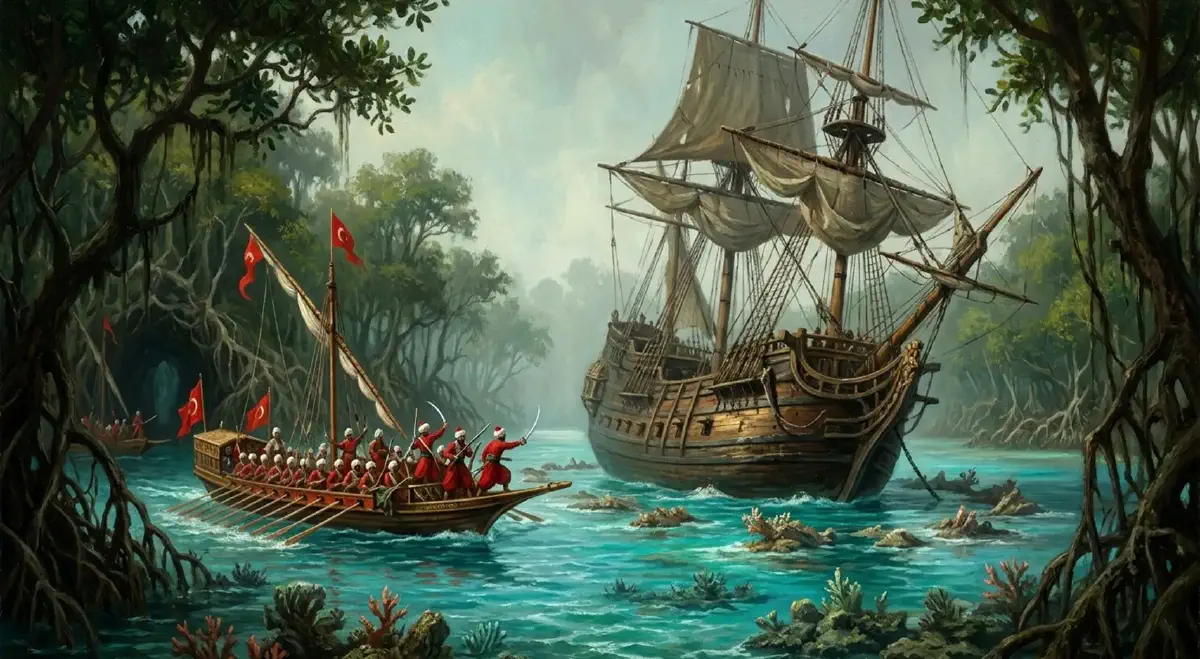
They used their galley fleet to wage a relentless campaign of coastal raiding, port denial, and support for local Muslim allies. An oared galley could hide in a shallow mangrove swamp where a Portuguese galleon could never venture. It could wait for the wind to die and then dart out to attack a becalmed Portuguese ship, swarm it with hundreds of Janissaries, and escape before reinforcements could arrive. The Portuguese, who had entered the Indian Ocean with contempt for oared vessels, quickly learned to fear them and began building their own galleys in Indian shipyards just to survive. The Ottomans forced the world’s first global oceanic empire to adapt to their medieval technology—a testament to the galley's lethal effectiveness in the right environment.
This was not a failure. It was a brilliantly successful, low-cost strategy that achieved the empire's primary goals: the Red Sea remained an Ottoman lake, the Portuguese never conquered the Holy Cities, and the spice trade continued to flow north through Cairo and Istanbul. The Ottoman Indian Ocean campaign was a logistical and strategic masterpiece, not a footnote of missed opportunities.
The Price of Pragmatism#
But pragmatism has a price. The decision to fight an asymmetric galley war meant the Ottomans never developed the shipbuilding infrastructure, the deep-sea sailing expertise, or the tactical doctrine of the broadside-firing galleon in the Indian Ocean. They could harass and disrupt the Atlantic empires, but they could never supplant them. The Dutch and English East India Companies, which followed the Portuguese, were thus able to eventually dominate the long-distance ocean highways of global trade unopposed by any Ottoman deep-water fleet.
The Red Sea Paradox is this: the only door the Ottomans had to the world ocean was one that they could only pass through with small, oared ships. The geography that gave them access simultaneously denied them the means to true oceanic mastery. They were not lazy or blind. They were trapped not just by Gibraltar, but by the very nature of their own coastline and the unforgiving material realities of their new naval bases.
This paradox sealed the fate of the Ottoman east. But what about the old heartland? The question remained: could the empire finally build galleons in the Mediterranean itself, where the timber and iron were plentiful? The answer would come, but it would be a long, painful, and often humiliating process, driven by catastrophic defeat in their own front yard.