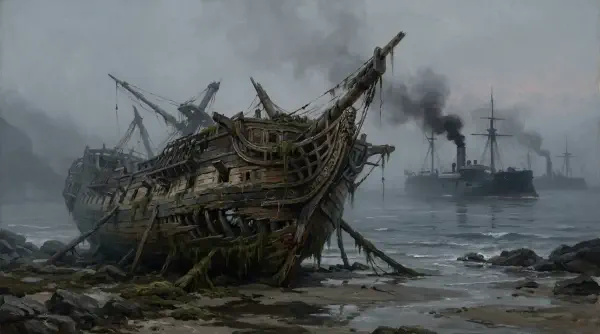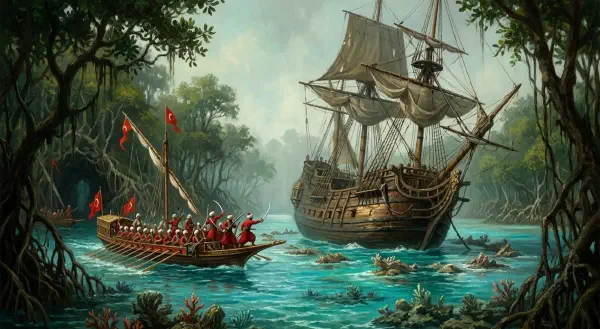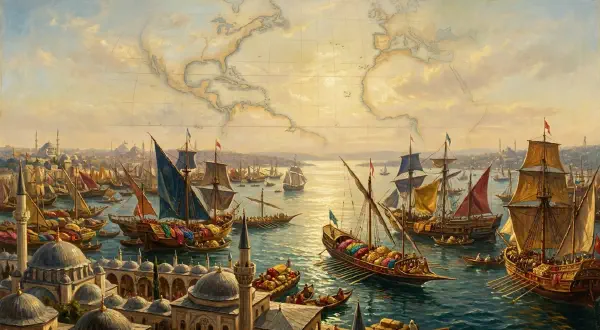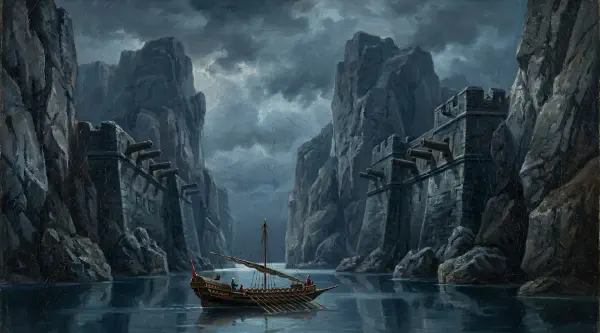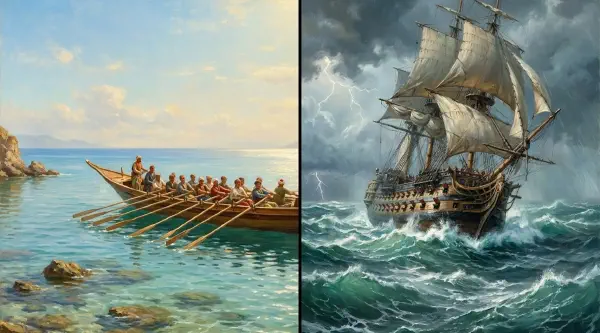
For centuries, the Ottoman Empire had clung to the galley—the shark of the inland sea—even as the Atlantic powers mastered the whale-like galleon. In the Red Sea, geography and logistics had conspired to make the shift to sail impossible. But in the Mediterranean itself, the empire had no such excuse. The forests of the Black Sea were thick with oak, and the Golden Horn’s shipyards were among the largest in the world. And yet, the Ottoman embrace of the sailing ship of the line was not a confident leap forward, but a stumbling, desperate stagger, forced upon them by a series of catastrophic defeats. The Mediterranean, their own home sea, had to become an ocean before they would truly change. By the time they did, it was already too late.
The False Dawn of Lepanto#
On October 7, 1571, the Ottoman galley fleet met a Holy League armada in the Gulf of Patras, near Lepanto. It was the last great clash of oared fleets in history, and the Ottomans were annihilated. Hundreds of their ships were sunk or captured, and tens of thousands of their experienced sailors and Janissaries were killed.
The response to this catastrophe was astonishing. The imperial shipyards worked around the clock for a single winter, and by spring, a brand-new galley fleet of 150 ships was launched. Grand Vizier Sokollu Mehmed Pasha famously remarked to a Venetian ambassador, “In wresting Cyprus from you, we have cut off one of your arms. In defeating our fleet, you have merely shaved our beard. The arm cannot grow back, but the beard will grow again thicker.” The empire treated Lepanto as a loss of replaceable material, not a verdict on their technology. The galley system was too deeply entrenched. Every admiral, every shipwright, and the entire Janissary corps, whose prestige and pay depended on boarding actions, had a vested interest in the status quo. The lesson of Lepanto was not learned; it was ignored.
The Cretan War: The Ocean Arrives in the Mediterranean#
The true reckoning came nearly a century later, during the long and brutal Cretan War (1645–1669) against Venice. The Venetians, having long observed the Atlantic powers, had transformed their navy. They now deployed large, heavily armed sailing ships of the line—galleons, which the Ottomans called kalyons. These were not the modest galleons of the 16th century. They were floating fortresses with multiple gun decks, capable of firing broadsides that could shatter a wooden hull into splinters.
The strategic dilemma for the Ottomans was agonizing. Their galley fleet, rowing from Istanbul, had to pass through the Aegean to reach the siege of Candia in Crete. Venetian kalyons, operating from their bases on Crete and the Ionian Islands, could do what a galley could never dream of: they could blockade the Dardanelles in any season, even in the rough winter weather that would swamp an oared vessel. They could stay at sea for months, severing the supply lines of the Ottoman army on Crete. The galley was no longer just obsolete for ocean exploration; it was losing a war in its own home waters.
For the first time, the Ottoman admiralty was forced into a desperate crash program. They began to build their own kalyons in the Imperial Arsenal, hiring and capturing Venetian, Dutch, and English shipwrights to teach them the secrets of deep keels, complex rigging, and the deadly art of the broadside. The transition was slow and painful. For decades, the Ottoman battle fleet was a strange, hybrid monster: squadrons of galleys and squadrons of sailing ships operating together, their tactics in constant, chaotic tension.
Chesma: The Night the Fleet Burned#
The hybrid fleet limped along until the 18th century, but the final, apocalyptic verdict on the Ottoman naval system came in 1770. A Russian fleet, which had sailed all the way from the Baltic Sea—a staggering feat in itself—entered the Mediterranean to attack the Ottomans in their own backyard. The two fleets met at Chesma Bay, off the coast of Anatolia.
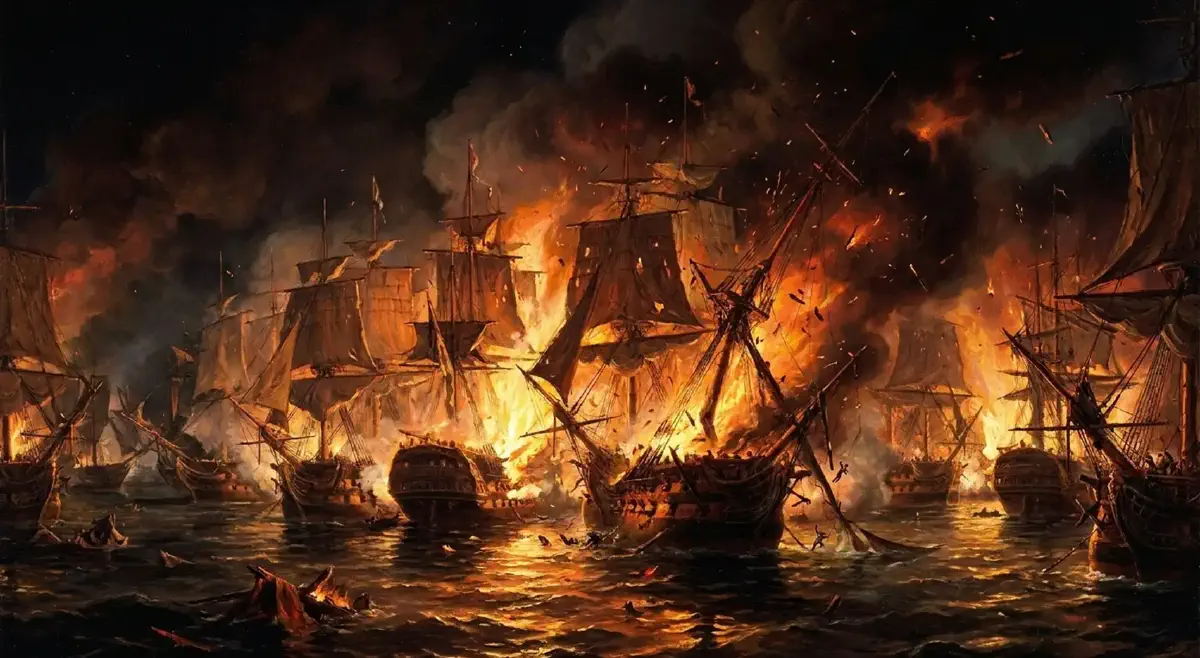
The Ottoman fleet, now composed primarily of sailing ships of the line, was anchored in a tight, defensive formation. But they were still fighting with the mind of a galley navy: huddling close to shore, relying on fortifications, and expecting a frontal assault. The Russians used incendiary fireships and aggressive night tactics to exploit this passivity. In a single catastrophic night, the entire Ottoman fleet was set ablaze and utterly destroyed. The flagship exploded, and thousands of sailors perished in the flames. It was not a battle; it was a slaughter. The lesson of Chesma was even more brutal than Lepanto: simply having sailing ships was not enough. You needed an entirely new naval culture—aggressive, seafaring, and masterful in the complex art of wind and gunnery—and the Ottomans did not have it.
The Reluctant Modernizers#
Chesma sparked a profound, terrified period of reform. The sultans brought in a wave of European experts, most notably French and later Swedish shipwrights, to rebuild the fleet from the ashes. New ships of the line and frigates were laid down, modeled exactly on the best British and French designs. By the early 19th century, Sultan Mahmud II possessed a battle fleet that, on paper, looked like a Mediterranean power. The ships were built with the right curves, the right guns, and the right rigging.
But appearances were deceiving. The Ottoman navy suffered from a terminal case of surface-level modernization. A fleet is not just its hulls. A fleet is its people. The empire never developed a professional, respected officer corps or a seasoned class of sailors. Command was often a matter of palace politics, not seamanship. The British Royal Navy’s power lay in its gunnery drills, its tradition of blockade duty, and its cadre of captains who had spent their lives at sea. The Ottomans could copy the ships, but they could not copy the centuries of maritime culture that made them lethal.
There was also the deepening industrial gap. A sailing ship of the line was the most complex machine of the age. It required copper sheathing to protect the hull, precise iron fittings, standardized ropes, and a constant supply of high-grade gunpowder. The Ottoman economy, still largely agrarian and artisanal, struggled to produce these at the scale and quality needed. The shipyards could build a beautiful frigate, but they could not sustain the industrial ecosystem required to keep a modern navy in fighting trim year after year.
Navarino and the Ironclad Future#
Just as the Ottomans had finally, painfully, learned to build and creakily operate their sailing fleet, the world changed again. The Battle of Navarino in 1827 saw an Ottoman and Egyptian combined fleet—a fleet of perfectly good sailing ships—annihilated in a few hours by a British, French, and Russian force that included early steam-powered warships. The age of sail was ending, and the age of steam and iron was dawning.
The pattern repeated itself, now at an even more desperate pace. The empire ordered steam frigates and ironclad battleships from European shipyards, running up colossal debts. But the same fundamental problems persisted: a lack of trained engineers, a weak industrial base, and a doctrine that was always a generation behind. The modernization was always a purchase, never a creation. The navy became a beautiful, expensive, and ultimately hollow symbol of a state that could not generate power from within.
The Deeper Sickness#
The story of the painful modernization of the Ottoman navy is a microcosm of the empire’s wider collapse. It shows that the geographic and technological traps we have explored were not just about ships. They were symptoms of a deeper condition: a structural rigidity that made adaptation slow, superficial, and perpetually inadequate. The switch from galley to galleon, when it finally came, was a tactical fix for a strategic disease. The empire could buy ships, but it could not buy the centuries of accumulated maritime knowledge, the industrial revolution, or the flexible, innovative state structures that made the Atlantic powers dominant.
The Mediterranean finally did become an ocean, but the Ottoman ship of state was already taking on water, and no new hull could save it.
In our final article, we will bring the entire journey together. We will return to the original theory of the geostrategic trap, place it alongside the internal decay, the failure to industrialize, and the rise of nationalism, and reach a final verdict on what really sent the empire to the bottom.
Ready for Article 7: "Beyond Geography – A Conclusion" when you are.