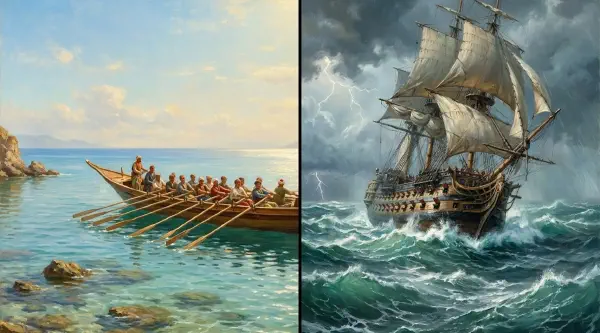
We began this journey with a simple, powerful idea: that the Ottoman Empire collapsed because it was denied access to the oceans. Locked in the Mediterranean while the Atlantic powers gorged on the wealth of the Americas and Asia, the empire was slowly strangled, its once-vital role as the middleman of world trade rendered obsolete by a geographic shift it could not control. Over the course of this series, we have traveled from the locked gate of Gibraltar to the coral reefs of the Red Sea, from the sleek hull of a galley to the thunderous broadside of a galleon, and from the forgotten Ottoman voyages to Indonesia to the desperate shipbuilding programs of the 19th century. The time has come to deliver a verdict.
The theory of the geostrategic trap is not wrong. It is, in fact, a profound and essential piece of the puzzle. But after everything we have examined, we can see that it is not the whole picture. The collapse was not a simple execution by geography. It was a systemic failure, a shipwreck caused by a perfect storm of mutually reinforcing forces, of which the closed sea was only one—though perhaps the one that set the tragedy in motion.
The Weight of the Sea#
Let us first acknowledge the immense power of the geographic argument, because it threads through every chapter of this story.
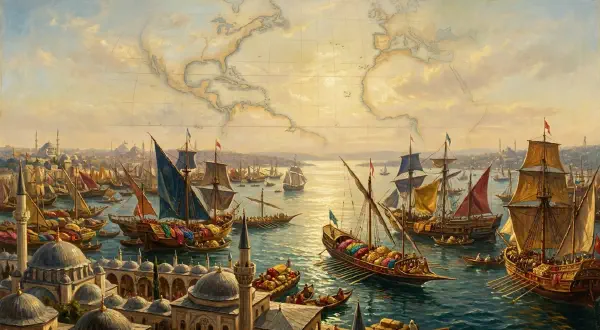
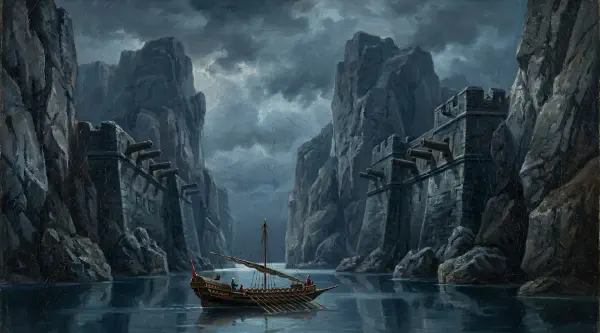
The Ottoman Empire was, without question, a Mediterranean prisoner. The Strait of Gibraltar was a hostile gate, slammed shut by the Spanish and later the British. The Ottoman galley fleet, perfectly adapted for the calm, enclosed middle sea, was a death trap in the open Atlantic. The wealth of the Americas, the silver that fueled European capitalism, and the direct oceanic routes to Asia all lay permanently beyond reach. The empire's economy, built on being the indispensable land bridge between East and West, slowly suffocated as the world's commercial center of gravity shifted to the ocean highways. This was not a defeat on a battlefield; it was a slow, structural starvation that spanned centuries.
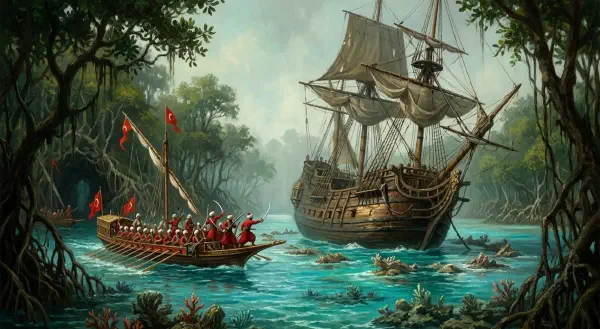
When the empire pivoted eastward in an astonishing burst of ambition, its geography betrayed it again. The Red Sea, its only doorway to the Indian Ocean, was a navigational nightmare and a logistical black hole. Building a fleet of ocean-going galleons at Suez was an industrial impossibility, as every plank and nail had to be dragged across a desert. The Ottomans were forced to fight an asymmetric galley war—brilliantly and successfully—but they could never truly become an oceanic power. The Red Sea Paradox meant that the only ocean access they had denied them the tools to master the ocean.
And even when they finally, painfully, adopted the sailing ship of the line in the Mediterranean itself, they were always a generation behind. The shift from galley to galleon was a technological lock-in that took centuries to break, and by the time they had rebuilt their fleet, the world had moved on to steam and iron. The geographic head start of the Atlantic powers had become an unassailable compound advantage.
Geography, then, was not a minor factor. It was a fundamental structural handicap that shaped the empire's strategic options, its economic fortunes, and its technological trajectory. Any explanation of the Ottoman collapse that ignores this is missing a crucial dimension of the story.
The Rot Within#
But if geography was a cage, the empire also rotted from within. The ship of state was not just trapped in the wrong sea; its own hull was riddled with decay.
The political system, once the most sophisticated in Europe, ossified. After the great wave of conquests ended at the gates of Vienna in 1683, the empire ceased to expand. This was a fiscal and military disaster, because the entire Ottoman system was built on constant territorial growth. Without new lands to distribute to soldiers and new tax revenue to fill the treasury, the state slowly slid into a cycle of corruption, factionalism, and palace intrigue. A long succession of weak and often incompetent sultans, secluded in the harem rather than leading armies in the field, accelerated the decay. The Janissary corps, the empire's elite military unit, transformed from an innovative fighting force into a conservative political lobby that violently resisted any reform that threatened its privileges.
This internal paralysis meant that the empire could not adapt effectively, even when it wanted to. The painful naval modernization we traced was a perfect example: the ships could be bought from Europe, but the maritime culture, the professional officer corps, and the flexible industrial base could not be copied. The state was structurally incapable of generating power from within in the way that England, France, or the Netherlands could.
The Industrial Chasm#
Beneath the political rot lay an even deeper economic chasm. The Atlantic powers did not just get rich from plunder and trade; they used that wealth to fuel the Industrial Revolution. Steam engines, mechanized textile mills, precision iron foundries, and railroads transformed these nations into engines of production.
The Ottoman Empire missed this revolution almost entirely. While Manchester and Birmingham smoked, Ottoman workshops remained artisanal. The empire became a vast market for cheap, mass-produced European goods, which crushed local industries and turned the region into an economic dependency. A state that cannot produce its own guns, rails, and steamships at scale cannot be truly sovereign. The Ottoman navy’s ships were purchased from foreign yards; their cannons were cast with foreign expertise. This technological and industrial dependency was a symptom of a terminal condition: the empire was being slowly colonized economically long before its final territorial dismemberment.
The Unraveling of a Multi-Ethnic Empire#
And then, in the 19th century, came the most explosive force of all: nationalism. The Ottoman Empire was a vast, multi-ethnic, multi-religious mosaic, held together by a shared loyalty to the sultan and the Islamic institutions of the state. The French Revolution unleashed the idea that political legitimacy came from the nation—a shared language, culture, and ethnicity—not from a dynastic overlord.
For the Ottoman Balkans, this was an existential earthquake. The Greeks, Serbs, Romanians, and Bulgarians, one by one, rose in national revolts, often supported by rival great powers. The empire fought to suppress them, but it was a losing battle against the spirit of the age. The loss of the Balkan provinces was not just a territorial reduction; it was an amputation of some of the empire's wealthiest and most developed regions. The nationalism that tore the empire apart was a political virus that had nothing to do with the Strait of Gibraltar or the design of a galleon.
The Relentless Pressure of Russia#
Finally, we must account for the simple, brutal force of geopolitics. For over three centuries, the Russian Empire pushed relentlessly south, seeking a warm-water port on the Mediterranean and access to the straits. War after war between the Ottomans and the Romanovs cost the empire vast territories in the Crimea, the Caucasus, and the Balkans. This was a direct, military, land-based threat that geography cannot explain away. Even an Ottoman Empire with an Atlantic coast would have faced the Russian bear on its northern frontier.
The Shipwreck Verdict#
So, what is the final verdict on the geostrategic trap?
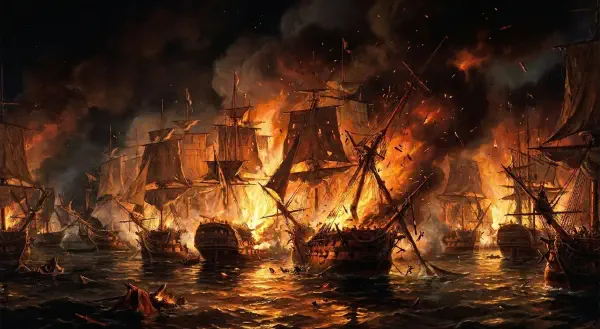
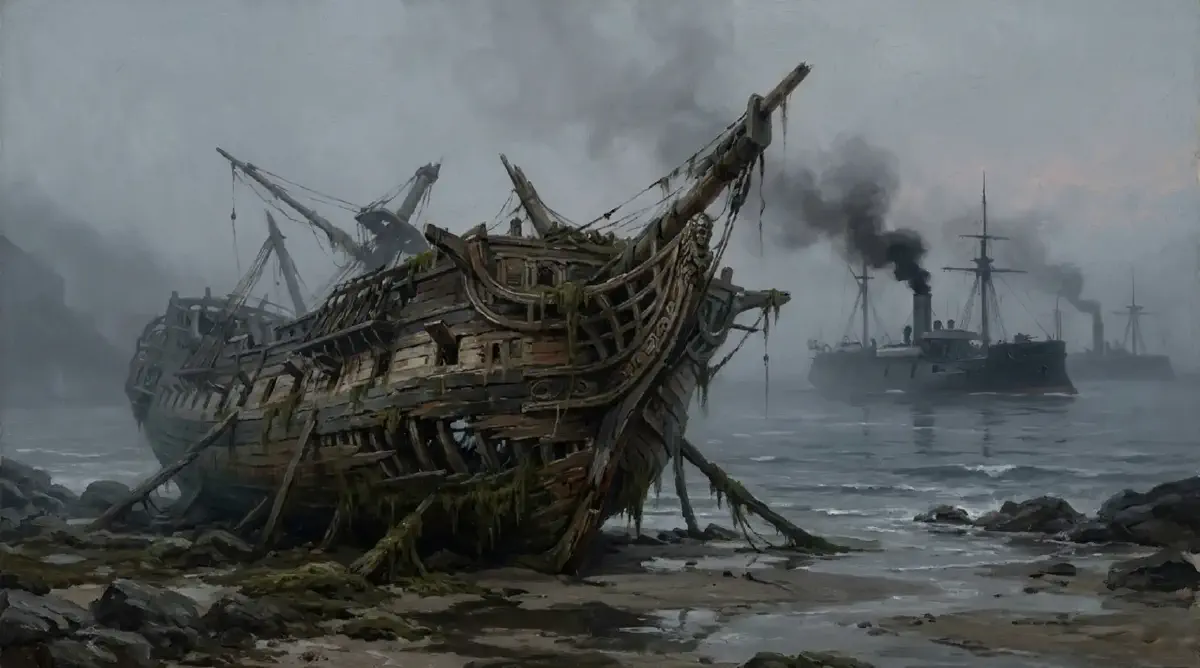
The Ottoman collapse was not a murder with a single killer; it was a shipwreck. The vessel found itself in a violent and irreversible shift in the global trade winds, a shift that its entire construction was ill-suited to survive. That is the geographic trap. But the ship also had a rotting hull, riddled with the dry rot of political corruption and institutional paralysis. Its engine was an outdated galley design, unable to compete with the steam-powered industrial warships of the West. And, in its final hours, its crew was tearing itself apart with the mutinous passions of nationalism, while a rival ship, the Russian Empire, rammed it repeatedly from the north.
The Ottoman Empire was a prisoner of its sea, yes, but that was not its only cage. It was also a prisoner of its own rigid institutions, its pre-industrial economy, and its increasingly untenable multi-ethnic structure. The closure of the Atlantic was the first and deepest wound, but it was the internal infections and external blows that turned a slow decline into a terminal collapse.
The theory we started with was a brilliant intuition, and history proves it to be profoundly, painfully true. But the whole truth is richer, sadder, and more human. Empires are not killed by maps alone. They are killed by the millions of choices they make—and fail to make—within those maps, over centuries, until the sea finally swallows them whole.
This concludes the series Prisoners of the Sea: Geography, Technology, and the Ottoman Collapse. Thank you for the journey. If you would like me to write the missing Article 3, or to compile all articles into a single document, or to propose a bibliography, I am at your disposal.