
The Decoy of Canvas and Steam#
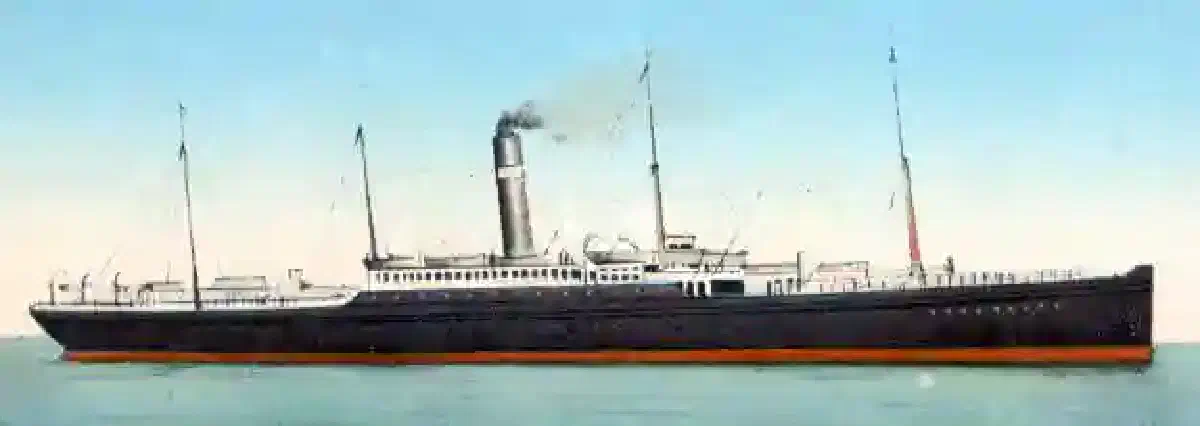
During the damp autumn of 1914, German U-boat commanders scanning the North Sea horizon encountered a terrifying sight: a massive, smoking British dreadnought patrolling the shipping lanes. The vessel possessed the unmistakable silhouette of a state-of-the-art capital ship, complete with towering smoke stacks and heavy gun turrets. Yet, beneath this imposing exterior lay a profound, theatrical secret. The deadly "guns" pointing from the hull were actually painted telegraph poles, and the entire armored superstructure was constructed from wooden planks and stretched canvas. This was the SS Merion, a converted merchant ship playing the role of a phantom battleship named HMS No-Go.
How did the world’s most formidable maritime empire find itself relying on stage carpentry to defend its sovereign waters? The paradox of Great War naval doctrine lay in the sudden vulnerability of steel. The rapid expansion of submarine warfare had rendered even the costliest battleships highly vulnerable, forcing naval commanders to innovate beyond raw firepower. The British Royal Navy realized that military victory depended not merely on physical destruction, but on controlling the enemy's visual field and cognitive processing. Deception emerged as a systemic necessity, a defensive and offensive tool born of resource constraints and strategic desperation. This essay examines how the British military transformed simple physical decoys into complex strategic force multipliers, redefining the boundaries of early 20th-century warfare.
The Architecture of Cognitive Displacement#
Military deception operates as a systematic intervention in an adversary's decision-making cycle, exploiting cognitive biases to redirect real military assets. The conversion of passenger liners into replica dreadnoughts was not an improvised stunt but a highly coordinated engineering and psychological protocol. By manipulating the sensory inputs available to German intelligence, the British Admiralty successfully engineered a massive cognitive displacement.
The Mechanics of Visual Spoofing#
The efficacy of naval decoys depended entirely on precise physical and operational replication. Engineers constructed dummy superstructures on merchant ship hulls, matching the specific silhouettes, draft heights, and speed profiles of Queen Elizabeth-class dreadnoughts. Steam lines were rerouted through dummy funnels to produce realistic coal-smoke plumes, simulating active boilers. Wooden barrels and canvas sheets were shaped into dual 15-inch gun turrets, complete with simulated recoil mechanisms. These decoys had to withstand close aerial and periscope observation, requiring exact paint matching and structural proportions. Operationally, the dummy ships maintained strict radio silence and sailed on mock patrol routes, convincing German intelligence that Britain had divided its Home Fleet.
The Convergence of Theater and Naval Doctrine#
The creation of the phantom fleet required a radical interdisciplinary synthesis of naval strategy and theatrical stagecraft. The British Admiralty recruited professional set designers, stage carpenters, and scenic artists from the London West End theater district. These specialists applied principles of forced perspective, lighting distortion, and optical camouflage to make small merchant hulls appear like 27,000-ton steel behemoths. Simultaneously, naval theorists integrated these illusions into traditional maritime doctrine. This synthesis established a new conceptual framework: the battlefield was no longer merely a physical space, but a cognitive medium where the commander’s perception of the enemy’s deployment was more critical than actual material reality.
Redirection of German Maritime Assets#
The strategic consequences of this theatrical warfare were immediate and highly measurable. German naval reconnaissance spent substantial resources tracking the phantom fleet, diverting U-boat patrols from vulnerable merchant convoys to intercept fake capital ships. In late 1914, German command held back offensive maneuvers in the North Sea, falsely believing that British dreadnought strength was significantly higher than its actual level. The decoy ships preserved valuable British capital assets, allowing real dreadnoughts to undergo maintenance or deploy to critical theaters like the Mediterranean without leaving domestic waters unguarded. This systemic redirection of enemy resources was achieved at a fraction of the cost of building a single real warship, demonstrating the immense economic efficiency of psychological operations.
The Enduring Legacy of Phantom Warfare#
The wooden dreadnoughts of World War I proved that the ultimate arena of military conflict is not the physical terrain, but the adversary's mind. By systematically manipulating German perception, the British Admiralty demonstrated that strategic dominance could be achieved through the clever projection of simulated strength. This represented a profound philosophical shift from traditional, material-heavy naval doctrine to a highly sophisticated model of cognitive warfare. The cheap, theatrical conversions of merchant vessels paved the way for the elaborate, multi-dimensional military deceptions of the mid-20th century, proving that an empire’s greatest weapon is often its capacity to control the narrative.
Ultimately, the phantom fleet of 1914 established a lineage of tactical deception that continues to define modern defense systems. From the inflatable tank decoys of World War II to the sophisticated electronic and radar spoofing of contemporary cyber warfare, the basic principles of cognitive displacement remain unchanged. These wooden battleships revealed that in the theater of war, the illusion of power is often indistinguishable from power itself. As modern conflict increasingly migrates into the domains of information and digital simulation, the lessons of HMS No-Go remind us that the most vulnerable node in any defense network remains the human brain, which is always ready to believe what it is conditioned to see.