
The Marvels of the Market Square#
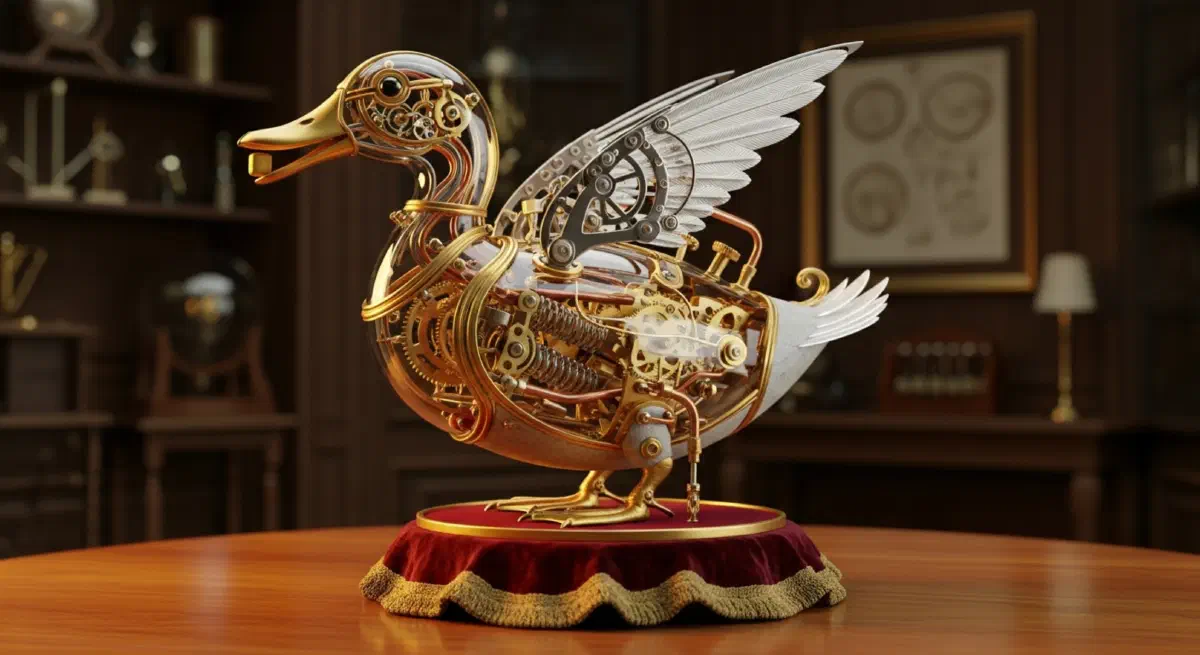
In the gilded salons of late 18th-century Europe, a wealthy and educated public gathered to witness a series of spectacles that seemed to defy the natural order. In London, a performing "Learned Pig" was presented to aristocratic onlookers, seemingly capable of spelling out complex words, solving mathematical equations, and reading minds by selecting printed cards on the floor. Across the English Channel, crowds in Paris gasped as inventor Jacques de Vaucanson demonstrated his famous mechanical duck. This life-sized copper automaton flapped its wings, drank water, swallowed grain, and, within minutes, executed a seemingly perfect digestive process, discharging a realistic waste substance from its mechanical rear.
The paradox of these exhibitions lay in their timing. The Age of Enlightenment, celebrated for its rigorous scientific rationalism and rejection of superstition, was simultaneously the golden era of elaborate biological and mechanical hoaxes. How did some of the greatest minds of the century, including the philosopher Voltaire and the moralist Samuel Johnson, fall victim to performing swine and clockwork birds? The answer lies in the deep philosophical anxieties of the era. As science dismantled old religious dogmas, European society became obsessed with a single, urgent question: what separated the human soul from mechanical matter and animal instinct? This essay examines how clever showmen exploited these intellectual vulnerabilities, transforming simple mechanical tricks and animal training into a highly lucrative industry of philosophical deception.
The Illusion of Sentience#
The success of Enlightenment automata and performing animals did not rely on advanced, revolutionary engineering or biological breakthroughs. Instead, these exhibitions functioned as sophisticated cognitive traps, designed to exploit the audience’s own intellectual biases and desire for philosophical validation. By understanding the mechanisms of these deceptions, we can uncover how easily human reason can be subverted by the appearance of intelligence.
The Secret Lever and the Hidden Cue#
The marvels of the "beast-machines" were built on simple physical mechanisms concealed behind elaborate showmanship. The Learned Pig did not comprehend English grammar or mathematics; rather, it responded to microscopic, highly practiced physical cues from its trainer. A slight shift in posture, a subtle click of a fingernail, or a change in vocal tone signaled the animal when to stop pacing and select a specific card—a psychological phenomenon now known as the "Clever Hans" effect. Similarly, Vaucanson’s Defecating Duck was a masterpiece of mechanical illusion. The swallowing of grain and the subsequent excretion were entirely disconnected processes. The grain was collected in a hidden neck tube, while the "digested" output was pre-loaded into a secret internal reservoir filled with green-dyed breadcrumbs, released by a spring-loaded valve activated by the operator.
The Collision of Mechanical Philosophy and Mass Entertainment#
These exhibitions gained immense traction by inserting themselves directly into the raging intellectual debates of the late 18th century. Enlightenment thinkers were divided between René Descartes’ "beast-machine" theory—which argued that animals were merely complex, soulless biological clocks—and the materialist views of Julien Offray de La Mettrie, who posited that humans themselves were merely advanced machines. Showmen capitalized on these controversies, marketing their spectacles as empirical evidence in these debates. This created a highly profitable commercial ecosystem where ticket sales were driven by intellectual curiosity. Audiences were not merely seeking amusement; they were paying to test their own philosophical frameworks against the physical proof presented on the stage.
Baffling the Intellectual Elite#
The ripple effects of these deceptions shook the highest levels of European academic and literary society. The Learned Pig became a major subject of satire and debate in British publications, prompting the intellectual Samuel Johnson to write on the limits of animal capability. Meanwhile, Vaucanson’s duck was celebrated by Voltaire as a triumph of French genius, famously declaring that without this mechanical marvel, there would be nothing to remind Europe of France’s intellectual glory. The duck’s apparent digestion became a key talking point in early physiology lectures, misleading researchers for decades before the mechanical trickery was finally exposed. These hoaxes delayed genuine scientific inquiry into animal cognition and mechanical design, proving that even the most rational elites could be blinded by a compelling, well-executed narrative.
The Ghost in the Modern Machine#
The historical craze for performing swine and clockwork ducks reveals a persistent, fundamental vulnerability in human psychology: our deep-seated tendency to project consciousness and intent onto non-human entities. When confronted with a machine or an animal that appears to respond to complex stimuli, our brains instinctively bypass logical skepticism in favor of anthropomorphism. The showmen of the Enlightenment did not invent this cognitive bias; they simply constructed the physical apparatuses necessary to monetize it. This historical episode serves as a powerful reminder that the illusion of sentience is incredibly easy to manufacture when the audience is already intellectually primed to seek it.
Today, this cognitive vulnerability has found a new, highly sophisticated expression in our interactions with generative artificial intelligence. Much like the spectators who marveled at Vaucanson's pre-loaded duck, modern users frequently mistake large language models and conversational interfaces for genuine, self-aware intelligences. The underlying mechanism remains the same: the machine generates highly fluent, structurally correct responses based on statistical cues, and the human observer projects a conscious, thinking mind behind the digital curtain. As we navigate the complex ethical and social implications of advanced technology, the lessons of the Enlightenment automata warn us to look past the captivating performance and examine the hidden levers and pre-programmed reservoirs that construct our modern illusions of intelligence.