
The Princess and the Native#
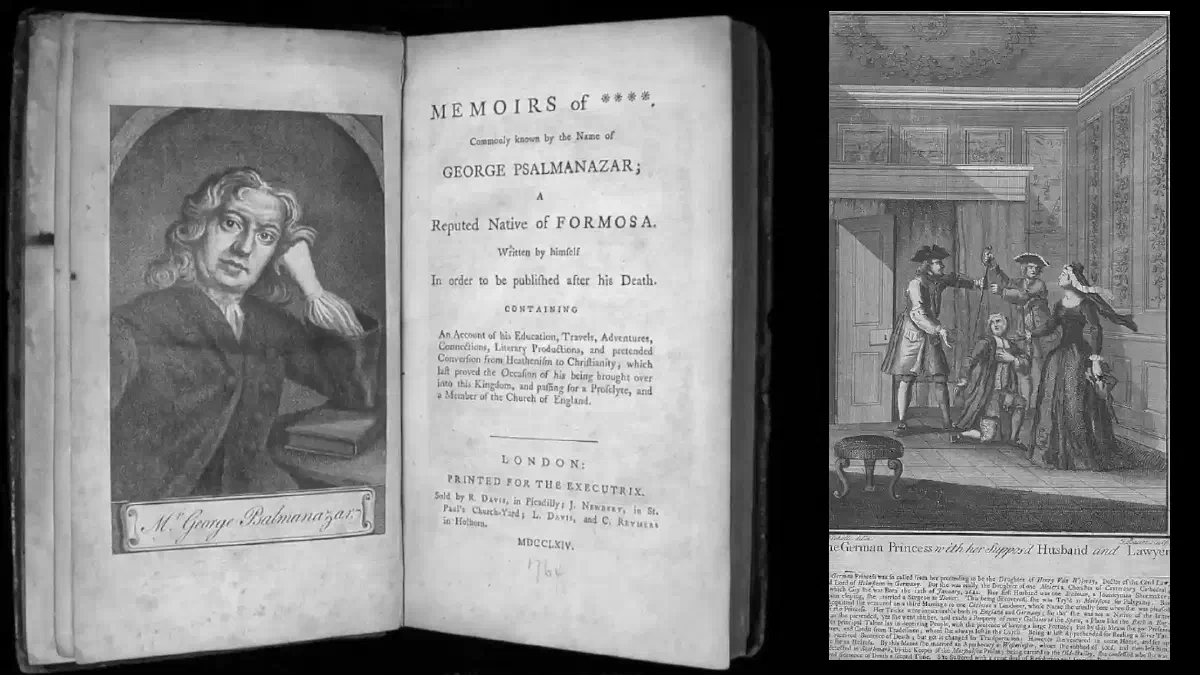
In the bustling coffeehouses and aristocratic salons of late 17th and early 18th-century London, two spectacular figures took high society by storm. The first was Mary Carleton, a young woman who arrived in London in 1663 claiming to be a wealthy German princess escaping an unwanted, high-born marriage. With her elegant manners, foreign accent, and forged letters of recommendation, she easily married an ambitious, wealthy young English aristocrat. Decades later, in 1703, a pale young man named George Psalmanazar was introduced to the Bishop of London and the Royal Society. He claimed to be a native of Formosa (modern-day Taiwan), who had been abducted by Jesuit priests and brought to Europe. Psalmanazar captivated the English intellectual elite by writing an entire book on Formosan culture, which detailed a highly complex language, a unique alphabet, and a bizarre religion that allegedly sacrificed 18,000 children annually to the gods.
The paradox of these dual impostures lay in their immediate, widespread acceptance. London’s high society, which prided itself on its rigid social hierarchies, class distinctions, and intellectual sophistication, was completely deceived by two uneducated, low-born grifters. Mary Carleton was actually a poor bricklayer’s daughter from Canterbury, and George Psalmanazar was a French runaway who had never traveled east of Germany.
How did these two individuals manage to bypass the strict social gatekeepers of early modern England? They did so by weaponizing the elite's own prejudices and expectations. This essay explores the mechanics of their identity thefts, analyzing how their successful fabrications exposed the arbitrary, highly performative nature of class and ethnicity in the early modern world.
The Social Currency of Deception#
Identity is not an immutable, biological fact; it is a collection of socially agreed-upon behaviors, accents, and aesthetic markers that must be continuously performed and validated. Mary Carleton and George Psalmanazar succeeded because they understood that early modern society policed these boundaries through highly superficial criteria. By dissecting their performative strategies, we can uncover how easily the elite's social sorting mechanisms can be manipulated.
The Mechanics of Identity Theft#
The success of these impostures depended on the meticulous construction of cultural and social scripts. Mary Carleton utilized forged aristocratic letters, dressed in imported European silks, and adopted a sophisticated, haughty demeanor that English gentlemen associated with continental nobility. She understood that the English elite were so desperate to align themselves with foreign aristocracy that they would overlook the lack of formal documentation. George Psalmanazar took this performative script to an even greater extreme. He did not merely claim to be Formosan; he invented an entire linguistic grammar, translated traditional Christian prayers into his fictional language, and practiced a series of bizarre dietary and sleep rituals—such as eating raw meat and sleeping upright in a chair—to satisfy the public's expectations of exotic behavior.
The Market for Social Climbing and Exoticism#
These deceptions were amplified by the explosive growth of early modern print capitalism and the colonial appetite for the exotic "Other." The newly established print shops of London were desperate for sensational content, turning Carleton’s subsequent trial and Psalmanazar’s Formosan book into massive bestsellers. The English public was eager to consume narratives that reinforced their own cultural and religious superiority. Psalmanazar’s fabricated Formosa, with its depiction of brutal pagan priests and cruel Jesuit kidnappers, served as perfect anti-Catholic and anti-foreign propaganda, aligning perfectly with the geopolitical and religious anxieties of the British state. The elite validated Psalmanazar because his lies flattered their own ideological worldview.
The Infiltration and the Aftermath#
The consequences of these identity thefts shattered the credibility of London’s intellectual and social establishments. Mary Carleton, after being exposed as a fraud, turned her criminal notoriety into a highly successful stage career, performing as herself in a popular play titled The German Princess. Although she was eventually executed for recurring thefts, her career proved that the lines separating the theater, the court, and the criminal underworld were incredibly porous. George Psalmanazar’s deception was even more damaging, as he was appointed to translate religious texts and lecture at Oxford University before his eventual confession. His fraud forced a massive re-evaluation of travel literature and scientific ethnography, revealing that the academic elite possessed no objective tools to distinguish genuine empirical data from high-quality, colonial-themed fiction.
The Permanent Theatre of Identity#
The historical exploits of Mary Carleton and George Psalmanazar demonstrate that social class and cultural identity are fundamentally performative constructs. By successfully mimicking the speech, manners, and exotic behaviors expected of their respective roles, these low-born impostors proved that anyone could access the highest corridors of power if they mastered the appropriate cultural codes. The elite did not reject them because their performances were flawed; rather, they embraced them because the deceptions confirmed their own pre-existing biases about social status and foreign cultures.
In our contemporary digital landscape, the legacy of early modern imposture has found a powerful resonance. The rise of social media has democratized the tools of self-fashioning, allowing anyone to construct a highly curated, online persona that simulates wealth, status, or cultural authority. From digital "influencers" who rent private jets for photo shoots to corporate impostors who secure millions in venture capital through carefully rehearsed tech-jargon, the basic mechanics of identity theft remain unchanged. Mary Carleton and George Psalmanazar remind us that in a society obsessed with superficial markers of success, the performance of identity will always be a highly lucrative currency, and the gatekeepers of high society will remain perpetually vulnerable to those who know exactly how to play the part.