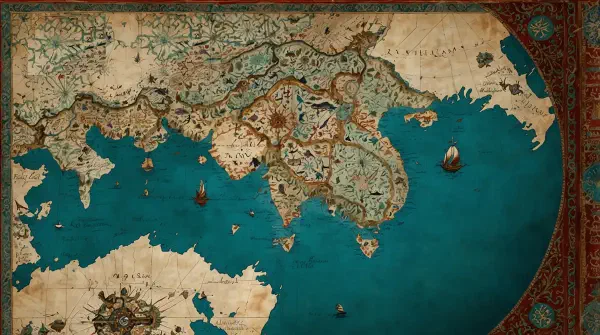
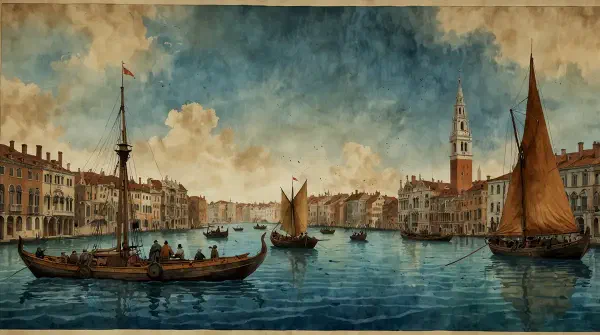
Series Overview
#Who should read this series?
- Policy analysts seeking to understand why resource windfalls so often fail to produce development.
- Historians and students of global divergence looking for a data-driven counter-narrative to Eurocentrism.
- Economists interested in the deep institutional roots of long-run growth.
- General readers who want to understand why the modern world looks the way it does—and why it could have been so different.
How to read it:
The series is designed to be read sequentially, as each article builds on the previous. However, each piece also stands alone as a self-contained argument, with its own data, counterfactuals, and editorial punch. A synopsis table at the end of Article 7 provides a quick reference.
Expected reading time: ~10 minutes per article.
The Uncomfortable Conclusion
#Europe's rise was not a triumph of human agency; it was a triumph of contingent convergence. The Europeans who crossed the Atlantic did not know they were triggering a global divergence; they were chasing gold, saving souls, and fleeing debtors' prisons. The silver they extracted did not make them rich; it made their rivals rich. The coal they mined did not come from genius; it came from geology. The literacy they developed did not come from culture; it came from the brute physics of moving grain by barge.
That is not a cynical story. It is a realistic one. It tells us that history is not a morality play; it is a series of accidents, some fortunate, some tragic. And it tells us that the present distribution of wealth and power is not a reflection of inherent worth—it is a reflection of a lottery that happened to be drawn, once, in a small corner of Eurasia.
The question for our own era is whether we can learn from that lottery. The factors that made Europe rise—credible institutions, commercial literacy, accessible energy, and political pluralism—are not secrets. They can be built, or they can be neglected. But they cannot be copied without the historical processes that generated them. Development is not a blueprint; it is a path.
And the path, as the Ottomans discovered, depends on choices made by elites, often against their own short-term interests. That is the final lesson of "The Unlikely Spark."
Series Synposis
#| Article | Title | Core Argument |
|---|
| 1 | The Gun, the Rabbit, and the Forest | The Atlantic was a trigger, not the engine; Europe's substrate was fragmentation, literacy, and debt markets. |
| 2 | The Blue Arc | Navigable waterways forced commercial literacy and financial abstraction; the Yangtze had better rivers but no fragmentation. |
| 3 | The Perpetual Auction | Sovereign fragmentation created credible public debt; Spain defaulted nine times; the Netherlands borrowed at 4%. |
| 4 | The Venomous Stream | American silver was a liquidity injection; Spain's Dutch disease financed the Netherlands' and England's capital markets. |
| 5 | The Toll Gate That Failed | The Ottomans were operationally competent but institutionally rigid; the printing ban was a fatal choice, not a geographical trap. |
| 6 | The Black Clock | The Dutch had the capital but lacked coal; Britain's accessible coalfields provided the energy to scale commercial wealth into industry. |
| 7 | The Great Lottery | Four factors—water, fragmentation, silver, coal—converged contingently; Europe's rise was a lottery jackpot, not an inevitability. |
References
#Primary Sources
#- Bernstein, W.J. (2003). Government and the birth of market capitalism. Efficient Frontier.
- Braudel, F. (1972). The Mediterranean and the Mediterranean World in the Age of Philip II. Harper & Row.
- Braudel, F. (1979). The Wheels of Commerce. Harper & Row.
- Buringh, E., & Van Zanden, J.L. (2009). Charting the "Rise of the West": Manuscripts and printed books in Europe, a long-term perspective from the sixth through eighteenth centuries. Journal of Economic History, 69(2), 409–445.
- Casale, G. (2010). The Ottoman Age of Exploration. Oxford University Press.
- De Vries, J. (1984). European Urbanization, 1500–1800. Methuen.
- De Vries, J., & Van der Woude, A. (1997). The First Modern Economy: Success, Failure, and Perseverance of the Dutch Economy, 1500–1815. Cambridge University Press.
- Dobado, R. (2014). The price of silver: Inflation and the Spanish Empire. Revista de Historia Económica.
- Febvre, L., & Martin, H.-J. (1976). The Coming of the Book: The Impact of Printing, 1450–1800. Verso.
- Flynn, D.O., & Giraldez, A. (1995). Born with a "Silver Spoon": The origin of world trade in 1571. Journal of World History, 6(2), 201–221.
- Lane, F.C. (1973). Venice: A Maritime Republic. Johns Hopkins University Press.
- Maddison, A. (2010). Contours of the World Economy, 1–2030 AD. Oxford University Press.
- Mayhew, N.J. (1995). Population, money supply, and the velocity of circulation in England, 1300–1700. Economic History Review, 48(2), 238–257.
- Mitchell, B.R. (2013). International Historical Statistics, 1750–2010. Palgrave Macmillan.
- Neal, L. (1990). The Rise of Financial Capitalism: International Capital Markets in the Age of Reason. Cambridge University Press.
- North, D.C. (1966). The Rise of the Western World: A New Economic History. Cambridge University Press.
- Özbaran, S. (1974). The Ottoman response to European expansion. Belleten, 38, 129–146.
- Pomeranz, K. (2000). The Great Divergence: China, Europe, and the Making of the Modern World Economy. Princeton University Press.
- Quataert, D. (2000). The Ottoman Empire, 1700–1922. Cambridge University Press.
- Reinhart, C.M., & Rogoff, K.S. (2009). This Time Is Different: Eight Centuries of Financial Folly. Princeton University Press.
- Tilly, C. (1990). Coercion, Capital, and European States, AD 990–1990. Blackwell.
- Tracy, J.D. (1985). A Financial Revolution in the Habsburg Netherlands: Renten and Renteniers in the County of Holland, 1515–1565. University of California Press.
- Volker, F. (1971). The Silver and Gold of the Americas. Cambridge University Press.
- Wrigley, E.A. (1987). People, Cities and Wealth: The Transformation of Traditional Society. Blackwell.
- Wrigley, E.A. (2010). Energy and the English Industrial Revolution. Cambridge University Press.
Data Repositories
#- Maddison Project Database. (2020). GDP per capita, 1–2016 AD. University of Groningen. https://www.rug.nl/ggdc/historicaldevelopment/maddison/
- Our World in Data. (2025). Literacy rate [Dataset]. https://ourworldindata.org/literacy
Supplementary Sources
#Bernstein, W. J. (2003). Government and the birth of market capitalism. Efficient Frontier. http://www.efficientfrontier.com/ef/903/sample.htm
Global silver trade from the 16th to 19th centuries. (n.d.). Wikipedia. https://en.wikipedia.org/wiki/Global_silver_trade_from_the_16th_to_19th_centuries