
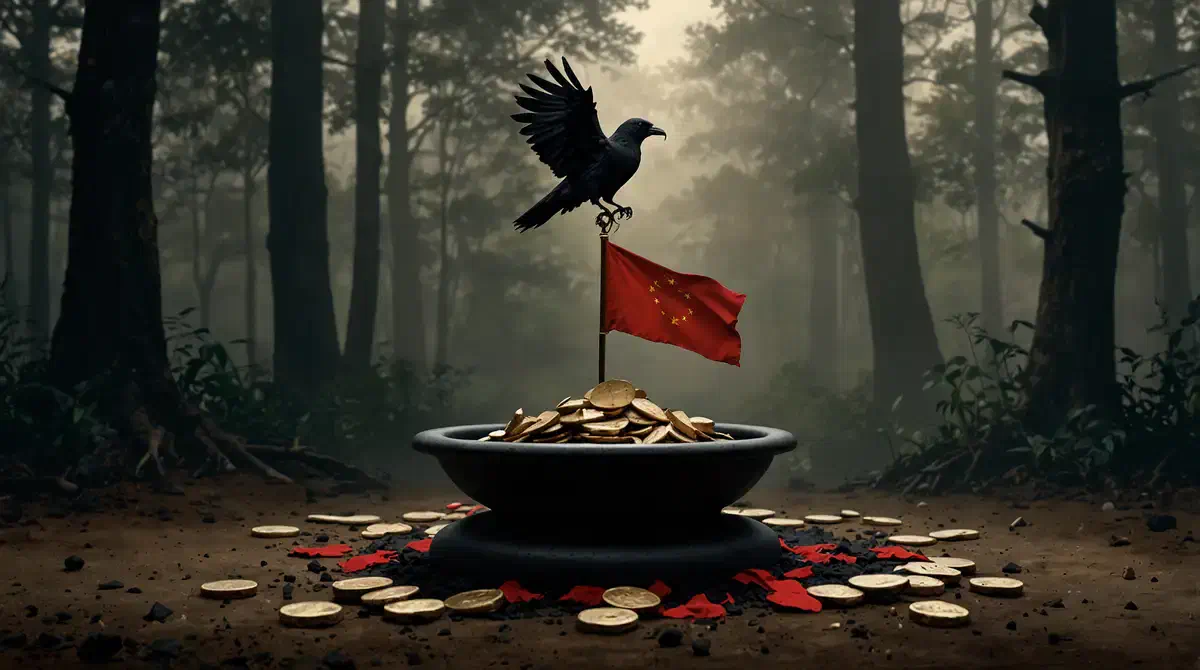
Europe's rise was not inevitable. It was a lottery ticket—and the Americas were merely the winning number.#
THE CONVENTIONAL STORY of Europe's ascent is seductive in its simplicity. It runs like this: a backward, peripheral peninsula on the edge of Eurasia stumbled upon the Americas, looted their silver and gold, and used that windfall to outcompete the Ottoman Empire, out-trade the Chinese, and eventually industrialise the world. The trigger was pulled when Portugal seized Ceuta in 1415; the Ottoman Empire, conveniently trapped east of the Mediterranean, watched helplessly as infinite American resources flowed at minimal cost into European coffers.
It is a neat narrative. It is also, in nearly every causal respect, wrong.
Not because the Atlantic did not matter. It mattered enormously. But to mistake a trigger for the mechanism—to confuse the rabbit for the hunter's skill—is to misunderstand the entire history of global economic divergence. This series, “The Unlikely Spark,” will argue that the true engine of Europe's rise was not what it extracted from the Americas, but what it had already built in its own fractious, waterlogged, and chronically indebted cities: a substrate of competitive pluralism, commercial literacy, and sovereign-debt markets that could absorb a resource shock without collapsing—and, in Spain's case, convert it into venture capital for its rivals.
This opening article dismantles the single-cause fallacy. The evidence is stark.
The Great Divergence Did Not Begin in 1492#
If American silver were the primary driver of European development, we would expect the Iberian peninsula—the direct recipient of that bullion—to lead the continent's economic take-off. The opposite occurred.
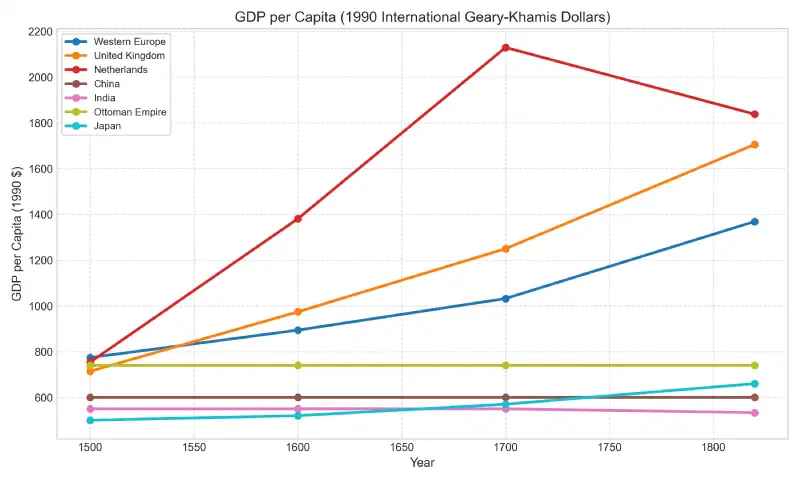
| Year | Spain (GDP per capita, 1990 $) | Netherlands | England |
|---|---|---|---|
| 1500 | 750 | 754 | 714 |
| 1600 | 853 | 1,381 | 974 |
| 1700 | 900 | 2,130 | 1,250 |
| 1820 | 1,008 | 1,838 | 1,706 |
Source: Maddison (2010)
Spain, sitting on the largest silver pile in history, was poorer per capita than the Netherlands by a factor of 2.4 in 1700. By 1820, it had barely grown since 1600. The Dutch and the English, with negligible direct access to American mines, pulled decisively ahead. This is the classic resource curse—what we would today call Dutch Disease—centuries before the term was coined. American bullion inflated the Spanish price level, made domestic manufacturing uncompetitive, and financed foreign wars that were fought with German mercenaries and Flemish textiles. The silver entered Seville and left via Antwerp within months, funding the very rivals who would later surpass her.
The Ottoman "Trap" That Wasn't#
The second pillar of the conventional story—that the Ottomans were geographically paralysed—does not survive a glance at any 16th-century naval map. The Empire controlled the entire eastern Mediterranean, the Red Sea, the Persian Gulf, and the Black Sea. It was a tri-continental maritime power that sent fleets to Aceh (Sumatra) in 1569 and fought the Portuguese in the Indian Ocean with considerable operational competence.
The Ottomans were not beaten by Atlantic bypass; they were bypassed. The Portuguese chose the Cape route precisely because the Ottoman and Mamluk choke points made overland Silk Road tariffs ruinously expensive. But bypass is not defeat. The Ottoman state remained a peer competitor to European powers until the 1683 Siege of Vienna—nearly two centuries after Columbus. Its decline came from administrative overreach, military stagnation, and, crucially, a scribal monopoly on literacy that saw the printing press in Arabic script banned until 1727.
That was not a geographical lock; it was an institutional choice. And it is the single most telling difference between the two civilisations.
The Real Substrate: Liquidity, Literacy, and Fragmentation#
What did Western Europe possess in the 1400s that the Ottomans and Ming China did not? Not superior geography—the Yangtze Delta had better rivers; the Aegean had better harbours. Not superior technology—China had the compass, the stern-post rudder, and gunpowder centuries earlier.
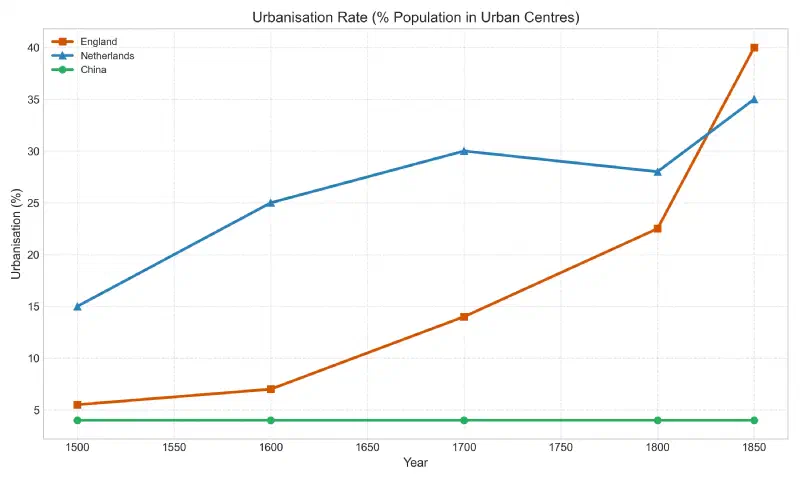
What Europe had was a forest of petty states. The continent was a patchwork of duchies, bishoprics, free imperial cities, and nascent nation-states that could not monopolise violence or taxation. To fund perpetual warfare, monarchs were forced to borrow from autonomous merchant bankers—the Fuggers, the Medici, the Wisselbank of Amsterdam. Those bankers demanded credible property rights, perpetual annuities, and transparent accounting. They received them, not because rulers were enlightened, but because a merchant could always move 50 kilometres downstream to a rival's jurisdiction. That exit option—made physically possible by the Rhine, the Meuse, and the Thames—forced rulers to bargain rather than expropriate.
By 1500, the corridor from Tuscany through the Rhine valley to Flanders had a male urban literacy rate of 25–30%—unmatched by any other empire. This was not a literary renaissance; it was a commercial one. Double-entry bookkeeping (invented in the 1340s), marine insurance contracts, and bills of exchange all required numerate, literate clerks. When Gutenberg's press arrived in the 1450s, it found a ready market of merchants, not monks. By 1500, over 30,000 distinct editions had been printed—the knowledge shock that the Ottomans deliberately declined.
The Silver as Venture Capital: A Concession#
To be clear: this series does not deny the Atlantic its catalytic role. We will devote an entire article (Article 4) to tracing the literal flow of Potosí silver to Antwerp, where it was loaned to England's Muscovy and Levant companies. Spain's Dutch disease was the Netherlands' seed capital. The silver that left Seville paid for Baltic grain, German mercenaries, and Flemish cloth—creating a pan-European payments system that financed the arms race of the 17th century.
But a catalyst is not the reaction. The reaction—the sustained growth, the institutional innovation, the eventual industrialisation—required a substrate that Europe had spent centuries building. That substrate was fragmented sovereignty, commercial literacy, and deep sovereign-debt markets. Remove any one of those, and the silver becomes what it was for Spain: an inflationary curse, not a developmental blessing.
What This Series Will Argue#
Over the next six articles, we will trace this causal chain in forensic detail:
- Article 2: How navigable rivers forced mercantile abstraction and literacy—and why the Yangtze Delta, with superior hydrology, did not produce a financial revolution.
- Article 3: How the perpetual auction of sovereignty created Europe's first credible public-debt markets, centuries before democracy.
- Article 4: How American silver, despite its human and financial cost, acted as an involuntary liquidity injection—and why Spain went bankrupt nine times between 1557 and 1666.
- Article 5: The Ottoman mirror—operationally competent, institutionally rigid, and tragically bypassed.
- Article 6: Why the Dutch, the richest per capita in 1650, did not industrialise first—and why Britain's shallow coal seams were the decisive scaling factor.
- Article 7: The synthesis—a lottery model of history, where four independent variables (water, fragmentation, silver, coal) converged in a narrow window, producing an outcome that was anything but inevitable.
The Takeaway#
The Americas were a rabbit that jumped. Europe had its gun cocked, not because of some innate European genius, but because centuries of intra-mural warfare, riverine trade, and sovereign competition had forced it to build a firearm—a financial-military-literacy complex—that no other civilisation possessed. When the rabbit appeared, the shot was fired. But the gun was forged in the counting-houses of Bruges, the foundries of Augsburg, and the salt marshes of Holland, long before a single ounce of Potosí silver reached Seville.
That is the story of Europe's rise. Not inevitability. Not geography. But a contingent, messy, and deeply improbable convergence of fragmentary advantages—one of which, as it happens, was the sheer luck of an ocean to the west.
Next Article: The Blue Arc – How waterways did not give Europe literacy, but forced it upon merchants who needed contracts to survive.
Sources for this article: Maddison (2010); Reinhart & Rogoff (2009); Buringh & Van Zanden (2009); Mayhew (1995). Full references in the series annex.