
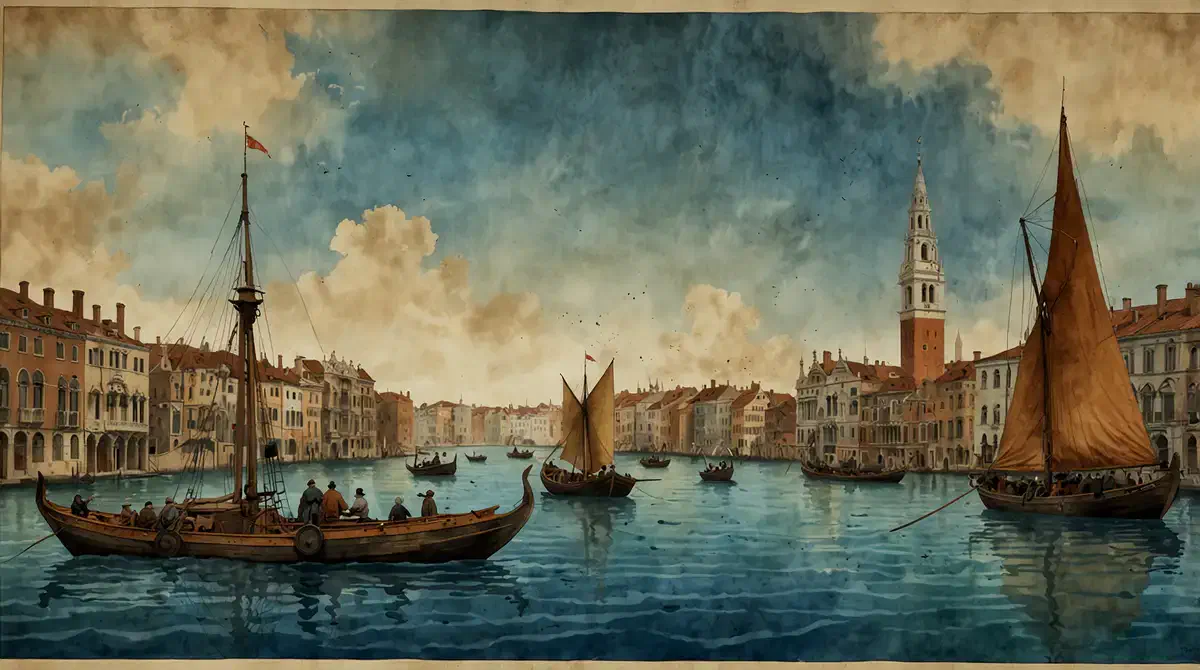
Water did not give Europe literacy. It forced merchants to invent abstraction—and that abstraction became the world’s first globalisation software.#
IMAGINE A MERCHANT in 14th-century Bruges. He has just loaded 200 barrels of Flemish wool onto a barge bound for the Rhine. The voyage will take two weeks, pass through three customs posts, and risk sinking, piracy, or spoilage. He does not know the buyer personally. He cannot accompany the cargo. He must trust a piece of parchment—a bill of lading—to represent the value of his goods, transfer that value to a factor in Cologne, and survive the journey as a legally enforceable claim.
That parchment was not a luxury. It was a survival necessity. And the geography that made that necessity acute—navigable rivers, sheltered estuaries, and shallow coastal seas—also made Europe, by 1500, the most commercially literate civilisation on earth.
The conventional story treats literacy as a cultural achievement—the Renaissance, humanism, the printing press. This article inverts that narrative. Europeans did not become literate because they were enlightened; they became literate because water transport made trade cheap, and cheap trade made contracts indispensable, and contracts made reading, writing, and arithmetic as essential as a rudder.
The Yangtze Delta had better rivers, deeper harbours, and more sophisticated shipbuilding. But it did not produce a financial revolution. Why? Because the Chinese state did not need to bargain with merchants—and without that bargaining, there was no institutional reason to turn parchment into power.
The Arithmetic of Water#
The raw physics of pre-modern transport is unforgiving. Moving one tonne of grain by ox-cart overland cost roughly 10 times more than moving the same tonne by river barge, and 20 times more than by coastal sailing vessel. A single horse-drawn wagon covered 25–30 kilometres per day; a river barge, with the same animal power towing along a towpath, could move 100 tonnes over the same distance.
This cost differential had a profound behavioural consequence. Overland trade was limited to high-value, low-bulk goods—silks, spices, precious metals—where the transport cost was a small fraction of the total price. But bulk staples—grain, timber, wine, wool, salt, herring—could only move profitably by water. And bulk trade, by its nature, required deferred settlement, credit, and risk-sharing.
Consider the arithmetic:
| Mode of Transport | Cost per Tonne-km (relative to overland) | Typical Cargo | Required Documentation |
|---|---|---|---|
| Overland (cart) | 1.0 (baseline) | High-value (silks, spices) | Minimal; cash transactions |
| River barge | ~0.10 | Bulk (grain, timber, wool) | Bills of lading, warehouse receipts |
| Coastal ship | ~0.05 | Bulk (salt, herring, wine) | Marine insurance, bottomry bonds |
| Oceanic caravel | ~0.02 | Mixed | Complex charters, joint-ventures |
Source: Calculated from historical freight rates compiled by Braudel (1979) and North (1966).
Every ton of wheat that floated down the Rhine required a contract specifying quantity, quality, delivery point, and the division of risk if the barge sank. Every barrel of herring shipped from the Baltic to Flanders required an insurer to price the probability of storm or piracy. Every roll of wool exported from England required a bill of exchange that could be discounted in Antwerp before the ship even docked.
That is the origin of European financial abstraction. Not speculation. Not greed. The brute physics of water transport forcing merchants to invent paper-based proxies for physical goods.
The Software: Double-Entry and Insurance#
By the 1340s, the merchants of Genoa, Florence, and Venice had standardised the most consequential invention in commercial history: double-entry bookkeeping. It was not an accounting nicety; it was a control system. For the first time, a merchant could track assets, liabilities, revenues, and expenses across multiple voyages, multiple currencies, and multiple partners—without ever seeing the physical goods. The ledger became a map of the commercial world, and the debits and credits became its longitude and latitude.
Simultaneously, marine insurance emerged as a formal contract. The earliest known policy dates to 1347 in Genoa, covering a voyage from Genoa to Mallorca. By 1400, insurance syndicates in Bruges and Venice were underwriting voyages to the Levant, pricing risk based on season, hull type, and the reputation of the captain. This was not a moral innovation; it was a practical one. Ships sank, and without insurance, a single loss could bankrupt a merchant family and freeze the entire credit chain.
The result was a dense, self-reinforcing loop:
Waterborne bulk trade → Need for deferred payment → Bills of exchange → Need for tracking → Double-entry ledgers → Need for risk pricing → Insurance contracts → Need for literate clerks → Urban schools → Ready market for printing presses
The Map That Proves the Rule#
If our thesis is correct, the distribution of literacy and printing in 15th-century Europe should trace the navigable river basins and coastal corridors—not the seats of power, not the universities, not the cathedrals.
Let us test it. The table below shows the regional distribution of incunabula (books printed before 1501), alongside the dominant transport geography of each region.
| Region | Share of Incunabula Editions (%) | Dominant Waterway | Urban Literacy (c. 1500, est.) |
|---|---|---|---|
| Italy | 36.4 | Po River, Adriatic coast | ~25% (merchant class) |
| German-speaking lands | 33.6 | Rhine, Danube, Elbe | ~20–25% (urban) |
| France | 17.5 | Seine, Rhône, Loire | ~15–20% |
| Benelux | 7.4 | Meuse, Scheldt, North Sea | ~30% (Flanders peak) |
| Iberia | 3.7 | Coastal (limited internal navigation) | ~10% |
| England | 1.4 | Thames, coastal (late developer) | ~10% |
Source: Febvre & Martin (1976); Buringh & Van Zanden (2009).
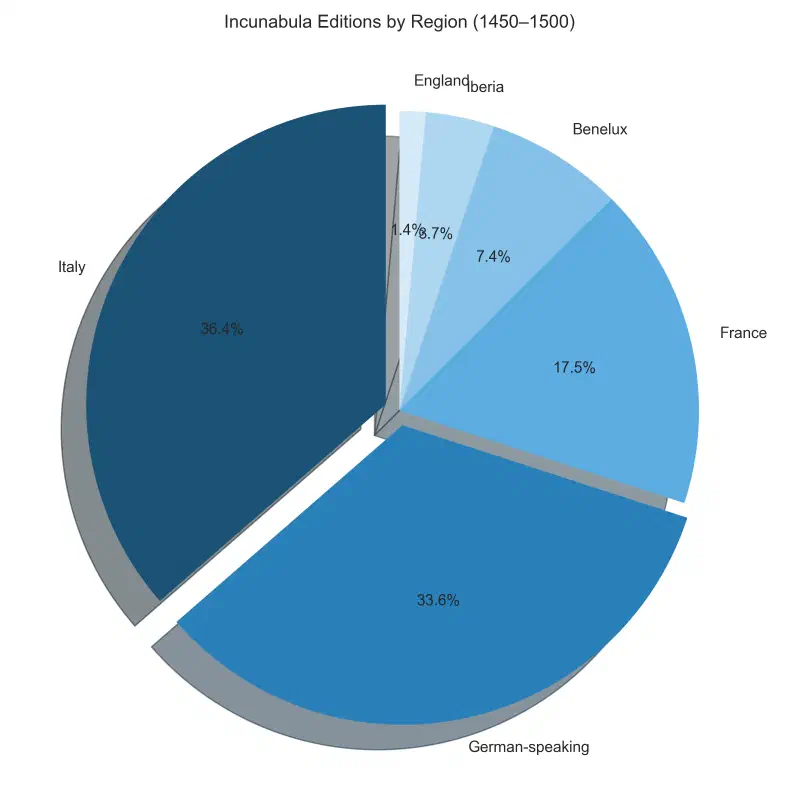
The correlation is striking. Italy and German-speaking lands—the two regions with the most extensive navigable river systems and coastal shipping—produced over 70% of Europe's printed books by 1500. England, despite being politically centralised and wealthy, lagged far behind because its internal waterways were less integrated until the 17th century.
But the decisive comparison is not within Europe; it is across civilisations.
The Yangtze Paradox#
The Yangtze River Delta in 1400 was hydrologically superior to the Rhine-Meuse basin in every measurable way. It had a more extensive network of canals, larger ships, more sophisticated grain barges, and a higher urbanisation rate. By 1500, the city of Suzhou alone had a population of ~600,000—larger than London, Paris, or Venice.
Yet the Yangtze did not produce a financial revolution. It did not produce marine insurance, perpetual bonds, or a printing press that reached the commercial classes. Why?
The answer is institutional, not geographical. The Ming state (1368–1644) was a unitary empire that monopolised the grain trade, controlled the Grand Canal, and taxed directly from the peasantry. It did not need to borrow from merchants to fund its wars; it simply conscripted labour and requisitioned grain. Merchants in Suzhou and Hangzhou were wealthy, but they were also politically fragile—the Emperor could expropriate their assets, ban their shipping, or execute their families with a single decree.
Without the threat of expropriation, there was no need for credible contracts. Without credible contracts, there was no demand for standardised ledgers. Without standardised ledgers, there was no market for a commercial printing press. The Ming had the water, but they did not have the competitive fragmentation that forced European rulers to bargain with their merchant classes.
The Ottomans, similarly, had the Aegean and the Red Sea. But the Sultan's scribal elite had a monopoly on literacy, and they banned the printing press in Arabic script until 1727—not out of ignorance, but because they understood perfectly well that a literate merchant class would demand political voice.
The Blue Arc#
Europe's literate belt—the corridor from Venice through the Rhine Valley to Flanders—was not a natural endowment. It was a forced adaptation to a geography that made trade cheap and predation abundant. Merchants who wanted to survive on those rivers had to learn to read, write, and calculate. Rulers who wanted to tax that trade had to promise not to expropriate. Printers who wanted to sell books had to serve the merchant, not the monk.
That is the "Blue Arc" we will trace in this series. It is not an arc of glory; it is an arc of insecurity. And that insecurity, paradoxically, became the most secure foundation for long-run growth that any civilisation has ever built.
What This Means for the Series#
The Atlantic trigger—the silver, the sugar, the slaves—would have been meaningless without the software of double-entry, insurance, and bills of exchange that Europe had already invented. The Dutch and English did not conquer the seas because they were braver; they conquered them because they had already conquered abstraction on the rivers of their own continent.
In our next article, we will turn to the political engine: how perpetual warfare and sovereign default forced European states to auction their crowns to private bankers—creating the bond markets that would eventually finance the Industrial Revolution.
Next Article: The Perpetual Auction – How sovereign debt made Europe creditworthy, not because its kings were honest, but because they were numerous.
Sources for this article: Braudel (1979) The Wheels of Commerce; North, D.C. (1966) The Rise of the Western World; Febvre & Martin (1976); Buringh & Van Zanden (2009); Lane, F.C. (1973) Venice: A Maritime Republic. Full references in the series annex.