

Europe's kings were not creditworthy because they were honest. They were creditworthy because they were numerous—and default meant your rival would fund your usurper.#
IN 1557, PHILIP II OF SPAIN—the most powerful monarch on earth, ruler of half of Europe and all of the Americas—did something that would become a habit. He suspended payments on his sovereign debt. His Genoese and German bankers, who had lent him fortunes to finance his wars against France and the Ottomans, were left holding worthless paper.
It was the first of nine Spanish bankruptcies between 1557 and 1666. Yet those same bankers—and their Dutch and English successors—continued to lend. Not out of naivety. Not out of patriotism. Because they understood a brutal arithmetic that the Ming Emperor and the Ottoman Sultan never had to learn: a defaulting European king could be replaced, bypassed, or outbid by a rival. And that threat—the credible possibility of losing his crown to a better-financed competitor—was the only collateral that mattered.
This article argues that Europe's sovereign-debt markets—the engine that would eventually finance global trade and industrialisation—were not born of fiscal prudence or enlightened governance. They were born of perpetual warfare and political fragmentation, which forced monarchs to auction their future revenues to private syndicates. The Ottomans and the Ming taxed land; Europeans taxed future revenue—and pledged their crowns as collateral. That difference, more than any technological or geographical factor, determined who could scale their military and commercial ambitions.
The Fiscal Trap of Empire#
Unitary empires face a structural advantage and a structural disadvantage. The advantage is scale: they can extract taxes directly from a vast peasantry without negotiating with intermediaries. The disadvantage is opaqueness: without competing sovereigns to benchmark against, there is no independent mechanism to enforce fiscal discipline. The Emperor can expropriate at will—and because he can, merchants will not lend long-term. The sovereign is trapped in a low-trust equilibrium.
Consider the Ming dynasty. By 1500, the Ming taxed approximately 10–15% of agricultural output directly through the land-tax system. That was sufficient to fund a standing army, the Grand Canal, and the imperial bureaucracy. But when the state faced a fiscal emergency—such as the Japanese pirate incursions of the 1550s or the Manchu invasions of the 1620s—it could not borrow. Instead, it debased its currency, requisitioned grain, or simply printed more paper money (which promptly hyperinflated). The Ming had no bond market, no perpetual annuities, no credible public debt. When the treasury was empty, the state collapsed.
The Ottomans faced a similar constraint. The Sultan's timar system—land grants to cavalry officers in exchange for military service—was a non-monetary fiscal mechanism. It worked for centuries, but it was rigid. When the empire needed silver to pay janissaries or finance naval expansion, the Sultan could not issue bonds. He had to debase the coinage (which triggered inflation) or confiscate private wealth (which triggered revolt). The Ottomans never developed a perpetual debt market because the Sultan never had to compete for capital—he could simply take it.
Europe was different. Not because its kings were wiser, but because they were poorer and more numerous.
The Auction Block of Sovereignty#
By 1450, Western Europe was a patchwork of over 500 distinct political units—kingdoms, duchies, bishoprics, free imperial cities, and maritime republics. No single ruler could monopolise violence. No single ruler could tax without consent—because merchants could always move their capital to a neighbouring jurisdiction with lower tariffs, better coinage, or more predictable justice.
This competition had a paradoxical effect. To finance the endless Habsburg-Valois wars, the Italian Wars, and the Eighty Years' War, monarchs had to auction their future revenues to private banking syndicates. The Fuggers of Augsburg, the Medici of Florence, the Wisselbank of Amsterdam—these were not charities. They lent at interest rates that reflected the perceived risk of default. And that risk was not based on the king's honesty; it was based on the credibility of his competitors.
Consider the mechanics. In 1521, Charles V of Spain (also Holy Roman Emperor) borrowed 300,000 florins from the Fugger banking house to finance his imperial election. The loan was secured not against Spanish land or treasure, but against the anticipated revenues from the Order of Santiago—a knighthood whose dues the Emperor could pledge because he was its Grand Master. If Charles defaulted, the Fuggers could not seize his crown. But they could fund his rival—the King of France, the Ottoman Sultan, or any rebellious Dutch province. That implicit threat—the exit option—was the only enforcement mechanism that mattered.
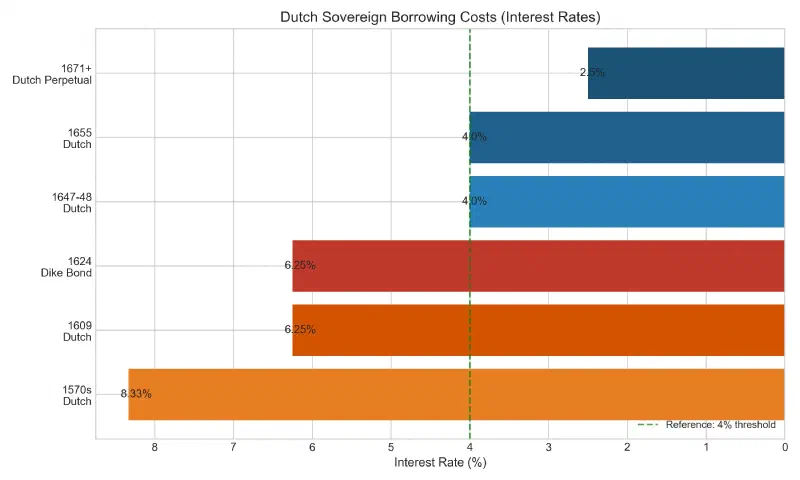
By the 1570s, Dutch merchants had perfected the instrument: the losrenten, a perpetual annuity that paid a fixed interest rate (initially 8.33%, later 6.25%, and by 1655, an astonishing 4%). These bonds were voluntary, transferable, and backed by the collective revenues of the seven United Provinces. Crucially, they were tax-free—the state did not tax the interest, because it needed to attract capital away from private loans. The result was the first permanent, deep, liquid public-debt market since the Roman Empire.
The Price of Credibility: A Data Story#
The table below tells the story in numbers. Notice the declining trajectory of Dutch borrowing costs—a direct reflection of credible institutions, not just economic growth.
| Year | Instrument | Interest Rate (%) | Event |
|---|---|---|---|
| 1570s | Dutch losrenten (perpetual annuity) | 8.33 | Decade before Dutch independence |
| 1609 | Dutch losrenten | 6.25 | After financial market maturation |
| 1624 | Dutch dike-repair bond | 6.25 | Bearer bond, tax-free, still paying in 1957 |
| 1647–48 | Dutch government bonds | 4.00 | Post-independence, peace with Spain |
| 1655 | Dutch government bonds | ~4.00 | Rate not seen since Roman Empire |
| 1671 | Dutch lijfrenten (age-graded annuities) | Variable | De Witt applies probability theory |
| 17th century | Dutch perpetual bond | 2.50 | Rate reduced over time |
Source: Bernstein (2003); Reinhart & Rogoff (2009).
Now contrast this with Spain's record. The table below is a cascade of fiscal failure—not because Spain was poor, but because its crown was too powerful to discipline.
| Year | Event |
|---|---|
| 1557 | First Spanish bankruptcy (Philip II) |
| 1575 | Second bankruptcy (suspension of payments) |
| 1596 | Third bankruptcy (Philip II) |
| 1607 | Fourth bankruptcy (Philip III) |
| 1627 | Fifth bankruptcy (Philip IV) |
| 1647 | Sixth bankruptcy (Philip IV) |
| 1652 | Seventh bankruptcy (partial default) |
| 1662 | Eighth bankruptcy (Philip IV) |
| 1666 | Ninth bankruptcy (Charles II) |
Source: Reinhart & Rogoff (2009).
Spain sat on the largest silver mountain in history. It defaulted nine times. The Dutch had no silver. They borrowed at 4%. The difference is not resource endowment; it is institutional competition. The Dutch state could not expropriate its creditors because they could simply move their capital to England or Hamburg. The Spanish king could expropriate at will—and did.
The Bond Market as a Substitute for Democracy#
This is a deeply inconvenient truth for modern development theory. The standard narrative holds that democracy, property rights, and the rule of law are prerequisites for long-term borrowing. The European experience suggests the opposite: credible public debt emerged before democracy, as a substitute for it.
The Dutch Republic was not a democracy in any modern sense. It was an oligarchy of merchant-regents who ran the state for their own commercial interests. But those interests aligned with fiscal credibility. The city of Amsterdam, which issued the most reliable bonds, was effectively a private corporation—the VOC (Dutch East India Company) was chartered as a joint-stock enterprise with limited liability, and its shareholders were the same families who sat on the city council. They did not trust the state; they were the state. And because they could not tax themselves without consent, they had to keep interest rates low to attract foreign capital.
England followed a similar path. The Glorious Revolution of 1688 is often credited with establishing credible public debt, but the crucial mechanism was not parliamentary sovereignty per se—it was the fact that the Crown was now competing with Parliament for control of the fiscal-military state. The Bank of England, chartered in 1694, was a private syndicate that lent to the Crown in exchange for a monopoly on note issuance. Its shareholders had a direct interest in ensuring the Crown did not default—and they had the political power to stop it. Credibility was not granted; it was purchased by a class of creditors who had the exit option and the veto power to enforce their contracts.
The Ottoman and Ming Contrast#
Now return to the Ottomans and the Ming. Both empires had larger populations, more sophisticated bureaucracies, and, in the Ming case, a more advanced monetary system (paper currency). But neither developed a perpetual bond market.
Why? Because neither faced the credible threat of replacement. The Ottoman Sultan could not be outbid by a rival banking syndicate; the Grand Vizier was appointed, not auctioned. The Ming Emperor could not be forced to honour a debt contract; he had no rival sovereign to whom the creditors could flee. The state was the sole buyer, seller, and enforcer of credit—and because it could always expropriate, no rational lender would lend beyond the short term.
This is not a moral judgment. It is a structural one. The Ottomans and Ming were rational actors within their own institutional frameworks. They did not need bond markets because they could tax directly. But that very direct taxation—efficient in peacetime—became a fatal rigidity in wartime. When the Ming faced the Manchu invasion, they could not borrow to hire mercenaries. When the Ottomans faced the Habsburgs, they could not issue perpetual annuities to fund a technological catch-up. The state collapsed under its own fiscal weight.
The Spillover to the Atlantic#
This brings us back to the trigger. American silver did not create European credibility; it was absorbed by it. The silver that entered Seville flowed immediately to Antwerp and Genoa to pay off the Spanish Crown's German and Italian creditors. Those creditors, in turn, reinvested in Dutch and English bond markets. The silver was not a domestic investment; it was a transfer payment to the most competitive capital markets in Europe.
That is why Spain's default record is not a counter-argument to our thesis; it is a confirmation. Spain's Dutch disease financed the Netherlands' fiscal credibility. The very mechanism that made Spain poor made Holland rich. The silver was a universal solvent—it dissolved Spanish industry and crystallised Dutch finance. But it could only do so because the Dutch had already built the vessels—the banks, the annuities, the insurance syndicates—to capture and retain that liquidity.
What This Means for the Series#
The Atlantic trigger would have been a fleeting windfall—like the Mughal treasure or the Ming silver—if Europe had not already developed the institutional plumbing to convert bullion into perpetual debt. The Ottoman and Ming empires received vast resources from trade (the Silk Road, Indian Ocean spices) and internal extraction. But without the competitive auction of sovereignty, those resources did not translate into long-term borrowing capacity. They were consumed, not capitalised.
Our next article will trace the silver itself—from Potosí to Antwerp—and show how Spain's curse became the Netherlands' endowment.
Next Article: The Venomous Stream – How Cerro Rico de Potosí, the greatest silver deposit in history, did not enrich its owner but fuelled the industrialisation of its rivals.
Sources for this article: Reinhart & Rogoff (2009) This Time Is Different; Bernstein (2003) "Government and the Birth of Market Capitalism"; Tracy, J.D. (1985) A Financial Revolution in the Habsburg Netherlands; Tilly, C. (1990) Coercion, Capital, and European States, AD 990–1990; Neal, L. (1990) The Rise of Financial Capitalism. Full references in the series annex.