
Cerro Rico de Potosí—the greatest silver deposit in history—did not enrich its owner. It became the involuntary venture capital fund of the industrialising world.#
IN 1545, AN INDIGENOUS ANDEAN NAMED DIEGO HUALLPA stumbled upon a mountain of silver at 4,800 metres above sea level in what is now Bolivia. The Spanish, who named it Cerro Rico ("Rich Mountain"), would extract over 150,000 metric tons of silver from its veins over the next 250 years—more than the combined output of all the world's known silver mines in the preceding two millennia.
That silver financed the Spanish Habsburgs' global wars, paid for German mercenaries to march through Flanders, and lubricated the first truly global trade network—linking the Andes to Antwerp, Manila to Mexico, and Potosí to Peking. It was, by any measure, the largest liquidity injection in human history.
Yet Spain, the direct recipient, ended the 17th century as a bankrupt, deindustrialised backwater. The Netherlands, which extracted no silver directly, became the world's financial capital. England, which barely touched the American mines, built the navy that would rule the waves.
How could such a torrent of wealth produce such divergent outcomes? The answer lies not in the quantity of silver, but in the mechanism of its flow. Spanish silver was not a national treasure; it was a transcontinental payment system—and the countries that built the infrastructure to intercept that system, rather than merely consume it, were the ones that industrialised.
This article traces the venomous stream: from the toxic mercury mines of Huancavelica to the counting-houses of Antwerp, and from the galleons of Acapulco to the bond markets of Amsterdam. It will show that American silver was the trigger—but it was a trigger that could only fire because Europe had already built the institutional gunpowder to convert bullion into capital.
The Mountain That Ate Spain#
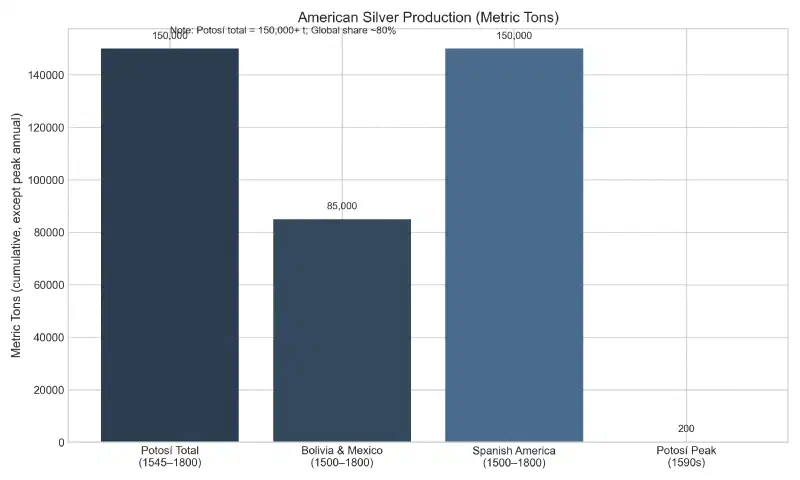
Let us begin with the scale. The table below, drawn from the most authoritative modern estimates, is astonishing even by contemporary standards.
| Period / Location | Silver Produced (metric tons) | Share of Global Production | Notes |
|---|---|---|---|
| Potosí (1545–1800) | 150,000+ | 60% of global at peak | Shipped from Potosí by end of 18th century |
| Bolivia & Mexico (1500–1800) | ~80% of world's silver | 80% | With 30% eventually ending up in China |
| Potosí peak (1590s) | ~200 tonnes/year | — | Annual production at peak |
| Potosí (1550–1572) | ~50 tonnes/year (avg) | — | Early smelting period |
| Potosí (1580–1630) | 81% of Peruvian silver | Up to 60% global | Peak production period |
Source: Mayhew (1995); Global Silver Trade data.
By 1600, Potosí alone was producing more silver annually than the entire rest of the world combined. The scale was so vast that the real value of the metal in Europe fell by more than 50% over the 16th century—the Price Revolution that devastated fixed-income rentiers and benefited commercial creditors.
But the extraction cost was anything but minimal. To refine the silver, the Spanish used the patio process, which required mercury—and vast quantities of it. The mercury came from Huancavelica in Peru, a toxic mountain that poisoned thousands of indigenous workers in its own right. The mita forced-labour system alone is estimated to have consumed 8 million indigenous and African lives over the three centuries of Spanish colonial rule. The financial cost was also staggering: armed galleons, heavily fortified ports, and a permanent naval presence in the Caribbean consumed a large fraction of the bullion before it ever reached Seville.
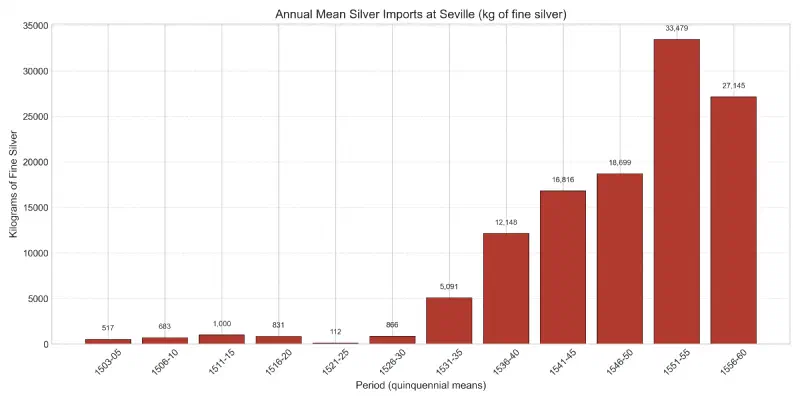
The table below shows the annual flow of silver into Seville—the official, registered imports. The unofficial contraband (to avoid the quinto, the Crown's 20% levy) may have been of similar magnitude.
| Period | Annual Mean Silver Imports (kg) |
|---|---|
| 1503–05 | 517 |
| 1506–10 | 683 |
| 1511–15 | 1,000 |
| 1516–20 | 831 |
| 1521–25 | 112 |
| 1526–30 | 866 |
| 1531–35 | 5,091 |
| 1536–40 | 12,148 |
| 1541–45 | 16,816 |
| 1546–50 | 18,699 |
| 1551–55 | 33,479 |
| 1556–60 | 27,145 |
Source: Mayhew (1995).
By the 1550s, Seville was receiving over 30 tonnes of fine silver per year—and most of it was leaving within weeks.
The Dutch Disease of the 16th Century#
The economic mechanism that explains Spain's ruin is textbook—except that it predates the textbook by 300 years. Dutch Disease occurs when a resource windfall appreciates the real exchange rate, making non-resource tradable sectors (manufacturing, agriculture) uncompetitive, while inflating domestic wages and prices.
Spain's silver inflow did exactly that. Between 1500 and 1600, the Spanish price level rose by roughly 400%—far faster than in England, the Netherlands, or France. Spanish wool, iron, and textile manufacturers could not compete with lower-cost producers from Flanders, England, or Italy. By 1600, Spain was importing most of its manufactured goods—paying for them, of course, with silver. Domestic industry atrophied. The entrepreneurial class migrated to the Church, the bureaucracy, or the military. The Habsburg court, awash in bullion, treated silver as disposable income rather than investable capital.
The table below shows the consequence. Spanish GDP per capita barely grew between 1500 and 1820, while its northern rivals surged ahead.
| Year | Spain (1990 $) | Netherlands | England |
|---|---|---|---|
| 1500 | 750 | 754 | 714 |
| 1600 | 853 | 1,381 | 974 |
| 1700 | 900 | 2,130 | 1,250 |
| 1820 | 1,008 | 1,838 | 1,706 |
Source: Maddison (2010).
Spain in 1820—after three centuries of American silver—was barely richer than it had been in 1500. The Netherlands, with no direct silver, was 2.4 times richer. England was 2.4 times richer.
The correlation is unambiguous: receiving the resource correlated with stagnation; being a conduit for the resource correlated with development.
The Flow: Seville → Antwerp → Amsterdam → London#
Where did the silver go? Not into Spanish textile mills or iron foundries, because there were none. It went, overwhelmingly, to pay for imports and service sovereign debt.
The Spanish Crown, as we saw in Article 3, was perpetually borrowing from Genoese, German, and Flemish bankers to finance its European wars. The silver that arrived in Seville was already pledged—often years in advance—to the Fuggers, the Wisselbank, and the Antwerp bourse. It was transferred directly to the great financial fairs of Besançon and Piacenza, where the Crown's creditors converted it into bills of exchange, and from there to the merchant houses of the Low Countries.
The Dutch and English merchants who dominated the Baltic grain trade, the Portuguese spice routes, and the French salt markets were paid in those same bills. They used the silver to buy Baltic timber, Polish wheat, and French wine—the physical inputs for their own shipbuilding, population growth, and urban expansion. The silver was never invested in Spanish infrastructure. It was circulated as a medium of exchange through the most commercially sophisticated network in Europe—which happened to be located in the Netherlands and England.
Consider the chain:
- Potosí → mule trains → Pacific coast → Panama → mule trains → Atlantic coast → galleons → Seville.
- Seville → remitted to Genoese and German bankers → bills of exchange → Antwerp and Amsterdam.
- Antwerp/Amsterdam → used to purchase Baltic grain, Flemish cloth, English wool, and Asian spices.
- Amsterdam → reinvested in Dutch losrenten (perpetual bonds) and VOC (East India Company) equity.
The Spanish Crown was a conduit, not a beneficiary. It extracted the royal quinto (20%), but most of that went directly to the Genoese syndicates as interest payments. The silver was a working capital injection into the European payments system—and the financial intermediaries that processed that payment were the ones that accumulated the stock of capital.
The Chinese Silver Sink#
One final twist completes the picture. A staggering 30–50% of all American silver ultimately ended up in China. Why? Because the Ming dynasty (and later the Qing) demanded that taxes be paid in silver, creating a permanent, structural demand for the metal. Chinese merchants exported silks, porcelains, and tea to Manila, where they were traded for Spanish silver galleons sailing from Acapulco. This was the first genuinely global trade circuit:
Andes → Potosí → Acapulco → Manila galleons → Philippines → Chinese junks → Fujian → Ming tax collectors.
The silver that did not enter Europe at all was still monetising the global economy—and stabilising the price of silver for European merchants. Without China's insatiable demand, the Price Revolution would have been even more inflationary, and the purchasing power of silver in Europe would have collapsed. The Chinese sink created a stable floor price, making American silver a surprisingly reliable reserve currency for the Atlantic trade. That reliability, in turn, made it easier for Dutch and English merchants to use silver as collateral for their own bond issues and equity shares.
The Atlantic trigger was not a one-way flow from colony to metropolis. It was a triangular global system—Andean silver to Chinese porcelains to European consumers—and the European merchants who dominated the shipping and insurance of that triangle were the ones who accumulated the institutional capital.
The Human Cost: A Necessary Footnote#
No account of American silver is complete without acknowledging that the extraction cost was written in bodies. The mita system at Potosí conscripted indigenous labourers from a vast radius, subjecting them to altitude sickness, mercury poisoning, and forced labour that killed a significant fraction of each annual cohort. The African slave trade, which supplied labour to the Mexican and Peruvian mines, added another layer of depredation.
The silver that financed Dutch bond yields and English shipbuilding was not a free resource; it was a mortal subsidy, extracted from populations that had no share in the resulting industrialisation. This is not an argument against the importance of the trigger; it is an argument that the trigger's human cost was astonishingly high, and that the beneficiaries were not the extractors (Spain) but the downstream financial intermediaries (the Dutch and English). The moral of the story is not that silver made Europe rich; it is that financial infrastructure allowed some European nations to capture the rents of extraction without bearing the costs of extraction. That is a privilege of position, not of production.
The Mechanism: Why Silver Was Venture Capital#
Let us now synthesise. American silver was the trigger—but it was only a trigger because it met the institutional substrate described in Articles 2 and 3:
- Literate commercial cities (Flanders, Holland, Rhine) could process the bills of exchange and insurance contracts that moved the silver from Seville to Antwerp.
- Sovereign-debt markets (Dutch losrenten, English perpetual bonds) could absorb the liquidity and convert it into long-term capital for trade companies and naval construction.
- Political fragmentation meant that capital could flow to the most credible borrower—which was not Spain (who defaulted) but the Netherlands (who honoured its debts).
The silver was, in effect, an involuntary venture-capital fund. Spain's rulers, desperate for war finance, sold their future silver yields at deep discounts to private syndicates. Those syndicates, in turn, reinvested in the most promising commercial ventures—which happened to be located in the Protestant north. Spain subsidised its own rivals.
No other civilisation had this plumbing. The Ottomans received silver from the Irani and Persian trade, but they lacked the bill-of-exchange networks to securitise it. The Ming received silver from Manila, but they lacked the bond markets to leverage it. Only Europe had both the liquidity demand (perpetual warfare) and the intermediation capacity (commercial cities with deep financial markets) to turn bullion into compound growth.
What This Means for the Series#
The silver was the bullet, but the gun was already loaded. The Atlantic trigger is not a myth—it is the single largest external shock in pre-modern economic history. But its developmental impact was not determined by who owned the silver; it was determined by who had the financial infrastructure to capture and redeploy the silver's liquidity. Spain owned the silver and went bankrupt. The Netherlands processed the silver and became the world's financial capital. England captured the spillover and built the Royal Navy.
Our next article will turn to the empire that was bypassed—the Ottomans—and ask why their strategic position, maritime competence, and fiscal resources could not match the European response.
Next Article: The Toll Gate That Failed – How the Ottoman Empire, despite controlling the Red Sea and Persian Gulf, was bypassed by a handful of Portuguese caravels—and why that bypass was a choice, not a fate.
Sources for this article: Mayhew (1995); Maddison (2010); Dobado, R. (2014) "The Price of Silver: Inflation and the Spanish Empire"; Flynn, D.O. & Giraldez, A. (1995) "Born with a 'Silver Spoon'"; Barrett, W. (1990) "World Bullion Flows, 1450–1800"; Volker, F. (1971) The Silver and Gold of the Americas. Full references in the series annex.