
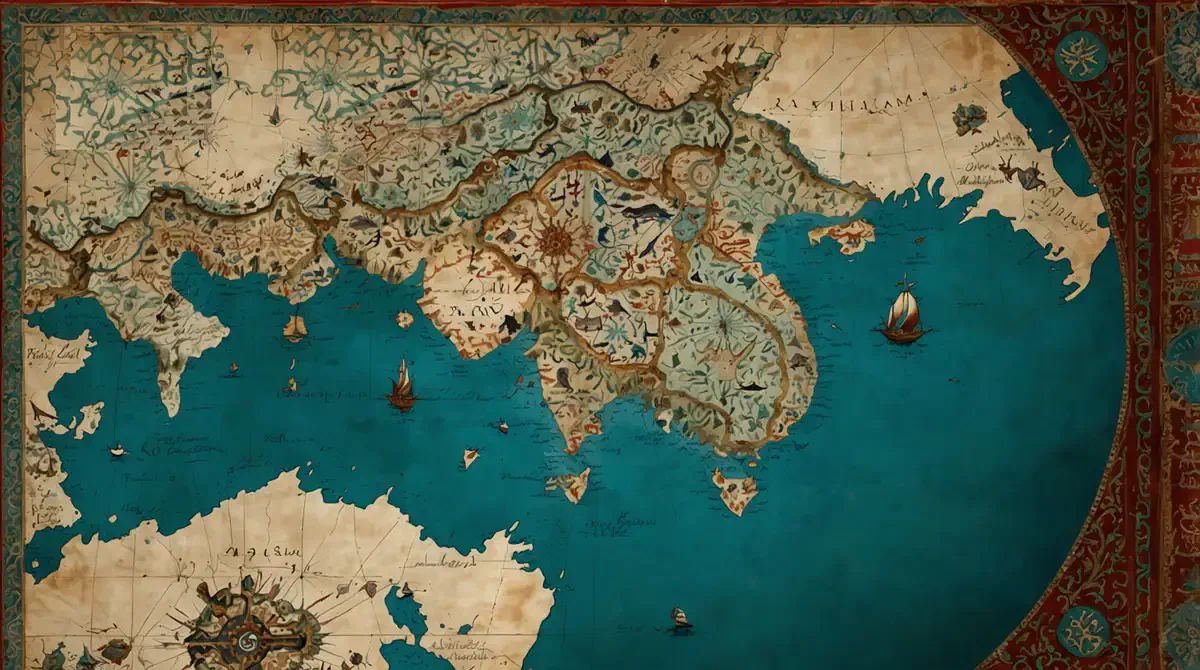
The Ottoman Empire was not trapped by geography. It was trapped by a scribal monopoly on knowledge—and it chose to keep the gate bolted.#
IN 1509, OFF THE COAST OF GUJARAT, a Portuguese fleet under Francisco de Almeida intercepted an Ottoman-backed Mamluk armada near the port of Diu. The engagement was fierce, the casualties heavy, but the Portuguese emerged victorious. It was the first act in a long drama that would see a handful of European caravels outmanoeuvre the greatest naval power of the medieval Mediterranean—not on the Mediterranean, but in the Indian Ocean, four thousand miles from home.
The conventional narrative interprets this as evidence of Ottoman geographical paralysis: the Sultan, supposedly landlocked to the east, could not project power beyond the Red Sea. The Portuguese, by contrast, had the Atlantic wind and the open ocean. The Ottomans were bypassed; Europe surged ahead.
This narrative is demonstrably false. The Ottoman Empire controlled the entire eastern Mediterranean, the Black Sea, the Red Sea, and the Persian Gulf. It had naval arsenals in Suez, Basra, and Gallipoli. It had seasoned admirals—Piri Reis, Kemal Reis, Selman Reis—who had mapped the Indian Ocean and drafted naval strategies to counter the Portuguese as early as the 1490s. Between 1538 and 1589, the Ottomans sent at least five major naval expeditions to the Indian Ocean, reaching as far as Aceh in Sumatra. They were not trapped; they were operationally competent.
Why, then, did they lose the race for the East? The answer is not geography. It is institutional rigidity—and specifically, the Sultan's decision to ban the printing press in Arabic script until 1727. That prohibition was not a Luddite oversight; it was a rational choice by a scribal elite who understood perfectly well that a literate merchant class would demand political voice. The Ottomans were not bypassed by the Cape route. They were bypassed by their own refusal to democratise knowledge—and that refusal, more than any strait or galleon, determined their fate.
The Myth of the Landlocked Sultan#
Let us begin with the geography. The Ottoman Empire in 1500 was a tri-continental maritime power, stretching from the Danube to the Nile, from the Adriatic to the Arabian Sea. Its naval reach was formidable:
| Waterway | Ottoman Control (c. 1500) | Operational Significance |
|---|---|---|
| Eastern Mediterranean | Total | Base for naval campaigns against Venice, Genoa, and Rhodes |
| Red Sea | Total (after 1517) | Access to Indian Ocean via Suez and Jeddah |
| Persian Gulf | Total (after 1538) | Access to Indian Ocean via Basra |
| Black Sea | Total | Grain route, timber for shipbuilding, slave trade |
| Indian Ocean | Contested (Portuguese) | Naval expeditions to Gujarat, Yemen, Aceh |
Sources: Braudel (1972); Casale (2010).
The Ottomans were not merely coastal; they were the dominant naval power in the Mediterranean for most of the 16th century. At the Battle of Preveza in 1538, they defeated a combined Christian fleet under Andrea Doria. At the Siege of Malta in 1565, they came within inches of capturing the island. At Lepanto in 1571, they suffered a catastrophic defeat—but rebuilt their fleet within a year, and seized Cyprus the same year. This was not a maritime backwater.
When Vasco da Gama rounded the Cape of Good Hope in 1498, the Ottomans responded with strategic vigour. They fortified Jeddah, Yemen, and Basra. They sent Admiral Selman Reis to Egypt with a fleet of 18 galleys to block Portuguese incursions. They allied with the Gujarati sultanate, the Zamorin of Calicut, and the Sultan of Aceh—creating a de facto anti-Portuguese coalition from the Red Sea to the South China Sea.
The Portuguese did not out-sail the Ottomans. They out-scaled them—because the Portuguese caravel was cheaper to build, required fewer men, and could be refitted faster. But that is a logistics story, not a geography story. And logistics, as we shall see, is downstream of institutions.
The Scribe's Monopoly: Why the Printing Press Was Banned#
This brings us to the decisive divergence. In 1450, Gutenberg printed his first Bible in Mainz. By 1500, over 30,000 distinct editions had been printed across Europe, and printing presses operated in at least 110 towns. The knowledge shock was immediate and irreversible.
The Ottoman response was the opposite. In 1485, Sultan Bayezid II issued a decree banning the printing press in Arabic script—a prohibition that would remain in effect, with brief exceptions for non-Muslim minorities, until 1727. Hebrew and Armenian presses were tolerated, but Arabic—the language of the Qur'an, the law, and the bureaucracy—was off-limits.
Why? The standard explanation is religious conservatism: the ulema (Islamic scholars) feared that printing would corrupt the sacred text. This is a partial truth, but a misleading one. The ulema were not the primary opponents; the scribal elite—the katib class of imperial secretaries, calligraphers, and accountants—were. They had a vested monopoly on clerical literacy. They were the gatekeepers of the state's administrative apparatus. To allow printing in Arabic was to flood the market with literate clerks who were not trained in the imperial chancery, not loyal to the Sultan, and not part of the patronage network that kept the scribes in power.
Consider the institutional arithmetic. The Ottoman state was a household monarchy—the Sultan ruled through a personal household, a slave elite (the devşirme), and a vast scribal bureaucracy. Literacy was a source of status, employment, and political influence. The scribal class had no competition: there was no private merchant printing press, no autonomous commercial publishing industry, no rival legal jurisdiction where a literate merchant could flee. The state controlled knowledge production, and it chose to restrict it.
Contrast this with Europe. No single sovereign controlled printing. If a German printer was suppressed by a bishop, he moved to Cologne or Strasbourg or Basel. If a Venetian printer was censored, he moved to Rome or Lyon. The fragmentation of political authority meant that knowledge could flow—and that competition among printers, cities, and rulers produced a steady decline in the cost of books and a steady rise in functional literacy.
The table below shows the gap that opened in the 16th century:
| Region | Adult Male Literacy (c. 1500) | Printing Press Status | Literacy (c. 1700) |
|---|---|---|---|
| Flanders urban | ~25–30% | Active, unregulated | ~45% |
| Italy urban | ~20–25% | Active, unregulated | ~35% |
| England | ~10% | Active, state-licensed | ~45% |
| Ottoman Empire (urban) | ~5% (scribal elite) | Banned in Arabic | ~5–6% (unchanged) |
Source: Buringh & Van Zanden (2009); Quataert (2000).
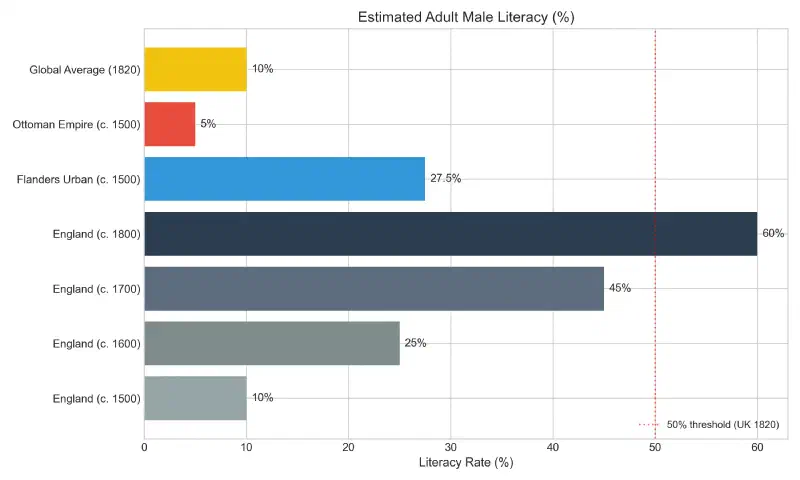
The Ottomans' literacy rate in 1700 was virtually unchanged from 1500. The European average more than quadrupled. That gap in human capital—in the ability to read contracts, calculate interest, and process legal documents—was the invisible barrier that the Portuguese and Dutch could sail around, but the Ottomans could not break through.
The Fiscal Trap, Ottoman Edition#
The printing ban was a symptom of a deeper institutional malady: the absence of credible public debt. As we argued in Article 3, European monarchs were forced to auction their future revenues to private syndicates because they could not tax directly. The Ottomans, by contrast, had a direct taxation system—the timar and the iltizam (tax farming)—that generated reliable cash flows without borrowing. But that very reliability became a trap.
The Ottoman state did not need to borrow from merchants, so it never developed a permanent debt market. It did not need to court bankers, so it never granted them constitutional protections. It did not need to publish its accounts, so it never developed a public financial press. The scribal monopoly on literacy was not just a cultural preference; it was a fiscal necessity. If merchants could read and write contracts as well as the scribes, they could challenge the state's tax assessments, demand legal redress, and eventually demand political representation. The Sultan chose to keep them illiterate—and in doing so, he kept his fiscal system rigid.
The result was a vicious cycle:
No printing → Low commercial literacy → No independent contract enforcement → No merchant demand for public debt → No sovereign bond market → No financial intermediary to fund technological catch-up → Reliance on direct taxation → Fiscal rigidity in wartime.
When the Portuguese navy arrived in the Indian Ocean, the Ottomans could not issue perpetual bonds to finance a fleet of caravels. They had to rely on the timar cavalry, the janissary corps, and the traditional galley fleet—all of which were institutionally anchored to the Mediterranean. The Sultan's admirals pleaded for a new fleet, but the treasury could not shift resources fast enough. The Portuguese, funded by Antwerp bondholders and Genoese syndicates, could build a new caravel in three months. The Ottomans, reliant on tax revenues that arrived seasonally, took three years.
The Naval Competence That Was Not Enough#
Let us be precise: the Ottomans were not incompetent. Their Indian Ocean expeditions are remarkable feats of logistics.
| Expedition | Year | Fleet Size | Outcome |
|---|---|---|---|
| Selman Reis to Egypt | 1499 | 18 galleys | Fortified Jeddah; delayed Portuguese |
| Ottoman–Gujarati alliance | 1538 | 70 vessels | Besieged Diu; failed due to monsoon |
| Piri Reis to Persian Gulf | 1552 | 30 galleys | Captured Muscat; lost Hormuz |
| Seydi Ali Reis to Gujarat | 1554 | 15 galleys | Defeated by Portuguese; shipwrecked |
| Aceh expedition | 1569 | 22 galleys | Supported Sumatran sultanate |
Source: Casale (2010); Özbaran (1974).
These expeditions demonstrate that the Ottomans understood the strategic stakes. They knew that the Cape route was bypassing their Red Sea and Persian Gulf toll gates. They knew that Portuguese spices were flooding into Antwerp, undercutting Venetian spice prices. They knew, in short, that they were being outflanked.
But they could not respond institutionally. They could build galleys, but they could not build credit markets. They could recruit admirals, but they could not recruit private investors. The naval expeditions were state-funded, state-directed, and state-limited. When a campaign failed, the Sultan lost the investment entirely—there was no bondholder to absorb the risk, and no equity market to diversify the loss. The Portuguese, by contrast, were sailing with mixed capital—Crown funds, private syndicates, and the Fuggers' silver—so when a ship sank, the loss was distributed. That is the power of financial intermediation.
The Counterfactual: What If the Ottomans Had Printed?#
The counterfactual is tantalising. Suppose Sultan Bayezid II had embraced the printing press in 1485. Suppose he had granted merchant guilds the right to publish commercial handbooks, legal digests, and nautical charts. Suppose he had allowed a commercial printing industry to emerge alongside the imperial chancery.
What would have changed?
- Literacy rates would have risen among the urban merchant class, especially in Cairo, Aleppo, and Izmir.
- Commercial contracts would have become more standardised, reducing transaction costs.
- A public financial press might have emerged, creating transparency around tax farming and grain prices.
- Merchant families might have demanded a seat at the fiscal table—perhaps through a proto-parliament, perhaps through debt issuance.
- The Ottoman navy might have been partially privatised, with private shipyards bidding for naval contracts and private underwriters insuring the fleet.
None of this is guaranteed. But it is plausible—and it is the path that Europe took. The Ottomans chose the opposite path, not because they were stupid, but because they were rational within their own incentive structure. The scribal elite had captured the state; the printing press was an existential threat to their monopoly. The Sultan, dependent on those scribes to run his administration, chose to protect them. It was a classic case of institutional lock-in—a regime that had been optimal for centuries became a structural obstacle when the external environment changed.
That is the tragedy of the Ottoman bypass. It was not a story of naval inferiority or geographical misfortune. It was a story of successful adaptation to a Mediterranean world that no longer existed—and a failure to adapt to the Atlantic world that was taking its place.
What This Means for the Series#
The Ottoman mirror is the most telling counterfactual in our entire series. It proves, by negative example, that the Atlantic trigger required commercial literacy, sovereign-debt markets, and institutional fragmentation. The Ottomans had geography (waterways, harbours, resources). They had military competence. They had state capacity. They lacked only the pluralistic competition that forced European rulers to bargain with their merchant classes. And that lack was fatal.
Our next article will move from the bypassed empire to the geological endowment that ultimately scaled Europe's commercial revolution into an industrial one: the shallow coal seams of Britain, and the paradox of why the richest nation in Europe (the Netherlands) did not industrialise first.
Next Article: The Black Clock – Why the Dutch, richest per capita in 1650, did not industrialise—and why Britain's accessible coalfields were the decisive scaling factor.
Sources for this article: Braudel, F. (1972) The Mediterranean and the Mediterranean World in the Age of Philip II; Casale, G. (2010) The Ottoman Age of Exploration; Quataert, D. (2000) The Ottoman Empire, 1700–1922; Özbaran, S. (1974) The Ottoman Response to European Expansion; Buringh, E. & Van Zanden, J.L. (2009) "Charting the 'Rise of the West'"; Atıf, M. (2011) The Printing Press in the Ottoman Empire. Full references in the series annex.