
The Dutch were the richest nation in Europe in 1650. They did not industrialise. Britain did—because coal sat just beneath the surface, and the surface was a legal and geological lottery.#
IN 1650, THE DUTCH REPUBLIC was the wealthiest society on earth. Its per capita GDP of $2,130 (in 1990 dollars) was double that of England, triple that of France, and nearly four times that of Spain. Amsterdam was the financial capital of the world, the Wisselbank was the first modern central bank, and the VOC was the most valuable corporation in history. Dutch shipping tonnage exceeded that of England, France, Spain, and Portugal combined.
By 1850, the Netherlands had been overtaken by Britain—not just in aggregate size (which was predictable, given population), but in per capita industrial output. The Dutch had the capital, the shipping, the financial infrastructure, and the global trade networks. They lacked only one thing: accessible, shallow coal.
Britain had it in abundance. And that geological endowment—a 100-mile-wide belt of Carboniferous coal seams running from Newcastle to Bristol, lying close to the surface and draining into navigable rivers—was the decisive scaling factor that transformed European commercial wealth into the first industrial revolution.
This article argues that silver financed the commercial revolution; coal financed the industrial one. Without coal, the Atlantic trigger would have produced a Dutch-style "Golden Age" of trade and finance—but not a sustained, self-reinforcing cycle of technological change and productivity growth. Without coal, Europe's divergence from Asia would have plateaued. The coal was the scaling factor that turned a lottery ticket into a perpetual annuity.
The Dutch Paradox: Why Riches Did Not Industrialise#
The Dutch Golden Age is a testament to the power of the Atlantic trigger. The Dutch had no silver mines, no slave plantations, no tropical colonies of their own (until later). But they had the financial infrastructure to intercept the silver flow from Seville, as we saw in Article 4. They used that liquidity to build a commercial empire that stretched from the Baltic to the Spice Islands.
Yet by 1700, the Dutch economy had hit a plateau. Real wages stagnated. Industrial output (textiles, shipbuilding, brewing) remained largely unchanged in productivity terms. The Dutch did not build steam engines; they did not mechanise spinning or weaving; they did not pioneer the factory system. Why?
The answer is energy. The Dutch had almost no coal. The Netherlands is a flat, alluvial delta with no significant coal deposits. The peat that fuelled its cities was cheap and abundant—but peat is low-energy, bulky, and flammable. It cannot be used for metallurgy, cannot fuel a blast furnace, and cannot generate the concentrated heat required for steam-powered machinery. The Dutch relied on wind, water, and imported Baltic timber for their shipbuilding and industry. Those were renewable, but they were also low-density. To scale industrial output, you need a concentrated energy source.
The British had exactly that. The coal seams of England and Wales lay close to the surface, accessible by shallow mining, and adjacent to rivers and canals that could transport the coal to urban centres. The table below shows the scale of the endowment—and its growth trajectory.
| Year | British Coal Output (Million Tonnes) | Cumulative Growth (1500–1850) |
|---|---|---|
| 1560s | ~0.2 | Baseline |
| 1700 | ~2.5–3.0 | 15x increase |
| 1750 | ~4.7–5.0 | 25x increase |
| 1800 | ~10.0 | 50x increase |
| 1850 | ~50.0–64.7 | 300x increase |
Sources: Wrigley (1987); Coal Industry data.
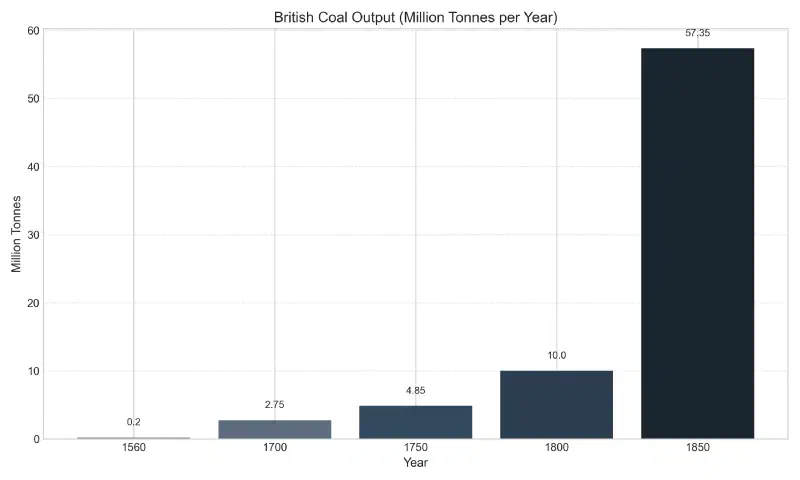
By 1850, Britain was extracting more than 50 million tonnes of coal per year—a 300-fold increase from 1560. That coal powered the steam engines that pumped water from mines, the blast furnaces that smelted iron, the locomotives that moved goods, and the factories that mechanised spinning and weaving. It was the physical substrate of the Industrial Revolution.
The Dutch, by contrast, imported coal from Britain—but at a transport cost that made it economically viable only for domestic heating and breweries, not for industrial-scale smelting or power. The Netherlands remained a commercial and financial economy, not an industrial one. Its prosperity was real, but it was rentier prosperity—based on shipping, insurance, and bond markets—not the productivity-led growth that coal enabled in Britain.
The Cost of Energy: Why Wood Was Not Enough#
To appreciate the coal advantage, consider the alternative. Before coal, Europe's primary industrial fuel was wood—specifically, charcoal. Charcoal was made by slow-burning timber in covered pits, a process that wasted 80% of the wood's mass and required vast tracts of forest. In 1600, a single blast furnace consumed the annual growth of 2,000–4,000 acres of woodland. By 1700, England had virtually deforested its interior; iron smelting was shifting to Wales and Scotland, where timber was still available.
The limitation was not just supply; it was scale. To produce one tonne of pig iron, you needed roughly 20 tonnes of wood. To produce the same tonne with coke (made from coal), you needed only 1.5 tonnes of coal. That is an order-of-magnitude difference in transport cost, labour input, and land use. Without coal, Britain could not have expanded its iron output from 25,000 tonnes in 1700 to over 2 million tonnes in 1850—an 80-fold increase that underpinned railway construction, machine tooling, and structural engineering.
The Dutch, with their forests exhausted and their coal deposits absent, could not make that leap. They imported Swedish iron, but they could not scale domestic metallurgy. They had no steam engine industry, no railway network, no machine-tool sector. Their financial capital, all that silver and bond wealth, was deployed in trade (the VOC, the Baltic grain fleet) and finance (the Wisselbank, the insurance syndicates)—not in capital goods production. The Dutch were the world's greatest merchants, but they were not the world's greatest manufacturers. And the reason was, in the end, geological.
The Coal-Iron-Steam Complex: A Self-Reinforcing Cycle#
Coal did not act alone. It was the first link in a chain that became self-reinforcing:
- Coal → pumped out of mines using waterwheels (initially) and Newcomen steam engines (after 1712).
- Steam engines → required iron cylinders; iron production scaled up using coke (coal-based fuel) instead of charcoal.
- Iron → used to build more steam engines, railways, and structural beams.
- Railways → lowered the cost of transporting coal from mines to factories, creating a virtuous cycle.
- Cheaper coal → powered more steam engines → more iron → more railways → cheaper coal.
This is the Industrial Revolution's core feedback loop. None of it happens without a cheap, abundant, accessible energy source. The British had it. The Dutch did not.
The table below shows the comparative energy endowments of the major European economies in 1700.
| Region | Coal Reserves (Billion Tonnes) | Accessibility | Proximity to Waterways | Industrial Outcome |
|---|---|---|---|---|
| Britain | ~200 (estimated) | Shallow, easy | Adjacent to canals/rivers | Industrialisation |
| Netherlands | Negligible | None | N/A | Commercial/financial plateau |
| Northern France | Moderate | Deeper, harder | Good | Delayed industrialisation |
| Germany (Ruhr) | Large | Moderate depth | Good | 19th-century industrialisation |
| Spain | Negligible | None | N/A | Deindustrialisation |
| Italy | Negligible | None | N/A | Commercial stagnation |
Source: Wrigley (1987); Mitchell (2013).
Britain's coal endowment was not unique—the Ruhr in Germany had comparable reserves. But Britain's was chronologically and geographically privileged: it was accessible in the 17th century, before deep mining technology was available, and it was located near the Thames and the canal network, which lowered transport costs. The German coal was deeper, requiring advanced pumping technology that did not exist until the British had already industrialised. Britain had a first-mover advantage that became self-reinforcing.
Why the Dutch Did Not Build Steam Engines#
The conventional explanation for the Dutch industrial plateau is cultural—the Dutch, having achieved a comfortable rentier economy, lacked the "spirit" of industrial capitalism. This is a lazy argument. Dutch merchants were as commercially aggressive as any in Europe; they pioneered joint-stock corporations, perpetual bonds, and marine insurance. They were not risk-averse.
The real explanation is energy density. A steam engine requires a concentrated heat source—coal, specifically—because wood and peat cannot generate the sustained, high-temperature heat required to boil water at pressure. The Dutch had peat, but peat produces a low-temperature, smoky flame. It is suitable for heating homes and boiling beer; it is not suitable for powering a Newcomen engine. The Dutch could import coal from Britain, but the transport cost (sea freight from Newcastle to Amsterdam) made it too expensive for industrial-scale use. By 1750, coal in Amsterdam cost three times as much as in London. It was cheaper to import Swedish iron than to smelt Dutch iron with British coal.
The consequence is stark: the Netherlands in 1800 had fewer than 10 steam engines. Britain had over 2,500. The Dutch did not industrialise because they could not afford the energy input.
The American Silver–Coal Connection#
Now we complete the causal chain that connects Potosí to Manchester. American silver, as we argued in Article 4, financed the Dutch financial system. That financial system, in turn, funded the British government during the wars with France (the Nine Years' War, the War of Spanish Succession). British victory in those wars secured its overseas trade routes, which generated the profits that were reinvested in domestic industry.
But domestic industry could only scale because of coal. The British did not need American silver to build steam engines; they needed coal. The silver financed the global trade that created the demand for industrial goods (cotton textiles, iron tools, steam pumps). The coal supplied the physical means to meet that demand. Remove either, and the Industrial Revolution stalls.
This is the key insight of our series: the Atlantic trigger created the demand; coal supplied the energy; fragmentation supplied the credit; literacy supplied the software. No single factor was sufficient; all four were necessary. And the Dutch, by possessing three but lacking the fourth (coal), could not complete the transition.
What This Means for the Series#
The coal factor is the final piece of our puzzle. It explains why the "trigger" (silver) did not immediately produce industrialisation—it took 150 years for the commercial wealth of the Atlantic to be transformed into the physical capital of the Industrial Revolution. And it explains why Britain, rather than the Netherlands, was the first industrial nation, despite the Dutch having a head start in finance and trade.
In our final article (Article 7), we will synthesise all four factors—waterways/literacy, fragmentation/credit, silver/liquidity, and coal/energy—into a single lottery model of history. We will argue that Europe's rise was a contingent convergence of four independent variables, none of which was inevitable, and all of which required the others to produce the outcome.
Next Article: The Great Lottery – How four factors—water, fragmentation, silver, and coal—converged in a narrow window of history, producing a divergence that was anything but predetermined.
Sources for this article: Wrigley, E.A. (1987) People, Cities and Wealth; Wrigley, E.A. (2010) Energy and the English Industrial Revolution; Mitchell, B.R. (2013) International Historical Statistics; De Vries, J. & Van der Woude, A. (1997) The First Modern Economy: Success, Failure, and Perseverance of the Dutch Economy, 1500–1815; Pomeranz, K. (2000) The Great Divergence. Full references in the series annex.