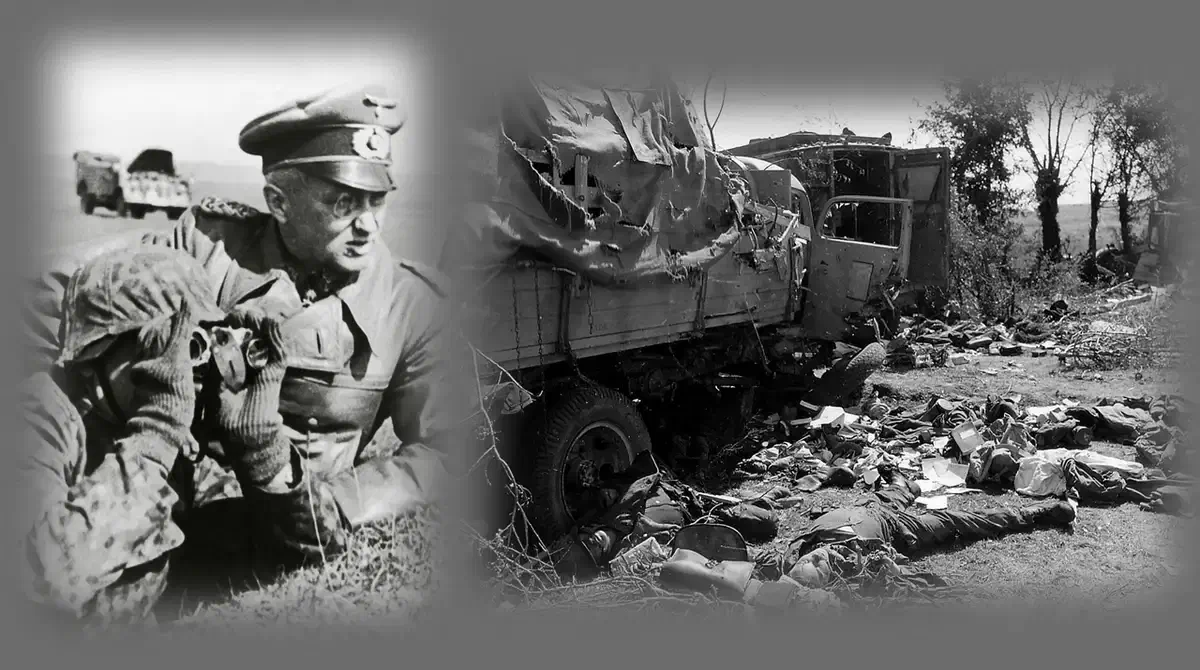
A systems analysis of a defensive commander, 1942–1945
Social Position and Institutional Entry#
Walter Model was born in 1891 in Genthin to a music teacher. He held no aristocratic prefix, placing him structurally outside the Prussian officer caste that dominated Wehrmacht senior command. This had operational consequences. Officers of Manstein's and Rundstedt's generation operated within a General Staff culture that maintained institutional distance from National Socialist leadership. Model had no attachment to that culture and no interest in preserving it. His alignment with the Nazi leadership structure reflected an institutional interest: the new order offered advancement pathways the traditional hierarchy did not.
By 1938, he was a committed National Socialist. His alignment with Hitler was reinforced by shared hostility toward General Staff conservatism. This made him an outsider among the old guard but positioned him precisely where the regime needed commanders: willing to take operational risk, resistant to institutional inertia, and trusted enough to be deployed in a crisis. From late 1941 onward, crises were the primary condition of the Eastern Front.
Command Architecture: Leadership as a Functional System#
Model's leadership operated through three consistent mechanisms.
Presence signalling. Model commanded from forward positions — a tank cupola, a trench line, a village under direct fire. His staff regarded this as unnecessary personal risk. The operational effect, however, was measurable: units that observed their commander under fire exhibited greater tactical persistence and lower rates of unauthorized withdrawal. The mechanism is straightforward. When command authority is visibly co-located with terminal risk, the cost-benefit calculation for hesitation changes at every level below. Model understood this and institutionalized it as operating procedure, not personal eccentricity.
Decentralized execution. Model organized his formations around Kampfgruppen — ad-hoc battle groups assembled from available assets regardless of formal unit boundaries: a handful of tanks, a company of panzergrenadiers, anti-tank guns, engineers. Each group received a commander and a single intent directive: find the enemy's shoulder and break it. Higher authorization was not required to execute. The system compressed the decision cycle and bypassed the coordination friction of rigid order-of-battle structures. This approach was studied intensively by NATO during the Cold War and formalized as "mission command" doctrine.
High-velocity personnel management. Model replaced hesitant or slow-moving officers rapidly, sometimes in front of their troops. This imposed a consistent standard with an unambiguous signal: delay in a counter-attack cost more than the officer performing it. The approach generated friction with his staff. Its effect on tactical tempo was directionally positive.
Together, these mechanisms produced a command system that was aggressive in initiative, decentralized in execution, and intolerant of stasis — consistent properties across all of Model's major engagements.
Tactical Doctrine: The Active Defense#
Model's operational philosophy rested on a single premise: defense is not a static posture but a dynamic process. German doctrine had been designed around offensive encirclement. When forced into defensive positions, most Wehrmacht commanders defaulted to two responses — rigid adherence to a fixed line, or collapse into retreat. Model operated a third: controlled absorption followed by deliberate counter-attack at the point of enemy overextension.
Three techniques defined his method.
Reverse slope positioning. Standard German practice placed machine-gun positions on the forward face of terrain features, where they were visible to Soviet artillery. Model repositioned forward outposts on the military crest — the rearward slope — so that Soviet preparatory fires struck empty ground. Infantry advancing over the crest encountered defensive fire at close range against an unsuppressed position. Armored reserves waited in the reverse valley, postured to counter-attack after the attacking infantry had been disrupted and disorganized. The technique was not original — Wellington used it at Waterloo — but Model imposed it as standard operating procedure across his sector and applied it systematically.
Shield and sword force allocation. Model divided available strength into two asymmetric components. The forward shield — approximately one-third of his force — held a thin contact line. Its function was not to stop the enemy but to identify the main attack axis and impose delay. The remaining two-thirds operated as a mobile reserve. Once the shield confirmed where the Soviet main effort was being concentrated, the reserve struck the flanks of the breakthrough rather than its spearhead. A penetrating force is most vulnerable where its supply columns and artillery are extended along narrow axes. Attacking there collapsed an assault more efficiently than frontal resistance at the point of contact.
Kampfgruppe organization. Model consistently broke formal order-of-battle boundaries to assemble functionally capable units from available resources. Junior commanders were given operational authority to execute without upward coordination. The requirement was that all subordinates internalize Model's intent — which he stated consistently and without ambiguity. This eliminated the approval latency that killed tactical opportunity in slower command structures.
The Authority Interface#
Model operated within a command structure that imposed "no retreat" as a standing directive. His behavioral response was consistent and systematic: verbal compliance followed by operational deviation framed in language acceptable to Hitler.
When withdrawal was operationally necessary, Model authorized it as a "local adjustment to prepare a better line for the counter-attack." In several instances, he constructed notional counter-attacks to justify pulling back thirty to fifty kilometers. Hitler accepted this framing because it preserved his preferred narrative while producing results. Model understood that Hitler evaluated commanders primarily on outcomes; the loyal framing was the transaction cost of operational latitude.
This pattern repeated across multiple engagements — Rzhev in 1942, Orel in 1943, Kursk in the same year. It represents a stable adaptation mechanism: extracting operational freedom within a system that formally prohibited it by translating actual intent into the language the principal required. The comparison case is instructive. Paulus at Stalingrad chose formal compliance over operational deviation. His army was destroyed. Model's armies survived.
The method had a structural ceiling. Model never challenged Hitler's strategic framework. He never argued that the war's outcome was determined or that strategic revision was required. He operated within the tactical layer and optimized outcomes within constraints he did not attempt to change. This bounded his contribution: he could preserve armies; he could not alter the campaign's trajectory.
Performance Record#
Rzhev, 1942–43#
The Rzhev–Vyazma salient — a 70-kilometer bulge west of Moscow — held no decisive strategic value. Hitler ordered it held; Stalin ordered it destroyed. Model's 9th Army defended it for fourteen months against nine Soviet offensive operations.
The largest, Operation Mars (November–December 1942), was commanded by Zhukov and launched in parallel with the Stalingrad encirclement. Model absorbed the attack using reverse-slope positions, Kampfgruppen counter-attacks on the flanks of each penetration, and deliberate sacrifice of space to preserve formation integrity.
| Operation | Soviet Casualties | German Casualties | Exchange Ratio |
|---|---|---|---|
| Mars (Nov–Dec 1942) | ~500,000 | ~150,000 | 3.3 : 1 |
| Full Rzhev (14 months) | ~1,000,000 | ~330,000 | ~3 : 1 |
Model held the salient. In March 1943, on his own initiative, he withdrew in good order to shorten the line — formally in violation of standing orders.
The tactical performance was measurably strong. The strategic assessment is less favorable. Every asset committed to Rzhev was unavailable elsewhere. The Sixth Army was being destroyed at Stalingrad on a separate sector during the same period. Rzhev represented optimal tactical output within a strategically irrational commitment. Model executed the mission he was given with high efficiency; the value of the mission itself was not his decision to make.
Kursk, July 1943#
Model commanded the northern pincer of Operation Citadel. Before the offensive launched, his intelligence assessments correctly estimated that Soviet defenses extended ten kilometers in depth, with prepared anti-tank belts and large armored reserves. He recommended postponement. The attack proceeded on schedule.
After six days, his panzer formations had advanced approximately twelve kilometers and lost an estimated half their armored strength. Hitler cancelled the operation on July 13. Soviet Operation Kutuzov struck Model's northern flank immediately afterward.
Model executed a controlled phased withdrawal to positions fifty kilometers west. Rearguards of anti-tank guns imposed cost on pursuing Soviet armor. A single panzer division was held in reserve to counter any breakthrough during the withdrawal. The Soviet pursuit was sustained but expensive — estimated Soviet losses during this phase exceeded 400,000. Army Group Centre survived as a functional combat organization.
Kursk was an operational defeat. Model converted it into a managed strategic withdrawal rather than a disintegration — which was the probable alternative outcome under a less adaptive commander.
Ruhr Pocket, March–April 1945#
On April 1, 1945, the US First and Ninth Armies completed the encirclement of Army Group B in the Ruhr industrial region. Model commanded approximately 300,000 men in a pocket roughly 100 kilometers across — no operational depth, no flanks available for counter-attack, no relief axis.
Model's doctrine was geometrically dependent on space. The Ruhr offered none. Mobile reserves had no fuel. Counter-attack corridors did not exist. The active defense could not function without the depth property on which its mechanics were based.
His forces imposed significant cost in urban and industrial terrain — American armored losses reached several hundred vehicles — but the outcome was determined by arithmetic. By April 15, ammunition was effectively exhausted and food had run out.
On that date, Model dissolved Army Group B. He released his youngest soldiers from military obligation and instructed older personnel to surrender or disperse. He then moved with a small staff to a wooded area near Duisburg and died by suicide on April 21, 1945. His remains were recovered in 1955 and reinterred at the German military cemetery at Vossenack.
System Limits#
Model's doctrine solved a specific, well-defined problem: defending a front line with depleted resources against a numerically superior attacker across a theater with adequate operational depth. It was not designed to solve — and could not solve — the underlying strategic resource asymmetry.
By 1943, German fuel and armor production could not sustain the mobile reserves that the active defense required. Each successful counter-attack reduced the assets available for the next one. Soviet industrial output was expanding; German output was under sustained strategic air attack. The exchange ratios Model achieved — consistently around 3:1 across his major engagements — were operationally impressive and strategically insufficient. Germany could not replace its losses at a rate comparable to the Soviet Union regardless of the ratio at which those losses occurred.
The doctrine was a tactical efficiency mechanism applied to a structural resource problem. It could delay the outcome; it could not reverse it. This is the correct interpretation of Model's performance: not a failure of execution, but a demonstration of the limits of tactical competence when strategic conditions are unfavorable by a sufficient margin.
Terminal Decision: Dissolution of Army Group B#
The April 15 decision to dissolve Army Group B requires analysis as a command decision.
Model's prior pattern had consistently prioritized combat continuation under conditions other commanders considered untenable. The April 15 decision reversed that pattern. Several explanations are consistent with available evidence.
First, the Ruhr offered no tactical exit. At Rzhev, withdrawal was geometrically possible; Model took it. At Kursk, disengagement was available; Model executed it. In the Ruhr, neither option existed. Continued resistance would have produced high-density attrition with no prospect of operational recovery.
Second, the dissolution decision minimized further casualties. By releasing personnel from obligation rather than ordering continued resistance, Model reduced deaths in a situation where the outcome was already determined. This is consistent with his prior practice of withdrawing armies to preserve them rather than expending them on untenable positions.
His personal decision to die by suicide rather than surrender is consistent with his documented behavioral profile throughout his career: extreme action-orientation, an identity built entirely on forward movement, and structural incompatibility with the passive role of a prisoner. His stated rationale — that a field marshal does not enter captivity — accurately describes his operating system. His legal exposure was substantial. He had signed the orders that defined the chain of command for his sector and understood the evidentiary record.
Structural Assessment#
Model's command approach was a high-performance adaptation to a constrained defensive environment. Within the conditions of the Eastern Front between 1942 and 1944 — adequate operational depth, degraded but functional German armored reserves, and an opponent capable of sustaining high casualties without strategic disruption — his methods produced measurably superior exchange ratios and repeatedly preserved formations that would otherwise have been destroyed.
Two structural dependencies limited the approach. First, it required operational depth; when that depth was removed at the Ruhr, performance collapsed. Second, it required a minimum level of mobile reserve capability; as German fuel and armor declined through 1944, this minimum became increasingly unattainable.
His management of the principal-agent relationship with Hitler was itself a functional output. He extracted operational latitude from a command environment that had destroyed other commanders by providing Hitler with the narrative framing he required while executing what the operational situation actually demanded. The formula worked consistently until the final encirclement, at which point there was nothing left to extract latitude for.
The net assessment is straightforward. Model was a first-order tactical defensive commander whose effectiveness was constrained by, and ultimately consumed by, structural conditions outside his domain of control. His methods delayed a determined outcome. They could not change it.
Sources: Newton, S. H. (2005). Hitler's commander: Field Marshal Walter Model — Hitler's favorite general. Da Capo Press. Zetterling, N., & Frankson, A. (2012). The drive on Moscow, 1941. Casemate Publishers. US Army Historical Division. (1949). MS # P-114: Model's defensive tactics. Department of the Army.