Human Systems and Behavior

Human Systems and Behavior


Most failures have a human signature. Cognitive shortcuts produce bad decisions; institutional incentives produce bad systems; economic orthodoxy produces bad policy. This category examines the behavioral, sociological, and economic forces that determine why individuals choose poorly, why organizations rot from within, and why the most confident theories about markets and development so often fail on contact with reality.



Series & Articles
#

The FDI Plantation: How Foreign Investment Became the New Colonialism – and How to Escape It

Foreign Direct Investment (FDI) is often celebrated as a shortcut to development. But for many developing countries, the reality resembles an old colonial plantation: foreign‑owned enclaves extract cheap labor, land, and tax breaks, while profits flow back to wealthy home countries. Local economies receive low‑wage jobs but little industrial deepening.

The Displacement Economy: What Happens to People Who Survive

A five-part series examining the system-level failure hidden behind displacement statistics: 117 million people forcibly displaced worldwide, a median exile duration exceeding 20 years, and an international framework built around a crisis it was never designed to make permanent.

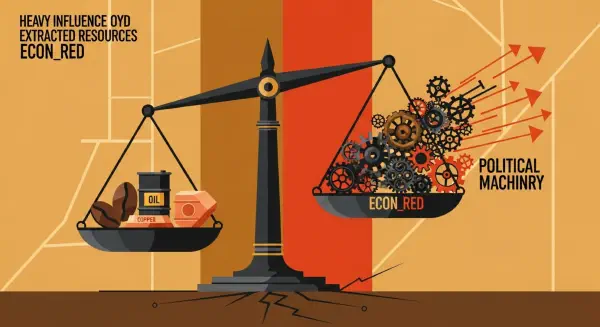
The Commodity Curse: How What You Grow Decides How You're Governed

A five-part series examining why the countries best endowed with natural resources are so frequently the worst governed, and how the arithmetic of commodity dependence — not culture, not climate, not colonial history alone — explains the pattern.

The Spectacle of Control: A Critical History of the Sports-Industrial Complex

This series examines the evolution of sports from survival-driven physicality to a commodified spectacle that serves economic and political interests. Through historical analysis, it reveals how mechanization birthed sublimated labor, engineered tribalism, and created mechanisms of social control and distraction.

The Architecture of Rot: How the Digital Economy Was Designed to Decay

A two-part forensic analysis of enshittification — the structural decay of digital platforms — tracing its mechanism, its institutional enablers, and the legal scaffolding that makes perpetual extraction possible.

The Genius Who Could Not Win: Hannibal, Rome, and the Limits of Tactical Brilliance

An exploration of how Hannibal's unparalleled battlefield genius ultimately succumbed to Rome's systemic resilience, offering timeless lessons on the interplay between individual brilliance and institutional strength.

Mapping Market Mayhem: Five Financial Theories That Explain the Gap Between Logic and Reality

Financial markets defy simple logic, blending mathematics, psychology, and human behavior. This exploration of five groundbreaking theories—from 1900s randomness to modern behavioral finance—reveals why experts fail, markets overreact, and even theory creators dismantle their own work.