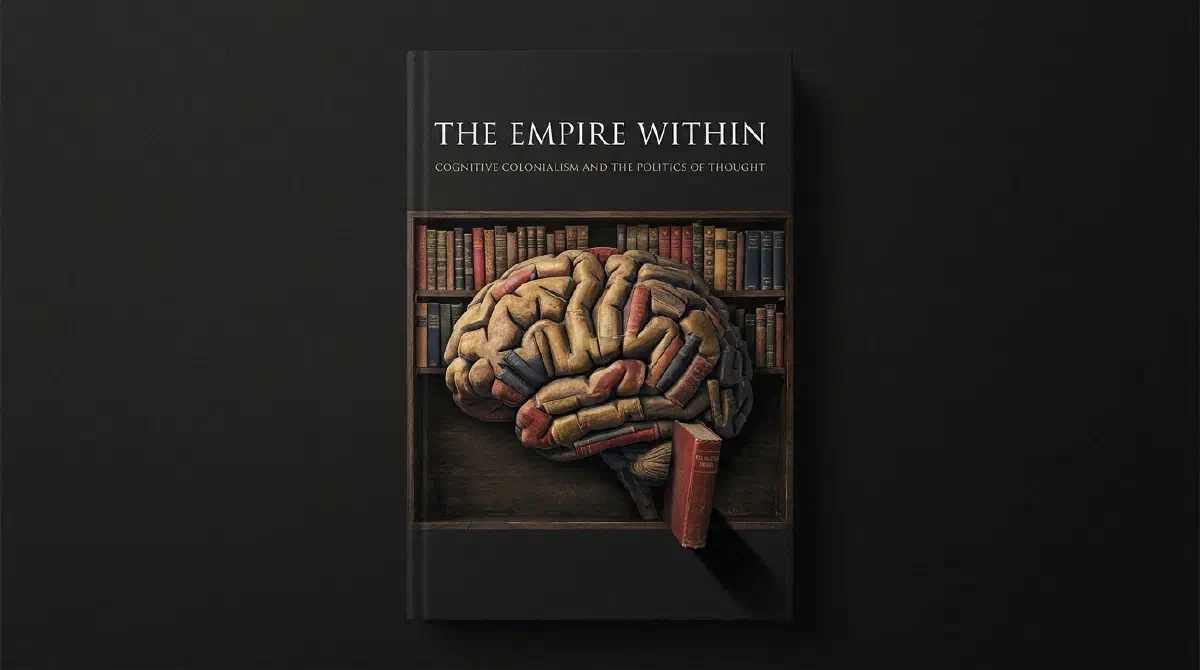
When we speak of colonialism, the mind instinctively reaches for the tangible: the redrawn borders, the extracted resources, the foreign flags lowered and raised. Yet the most durable and insidious form of empire does not occupy territory—it occupies the mind. Intellectual colonialism, or what scholars increasingly term "epistemic colonialism," is the process by which the ways of knowing, valuing, and imagining of the colonizer become so deeply embedded in the colonized that they are mistaken for universal truth. It is the empire that persists long after the last soldier departs, operating not through coercion but through consent, not through force but through the quiet architecture of what we are taught to consider legitimate knowledge.
The mechanisms of this epistemic empire are both structural and psychological. At the structural level, intellectual colonialism manifests in the stark asymmetries of global knowledge production. Scholars from the Global South have long observed that their academic institutions function as satellites orbiting Western centers of gravity. As Syed Hussein Alatas described, local intellectuals can become "knowledge compradors"—participants in foreign research agendas who lack the autonomy to set their own questions or define their own problems . The statistics are damning: from 2004 to 2014, the proportion of American publications cited globally rose from 47% to 56%, a figure that reflects not merely quality but the concentration of academic authority . Journals like Nature and Science function as gatekeepers of legitimacy, their imprimatur determining what counts as rigorous inquiry and whose questions merit funding. For scholars in the postcolonial world, this creates a peculiar bind: to be heard, one must speak in the idiom of the center, yet doing so often requires translating one's reality into categories that were not designed to hold it.
But the deeper violence of intellectual colonialism is psychological—what Alatas called the "captive mind." This is the internalized hierarchy that teaches the formerly colonized to view their own intellectual traditions as quaint, particularistic, or insufficiently rigorous while viewing Western frameworks as neutral, objective, and universal. Frantz Fanon understood this intimately: the colonized subject, he argued, is not merely ruled by force but is taught to desire the colonizer's gaze, to measure the self against a standard that was never meant to include them. In the contemporary academy, this manifests in curricula that treat European philosophy as "philosophy proper" while Asian, African, or Indigenous thought is relegated to area studies or ethnography. It appears in the assumption that a theory developed in Paris or London possesses universal applicability while a theory developed in Cairo or Jakarta is merely local knowledge. And it appears in the career trajectories of scholars from the Global South who find that their work gains credibility only when validated by a Western institution or published in a Western journal.
This is not a matter of individual prejudice but of what decolonial scholars call the "coloniality of knowledge"—the enduring structures that reproduce colonial hierarchies long after formal independence . The coloniality of power and the coloniality of knowledge are intertwined: economic and political inequalities are legitimized by epistemic hierarchies that position the Global North as the site of reason and the Global South as the site of raw data awaiting interpretation. As one recent analysis argues, Eurocentric knowledge "enables economic or political interests to produce biased policies which pretend to 'help' the Global South but which really serve the interests of Global North elites" . The intellectual is not innocent; the framework precedes the policy, and the policy follows the framework.
Yet intellectual colonialism is not merely a story of passive victimhood. It requires active reproduction, and this is where the question becomes uncomfortable. The "captive mind" is not simply imposed; it is often embraced, defended, and perpetuated by local elites who benefit from their proximity to metropolitan centers. Alatas was pessimistic about the prospects for genuine intellectual autonomy precisely because the comprador intellectual has a stake in the existing order . Universities in the Global South frequently reward conformity to Western standards—publication in indexed journals, citation of canonical authorities, adoption of fashionable theoretical vocabularies—while marginalizing scholars who pursue decolonial or Indigenous methodologies. The result is a self-reinforcing cycle: those who succeed within the system are those least likely to challenge its foundations.
The temptation, when confronting this reality, is to retreat into a simple inversion—to reject the West wholesale, to romanticize precolonial traditions, to construct a purified "authentic" knowledge untouched by foreign contamination. This is a trap. Decolonial scholars have been careful to distinguish between decolonization as a critical project and decolonization as a nativist fantasy. As Achille Mbembe and others have argued, the goal is not to replace one hegemony with another but to open space for what decolonial theorists call "pluriversality"—a world in which multiple knowledge systems coexist and interact without any single one claiming universal jurisdiction . This requires, as one recent paper insists, that the leadership of decolonization efforts come from the most marginalized, not from privileged scholars who may unconsciously reproduce the very hierarchies they claim to dismantle . It requires epistemic humility from those who have been trained to see their own frameworks as neutral.
What, then, does intellectual decolonization look like in practice? It begins with the recognition that the problem is not Western knowledge per se but its claim to monopoly. The point is not to stop reading Kant or Foucault but to read them alongside Ibn Khaldun and al-Jabri, to ask what each framework illuminates and what it occludes, to refuse the assumption that one tradition possesses the keys to universal truth. It means building institutions—journals, curricula, funding structures—that do not require translation into the language of the center as the price of admission. It means recovering and engaging with intellectual traditions that colonialism dismissed as folklore or superstition, not out of nostalgia but because they contain resources for thinking that the dominant paradigm has foreclosed. And it means, perhaps most difficult of all, cultivating the capacity for self-critique within one's own tradition, refusing the defensive posture that treats any criticism as betrayal.
Murad Hofmann, the German diplomat who converted to Islam and wrote The Emptiness of the Self and the Colonized Mind, posed the question with characteristic bluntness: "What do we take from the West, and what do we leave?" . This is the question that intellectual colonialism forces upon us, and it is not answered by slogans. It is answered by the slow, unglamorous work of building intellectual infrastructures that do not depend on metropolitan validation, by the cultivation of scholars who can move between traditions without being owned by any, and by the collective courage to ask, again and again, whose questions we are answering and whose interests our knowledge serves.
The empire within is not defeated by a single declaration of independence. It is dismantled room by room, syllabus by syllabus, citation by citation. The work is tedious. It is also, if we are honest, the only work that matters.