In the summer of 1997, Ha-Joon Chang was attending a conference in Hong Kong when he noticed street hawkers selling pirated software. This was not unusual in the city. What was unusual was the product on display: Windows 98, the operating system that Microsoft had not yet released. Someone had obtained a pre-release version, duplicated it, and put it on the street ahead of the official launch. Microsoft's intellectual property had been violated before its product had even reached the market.
What Chang did not mention in the anecdote, but documents in the chapter that follows, is that Microsoft's home country had spent much of the 19th century doing something very similar to Britain, France, and Germany — reproducing their authors' work without payment, adopting their industrial technologies without licence, and growing wealthy in the process. The difference between a developing country that pirated software in 1997 and the United States that pirated Dickens novels in 1842 is not a difference in principle. It is a difference in the balance of power.
Key Insights#
- The United States refused to protect foreign copyrights in its domestic law from independence until 1891, allowing American publishers to freely reproduce British books; Charles Dickens travelled to America in 1842 specifically to denounce American copyright piracy, which had made him famous but not wealthy there.
- Switzerland had no patent law until 1888 and deliberately excluded chemical inventions — the technology it was "borrowing" from Germany — from protection until 1907, when Germany threatened trade sanctions; pharmaceutical substances remained unpatentable in Switzerland until 1978.
- The Netherlands abolished its patent law in 1869, operating without one for over forty years; Philips, now a global technology company, started in 1891 as a producer of light bulbs based on Thomas Edison's patents, which Dutch law did not require it to respect.
- The World Bank estimates that TRIPS increases annual technology licensing payments by developing countries by approximately $45 billion — close to half the total annual foreign aid provided by rich countries ($93 billion in 2004–05).
- In 1995, two researchers at the University of Mississippi were granted a US patent for the medicinal use of turmeric, whose wound-healing properties had been documented in Indian medicine for thousands of years; the patent was only cancelled after expensive legal action by an Indian government research body.
- The interlocking patent problem has worsened as increasingly minute pieces of knowledge become patentable — the golden rice case required navigating 70 relevant patents held by 32 different companies and universities before the technology could reach the farmers who needed it.
- Abraham Lincoln, the only US president to hold a patent, supported strong IP protection; the country he led simultaneously refused to protect foreign copyrights for another thirty years after his death.
The historical record of today's rich countries#
In 1862, Britain revised its trademark law specifically to prevent German manufacturers from passing off counterfeit versions of British products. The Germans proved inventive in response. Some stamped the country-of-origin mark on the packaging rather than the product, so that it disappeared when the packaging was removed. Others sent goods in parts to be assembled in England, thus qualifying as British-made. One firm that exported sewing machines labeled "Singer" and "North-British Sewing Machines" placed the "Made in Germany" stamp in small letters underneath the treadle — visible only to someone willing to overturn the machine. The journalist Ernest Williams documented these practices in an 1896 book called Made in Germany. Today Germany is one of the most forceful advocates of strong international IP protection.
The United States operated for its first hundred years without protecting foreign copyrights. Its 1790 copyright law explicitly covered only American authors. Charles Dickens, whose novels were reproduced and sold throughout America in editions that paid him nothing, toured the country in 1842 and delivered public lectures denouncing this practice, to the irritation of American audiences who had been made literate partly by access to cheap books they could not have afforded at full price. The US signed the international Berne Convention on copyrights only in 1891, and even then did not recognize foreign copyrights on materials printed outside the US for a further century.
Figure 1: The horizontal axis spans 1700 to 2000; the vertical axis lists countries. Each point marks a key IP event for that country. The timeline reveals two structural patterns: first, countries introduced IP protections selectively, often explicitly excluding the technologies they were currently importing (Switzerland’s chemical patent exclusion, the US’s foreign copyright exclusion); second, the aggressive global harmonization of IP standards under TRIPS (1994) came at a point when rich countries had already built strong domestic IP portfolios, transforming the system from a tool of capability-building into a mechanism for extracting rents from latecomers.
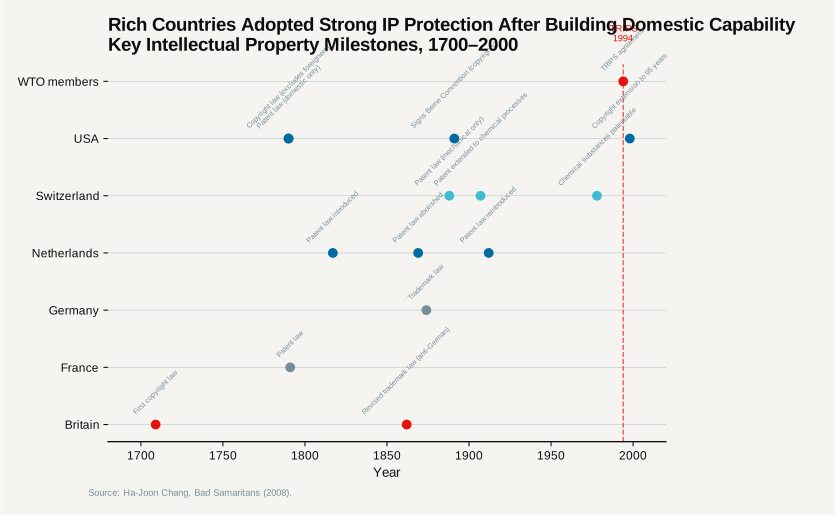
Switzerland is the most instructive case of deliberate IP strategy. The Swiss introduced their first patent law in 1888, covering only mechanical inventions. This automatically and intentionally excluded chemical inventions — a category that encompassed the technologies Switzerland was most actively borrowing from Germany. When Germany threatened trade sanctions in 1907, Switzerland extended protection to chemical processes but still refused to protect chemical substances — the actual compounds, not just the processes for making them. This distinction preserved Swiss freedom to develop pharmaceutical products without paying German royalties. Chemical substances remained unpatentable in Switzerland until 1978.
The TRIPS agreement changed the rules for latecomers#
The WTO TRIPS agreement of 1994 imposed a near-uniform global standard of intellectual property protection — 20-year patents, strengthened copyright, enhanced trademark protection — on all member countries as a condition of WTO membership. Unlike almost every other WTO agreement, this one had no symmetry of benefit: rich countries hold 97% of all patents worldwide. Strengthening patent protection is therefore, almost entirely, a transfer from the countries that use patented technology (developing countries) to the countries that own patents (rich countries).
The World Bank estimated that TRIPS would increase annual technology licensing payments from developing countries by approximately $45 billion — a figure close to half the total annual foreign aid provided by rich countries in the same period. This is not counting the costs of building and maintaining the new IPR enforcement infrastructure: patent offices, inspection capacity, trained patent lawyers, and the court time required to process infringement suits. Resources devoted to training patent inspectors and attorneys are resources not devoted to training doctors and engineers.
For developing countries that lack significant research capacity, the incentive structure created by stronger patents generates no domestic benefit at all. The logic of patents — create a temporary monopoly in exchange for the disclosure and eventual diffusion of new knowledge — presupposes that the country in question has researchers capable of producing the knowledge. If it does not, the only effect of stronger patent protection is to make existing foreign technology more expensive to acquire.
The originality bar has been lowered, not raised#
Since the 1980s, the American patent system has weakened rather than strengthened the requirement for genuine novelty. Professors Adam Jaffe and Josh Lerner documented the result: patents have been granted for a sealed crustless sandwich, a "bread refreshing method" (essentially toasting stale bread), Amazon's one-click internet ordering, and a "method of swinging on a swing" reportedly invented by a five-year-old. The number of patents granted annually in the US grew at 1% per year between 1930 and 1982; it grew at 5.7% per year between 1983 and 2002. American creativity did not increase sixfold. The novelty requirements weakened.
The consequence for developing countries is the theft of traditional knowledge: technologies and practices that have been in common use for centuries but were not formally documented in Western patent databases. The turmeric case — a University of Mississippi patent on wound-healing properties known to Indian traditional medicine for millennia, overturned only because India had the legal resources to challenge it — is the most-cited example. Countries that lack India's capacity to mount expensive legal challenges in American courts have no practical recourse when their traditional knowledge is appropriated.
Conclusion#
When rich countries were building their technological capabilities, they used whatever knowledge they could access, by whatever means were available — legal and illegal by the standards of the more advanced nations. They then closed the door. The question is not whether intellectual property protection is a useful institution — it is — but whether the current system is calibrated to serve the interests of the holders of existing knowledge rather than the producers of new knowledge.