
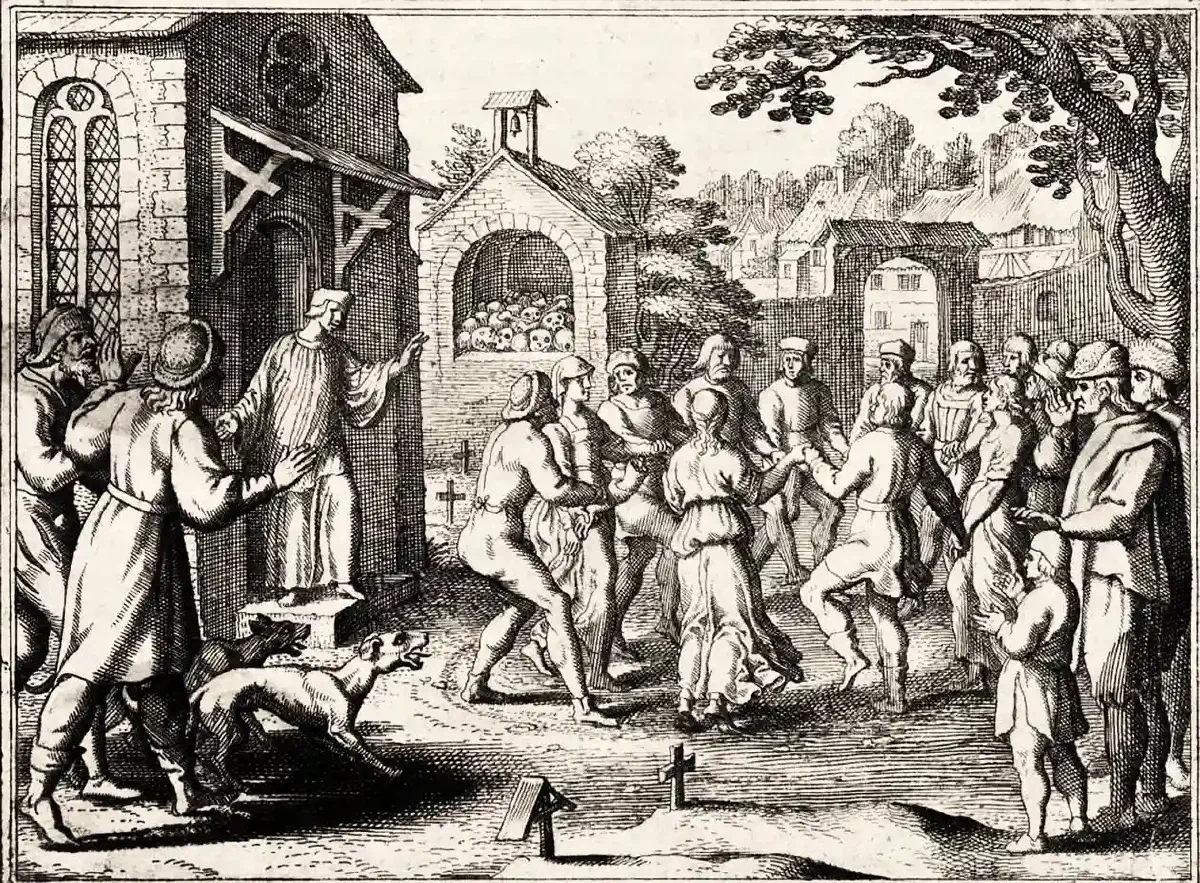
In July 1518, a woman known as Frau Troffea stepped into a narrow, unpaved street in the city of Strasbourg and began to dance. There was no musical accompaniment, yet she spun, twisted, and leaped with furious intensity for six consecutive days. Within a single week, thirty-four citizens joined her in this silent, agonizing marathon. By August, the count of active dancers had spiked to approximately 400 individuals, converting the city’s public plazas into stages of involuntary physical exhaustion. Dancers screamed of terrifying visions, their feet bleeding through shredded leather shoes as they spun under a sweltering summer sun.
Local chronicles noted that up to fifteen people died each day from strokes, heart attacks, and profound dehydration. This was not a celebration, nor was it a voluntary religious festival. It was a lethal, self-replicating behavioral epidemic that paralyzed one of the most prominent free cities of the Holy Roman Empire. The phenomenon presented a terrifying paradox to early modern observers. How could a completely non-infectious behavioral urge sweep through a stable urban population like a physical contagion?
                    THE MECHANISM OF MASS PSYCHOGENIC CONTAGION

  [ Acute Ecological Trauma ] ──► [ Hyper-Vigilance & Adrenaline Surge ]
               │                                      │
               ▼                                      ▼
   Subconscious Somatization               Cultural Threat Script:
  (Extreme Cortisol Spike)               "Curse of Saint Vitus"
               │                                      │
               └───────────► [ Visual Trigger ] ──────┘
                                (Frau Troffea)
                                      │
                                      ▼
                        [ Dissociative Choreography ]
                                      │
                                      ▼
                        [ Municipal Confirmation ] ──► Systemic Contagion
                        (Stages, Drums, Musicians)
This historical anomaly forces us to confront the profound fragility of human cognitive baseline stability. It reveals that under extreme circumstances, the boundary between individual agency and collective panic dissolves entirely. By examining Strasbourg’s fatal summer, we can decode the hidden systems of psychological contagion that continue to shape human behavior.
The Symbiosis of Shared Terror and Somatic Collapse#
The Strasbourg Dancing Plague of 1518 was not a supernatural curse, nor was it a simple case of food poisoning. Rather, it was a highly structured manifestation of mass psychogenic illness (MPI). This collective delusion was actively driven by extreme ecological devastation, institutional failure, and religious fatalism. The mind, when pushed past its cognitive breaking point, translates psychological agony into physical somatic actions.
This case study demonstrates that mass hysteria is never random; it follows a precise cultural script. When a population is conditioned to fear a specific spiritual or physical affliction, their shared stress will inevitably express itself through those exact symptoms. Understanding this mechanism allows us to analyze how collective trauma bypasses conscious intellect to dictate human physiology.
The Anatomy of a Contagious Trance#
Mass psychogenic illness operates through the rapid, subconscious transmission of physical symptoms within a highly stressed social group. Under acute psychological pressure, the human brain enters a state of hyper-vigilance. This neurological state triggers the release of high levels of cortisol and adrenaline, disrupting executive cognitive function. When a highly visible member of the community suffers a public breakdown, it serves as a behavioral catalyst.
In 1518, the citizens of Strasbourg were uniquely primed for this neural cascade. The local culture was saturated with the legend of Saint Vitus, a patron saint believed to punish the ungodly by forcing them to dance. Once Frau Troffea began her frantic movements, onlookers did not see a medical emergency; they saw divine wrath in action. This theological interpretation triggered a wave of intense, localized panic.
The brain of the observer, already destabilized by chronic stress, internalized this visual input. It somaticized the fear of Saint Vitus, compelling the observer's muscles to mimic the dancer's movements. The physical act of dancing further elevated the heart rate and body temperature, locking the victim into a dissociative trance. This neurobiological feedback loop allowed the illness to bypass conscious volition, turning onlookers into participants.
The Crucible of Bread, Belief, and Biological Stress#
For centuries, historians attempted to attribute the dancing plague to ergotism, a toxic poisoning caused by the fungus Claviceps purpurea on damp rye. Ergot poisoning contains chemical compounds structurally similar to LSD, which can induce severe convulsions, hallucinations, and gangrene. However, scientific analysis of the 1518 crisis reveals that ergotism cannot explain the epidemic's longevity or coordination.
Ergotism typically restricts blood flow to the extremities, making prolonged, athletic dancing physically impossible. Furthermore, the localized nature of the outbreak and the high level of motor coordination required to dance for days contradict the chaotic, paralyzing seizures of ergot poisoning. The true driver of the crisis was a convergence of catastrophic socioeconomic factors.
+----------------------------------------------------------------------------------------+
|                            THE TRIAD OF EPIDEMIC STRESS (1518)                         |
+------------------------------------+---------------------------------------------------+
| Stress Factor                      | Socio-Biological Impact                           |
+------------------------------------+---------------------------------------------------+
| Grain Failure & Malnutrition       | 150% Inflation in Rye Prices; Chronic Hunger      |
| Epidemic Invasions                 | Syphilis, Smallpox, and Leprosy Outbreaks         |
| Theological Terror                 | Clerical Guilt & Fear of Saint Vitus Wrath        |
+------------------------------------+---------------------------------------------------+
| RESULT: Historic Minimum for Mass Cognitive Dissociation                              |
+----------------------------------------------------------------------------------------+
In the decade leading up to 1518, Strasbourg suffered from a series of brutal crop failures, inflating grain prices by over 150%. This economic collapse was accompanied by devastating outbreaks of smallpox, leprosy, and a newly imported, highly lethal strain of syphilis. The population was physically malnourished and psychologically traumatized. The psychological threshold for collective dissociation had been lowered to a historic minimum. When combined with the heavy religious guilt propagated by the local clergy, this ecological pressure cooker turned a single case of hysteria into a regional psychological wildfire.
Municipal Folly and the Lethal Choreography#
The rapid escalation of the plague was directly accelerated by the catastrophic intervention of Strasbourg’s municipal authorities. Confused by the sudden outbreak, the city council consulted local physicians. These doctors, adhering to classical humorism, ruled out supernatural causes. They declared that the dancing was caused by "hot blood," a natural physical imbalance that could only be cured by letting the victims dance continuously.
This medical diagnosis led to a disastrous policy decision. Instead of isolating the affected individuals, the city council actively facilitated their movements. They cleared the city's central grain market, constructed large wooden stages, and hired dozens of professional musicians and dancers to keep the afflicted moving day and night.
This institutional policy transformed a private psychological crisis into a massive, state-sanctioned spectacle. By organizing the dancing, the authorities inadvertently removed the social stigma of the breakdown. They provided a physical infrastructure that validated the mass delusion. The constant rhythmic pulse of the drums and pipes acted as an auditory driving force, deepening the hypnotic states of the dancers. This public display dramatically lowered the psychological barrier for nearby observers, causing the number of victims to swell from dozens to hundreds in a matter of weeks. The municipal attempt to manage the crisis had instead institutionalized the contagion.
The Eternal Echo of Strasbourg's Drums#
The Dancing Plague of 1518 was finally brought to an end when the city council reversed its strategy. Realizing their interventions had failed, they banned all public dancing, shuttered the music halls, and forced the survivors into rustic shrines dedicated to Saint Vitus. There, the exhausted dancers were given red shoes smeared with holy oil and sprinkled with holy water. Within days, the collective trance dissolved, leaving behind a scarred city and dozens of fresh graves.
This historical event is far more than a quirky medieval curiosity. It stands as a stark warning about the power of social feedback loops and the limits of institutional crisis management. When authorities validate a shared delusion, they systematically accelerate its spread, converting localized panic into systemic collapse.
Today, the physical stages of Strasbourg have been replaced by the digital infrastructure of social media. Modern psychological contagions do not manifest as bleeding feet in public squares, but as rapid, algorithmic panics, virtual mobs, and coordinated ideological hysteria. The core neurological machinery remains entirely unchanged. Under acute systemic stress, human communities will still seek a culturally familiar outlet to somaticize their shared fears. The drums of Strasbourg are no longer played on wooden flutes, but their rhythm still dictates the steps of the modern digital crowd.