
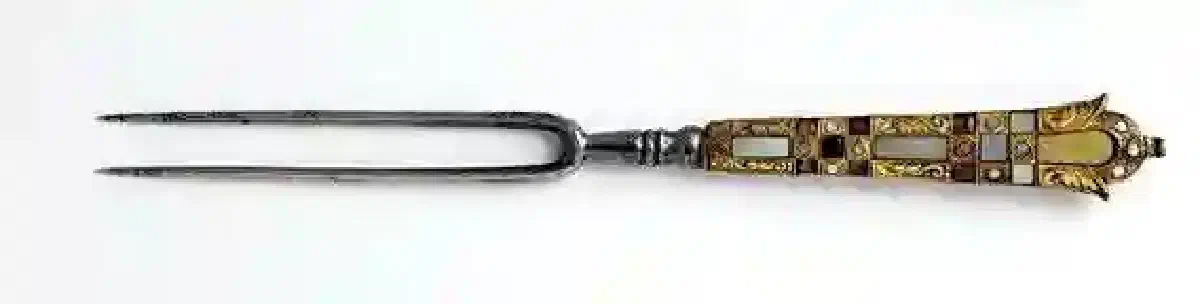
In the autumn of 1004, the high-society wedding of the Byzantine princess Maria Argyropoulina to Giovanni Orseolo, the son of the Doge of Venice, scandalized the Christian world. At the grand wedding feast, the princess did not use her fingers to eat her roasted meat, as was the universal custom among the European elite.
Instead, she unveiled an exquisite, two-tined golden instrument: a fork. She used the utensil to delicately lift small morsels of food to her mouth, avoiding any direct contact between her hands and the meal.
This simple display of refinement was met with immediate, visceral horror by the attending clergy and nobility. Local priests openly condemned the princess’s behavior as an act of heretical pride and an insult to God.
When the princess tragically died of the plague a few years later, the celebrated theologian Peter Damian declared her death to be a direct, divine punishment for her heretical decadence. He wrote that God had struck her down because she had arrogantly rejected the natural fingers God had given her. Why did a simple, highly efficient dining utensil spend centuries branded as an instrument of Satan?
                    THE BODILY MEDIATION CONFLICT

  [ Divine Creation Model ] ──► [ Natural Human Digits / God-Given Fingers ]
             │                                     │
             ▼                                     ▼
     Direct Connection to                   Theological Premise:
      Material World                      Fingers Are Perfect Utensils
             │                                     │
             └───────────► [ Mechanical Mediation ] ┘
                             (Two-Tined Golden Fork)
                                       │
                                       ▼
                        [ Heretical Vanity Label ]
                                       │
                                       ▼
                        [ Class Etiquette Threat ] ──► Manual Discipline Erosion
This historical moral panic reveals that etiquette is never a neutral set of manners. It is a heavily policed social border, designed to enforce cultural conformity and suppress any behavior that challenges the established cosmological order. By examining the long, absurd resistance to the fork, we can decode how societies weaponize tradition to resist change.
The Polarization of the Table#
The multi-century European resistance to the fork was a battle over the definition of natural order and the limits of bodily discipline. The panic was driven by a deep theological anxiety over the artificial mediation of the human body, combined with the rigid class hierarchies of the feudal era.
This case study demonstrates that even the most mundane tools are heavily politicized when they disrupt long-standing sensory and physical habits. The ruling classes will violently reject any innovation that they perceive as a threat to their established cultural identity. By tracing the history of the fork, we can understand how technological adoption is dictated by cultural warfare.
The Theological Rejection of Bodily Mediation#
To understand the visceral reaction to the fork, we must analyze the medieval worldview surrounding the human body and divine creation. In medieval Europe, the physical world was viewed as a direct, purposeful design of God. Every limb, organ, and digit had a specific, divinely ordained function.
The hand was praised by theologians as the ultimate, natural tool for eating. God, in His infinite wisdom, had created fingers to touch and hold food, making the act of eating a direct, spiritual connection to the material world.
The introduction of the fork shattered this theological harmony. By placing a metal instrument between the human mouth and the food, the fork was viewed as an arrogant rejection of God’s natural design.
Clergy argued that using metal prongs was an implicit statement that God’s fingers were dirty, imperfect, or inadequate. This bodily mediation was branded as heretical vanity. The fork’s shape—resembling the pitchfork of the devil—only deepened this cultural panic. It was viewed as a corrupting, artificial device that separated humans from the natural state of creation, proving that any mechanical mediation of the human body is initially met with deep spiritual terror.
The Crucible of Class Pride and National Xenophobia#
The debate over the fork was further complicated by intense socioeconomic class dynamics and national rivalries. During the Middle Ages, hand-eating was not chaotic; it was governed by an incredibly complex, highly policed system of etiquette. Elites distinguished themselves from the peasantry by using only three fingers to touch dry food, keeping their pinkies and ring fingers perfectly clean.
This manual discipline was a critical marker of high birth. The fork threatened to democratize cleanliness. If anyone could use a simple metal tool to keep their hands clean, the hard-earned physical discipline of the nobility would lose its social value.
+----------------------------------------------------------------------------------------+
|                   THE SEVEN-CENTURY ETICO-HYGIENIC TRANSITION                          |
+------------------------------------+---------------------------------------------------+
| Historical Era                     | Cultural & Theological Status                     |
+------------------------------------+---------------------------------------------------+
| Byzantine / Venice (1004)          | Heretical Vanity; Divine Punishment (Plague)      |
| Renaissance North (1500s-1600s)    | Effeminate Foreign Affectation ("Silken Bastards")|
| Enlightenment Versailles (1700s)   | Banned by Louis XIV; Subversion of Royal Order   |
| Industrial Revolution (1800s)      | Universal Bourgeois Standard of Hygiene & Civility|
+------------------------------------+---------------------------------------------------+
| RESULT: Heretical Instrument Normalized into Invisible Daily Utility                   |
+----------------------------------------------------------------------------------------+
Furthermore, the fork was viewed through a lens of deep national xenophobia. It originated in the wealthy Byzantine Empire and was popularized in Renaissance Italy. To northern European nations like England and Germany, the fork was mocked as an effeminate, over-refined Italian affectation.
English writers ridiculed men who used forks as "spruce silken bastards" who were too delicate to touch their own meat. This nationalist rhetoric framed hand-eating as a masculine, honest, and patriotic act, while the fork was condemned as a foreign conspiracy designed to soften the warriors of the north. The dining table became a battlefield where class pride, gender performance, and national identity clashed over two metal prongs.
The Glacial Triumph of the Utensil#
The final adoption of the fork was an incredibly slow, agonizingly gradual process that took over seven hundred years to complete. Despite the constant theological and cultural resistance, the fork possessed an undeniable material advantage: hygiene. As global trade expanded and urbanization accelerated, populations became increasingly vulnerable to devastating epidemics.
The realization that direct manual contact with shared food facilitated the spread of disease slowly began to erode the theological arguments for hand-eating.
However, this transition was heavily resisted by traditionalists. King Louis XIV of France, ruling at the height of Versailles' splendor, actively banned his children from using forks, declaring them to be a heretical luxury that undermined royal discipline.
It was not until the late 18th and early 19th centuries, with the rise of the industrial bourgeois class, that the fork finally achieved universal dominance. The new capitalist elite, eager to distinguish themselves from both the old aristocracy and the working poor, adopted the fork as the ultimate symbol of modern, scientific refinement.
This shift forced manufacturers to produce millions of silver forks, transforming the heretical luxury of a Byzantine princess into a global industrial standard. The fork had finally conquered the world, but only after surviving a seven-century culture war.
The Invisible Prongs of Modern Etiquette#
Today, we use the fork daily without a single thought, completely blind to the historical blood, sweat, and theological fury that paved the way for its presence in our drawers. The fork’s long journey from Satanic implement to mundane necessity serves as a perfect model for how societies process technological disruption.
It proves that the initial moral panic surrounding a new tool is rarely about the tool itself. Instead, it is a defensive reaction against the shifting social hierarchies and bodily habits that the tool introduces.
This cultural machinery remains fully active today. Every time a new technology emerges that alters how we interact with the physical world—whether it is virtual reality headsets, artificial intelligence, or neural implants—it is met with the exact same theological and cultural resistance that faced the fork.
Critics brand these devices as unnatural, heretical, and destructive to our "human essence". They argue that we are rejecting the "natural" ways of communicating and living. But history suggests that, just like the fork, today’s heretical devices will inevitably become tomorrow's invisible necessities. The prongs of the devil have a persistent habit of turning into the tools of the modern home.