
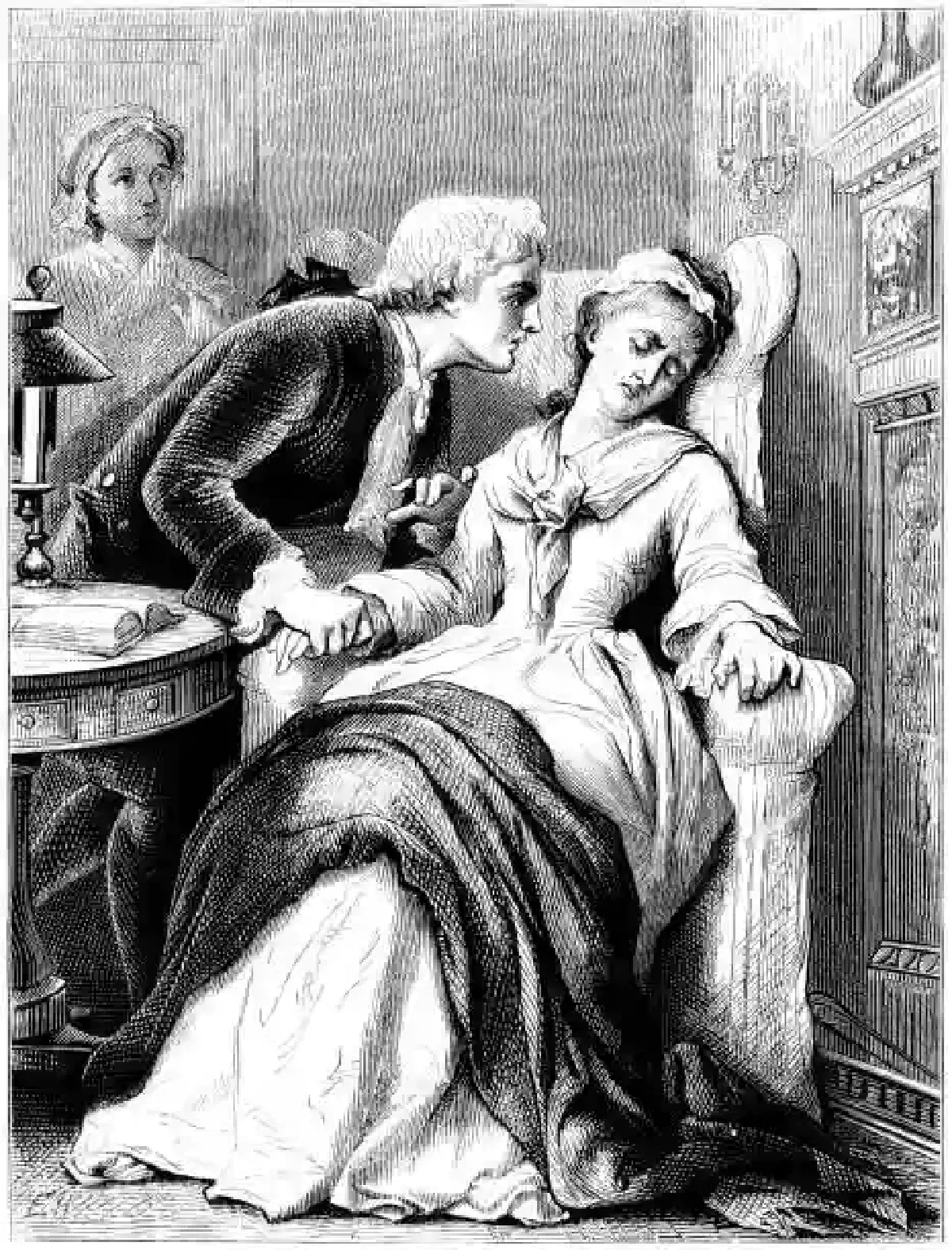
In the closing decades of the 18th century, prominent European physicians began warning families of a highly contagious, physically devastating epidemic sweeping through the youth. The disease was termed "reading fever" (Lesewut) or "novel-reading mania".
Medical journals reported that young women who spent hours in private chambers reading cheap, mass-market novels were showing alarming physical symptoms. These included chronic migraines, pale skin, overheated imaginations, erotic delirium, and sudden nervous collapses.
Even more terrifyingly, leading gynecologists published treatises claiming that the intense emotional stimulation caused by reading romantic fiction would divert blood flow away from the uterus, causing permanent infertility and uterine damage.
Paternal lockboxes were sold to keep young girls from accessing subscription libraries, and local magistrates seriously debated whether cheap novels should be classified as hazardous substances. Why did the simple, quiet act of reading a story trigger a massive, state-sanctioned medical and moral panic?
               THE MEDICALIZATION OF UNMONITORED INTERIORITY

  [ Mass Print & Subscription Libraries ] ──► [ Silent Solitary Reading ]
               │                                      │
               ▼                                      ▼
    Unmonitored Private Interiority        Disruption of Patriarchal Surveillance:
   (Female Emotional Autonomy)            "Lesewut / Novel-Reading Mania"
               │                                      │
               └───────────► [ Medicalization Defense ] ┘
                             (Nervous Energy Depletion)
                                      │
                                      ▼
                        [ Institutional Isolation ]
                                      │
                                      ▼
                        [ Market Co-Optation ] ──► Conduct Novels & Domestic Vaccine
This historical panic reveals that the medicalization of behavior is often a desperate systemic attempt to control demographic shifts and preserve patriarchal power. By dissecting the 18th-century "reading fever," we can understand how societies weaponize medicine to suppress the rise of private, unmonitored human interiority.
Mass Print and the Rebellion of the Mind#
The 18th-century novel-reading panic was a direct defense mechanism by the patriarchal establishment against the rapid democratization of literacy and the birth of female psychological autonomy. It was driven by a deep fear of the unmonitored, private spaces that reading constructed, combined with the sudden economic power of cheap print.
This case study proves that the ruling class will always attempt to pathologize any technology that enables marginalized groups to develop an independent interior life. By examining this literary epidemic, we can trace the structural parallels between historical and modern media panics.
The Medicalization of Female Autonomy#
To understand the panic, we must analyze how the physical act of reading a novel fundamentally disrupted 18th-century social structures. Before this period, reading was a highly communal, oral, and heavily monitored activity. Families would gather around a table to listen to a patriarch read aloud from Scripture or state-approved histories.
The rise of the mass-market novel, combined with cheaper paper and the expansion of subscription libraries, shattered this communal control. For the first time, individuals—especially young, middle-class women—were reading silently and in private.
This silent, solitary reading created an unmonitored psychological space. Inside the pages of a novel, a young woman could experience complex emotional narratives, critique societal expectations, and explore romantic and sexual desires completely free from parental surveillance.
This psychological independence was deeply threatening to a society that relied on the absolute submission of women to secure dynastic marriages and domestic labor.
Unable to directly police the internal thoughts of their daughters, the patriarchal establishment turned to the ultimate tool of social control: medicine. By framing silent reading not as a choice, but as a literal, infectious disease, they could justify the physical restriction of women’s movements and the confiscation of their books under the banner of public health.
The Crucible of Reproductive Science and Romantic Empathy#
The novel panic was further intensified by the highly flawed medical theories of the late Enlightenment. Eighteenth-century medicine was heavily dominated by "nervous theory," which posited that human health was dictated by the delicate balance of fluids and nervous energy.
Physicians argued that the human body possessed a finite amount of vital energy. If a young woman spent hours in an emotionally heightened state, empathizing with the fictional struggles of romantic characters, her nervous system would consume all available energy.
This left no vital force for her reproductive organs, which were believed to require complete physical rest to mature.
+-----------------------------------------------------------------------------------------+
|                        MEDIA PANIC RECURSION ARCHITECTURE                               |
+------------------------------------+----------------------------------------------------+
| 18th-Century "Reading Fever"       | 21st-Century Digital Screen Panic                  |
+------------------------------------+----------------------------------------------------+
| Medium: Mass Epistolary Novels     | Medium: Algorithmic Social Media & Smartphones     |
| Victim Class: Young Women / Daughters| Victim Class: Youth & Digital Natives            |
| Medical Diagnosis: Uterine Atrophy | Medical Diagnosis: Brain Rewiring & Attention Loss |
| Systemic Motivation: Guard Family  | Systemic Motivation: Loss of Traditional Monopolies|
+------------------------------------+----------------------------------------------------+
| RECURSIVE PATTERN: New Media Baselines Are Always Medicalized to Restore Surveillance   |
+----------------------------------------------------------------------------------------+
Furthermore, the rise of the epistolary novel—written in the form of intimate letters—was accused of causing "hyper-empathy". Critics argued that young readers could no longer distinguish between fictional narratives and real life, leading to a state of permanent cognitive delusion.
This scientific framing transformed the novel from a simple entertainment product into a biohazard. It allowed fathers, husbands, and doctors to operate as a coordinated border patrol, physically locking up books and isolating women to protect their reproductive capacity for the good of the state.
The Co-Optation of the Page#
The containment of the "reading fever" did not occur through violent state bans, which proved completely impossible to enforce due to the immense profitability of the publishing industry. Instead, the moral panic resolved through a highly effective strategy of cultural co-optation.
Publishers and conservative writers quickly realized that instead of fighting the novel, they could weaponize its format.
In the late 18th and early 19th centuries, there was a massive spike in the production of "conduct novels". These books borrowed the engaging, romantic formulas of popular fiction but used them to teach obedience, domestic duty, and the dangers of female independence.
The protagonist of a conduct novel who read too many romantic books was inevitably led to ruin, poverty, and death, while the obedient, home-bound heroine was rewarded with a wealthy, stable marriage.
This co-optation successfully converted the novel from a tool of psychological liberation into an instrument of domestic socialization. The state and the market had successfully neutralized the threat, turning the infectious "fever" of literacy into a vaccine for patriarchal conformity.
The Algorithmic Panics of the Modern Screen#
The 18th-century "reading fever" has long since dissolved into history, and today we view the era's medical warnings with a mixture of amusement and disbelief. The novel is now universally praised by educators, parents, and doctors as the ultimate tool for cognitive development, empathy, and intellectual refinement.
Yet, the structural machinery of the reading panic has not disappeared. It has simply migrated to new media platforms.
In the 21st century, we are witnessing the exact same moral and medical panics surrounding youth screen time, smartphone usage, and social media platforms. Just as 18th-century doctors warned that novels would "overheat" the female brain and cause physical decay, modern critics claim that digital screens are "rewiring" our children's brains and causing a mental health epidemic.
While some concerns are valid, the hyperbolic, panic-driven language remains identical to the Lesewut of 1780.
Once again, society’s deepest anxieties about changing communication habits, shifting economic realities, and the loss of parental control over youth attention are being translated into medical crises. By analyzing the reading panic, we can recognize that every major media transition in human history is accompanied by a coordinated attempt to pathologize the new baseline of human attention. The screen is merely the modern novel, and the panic remains, as always, a battle for the control of the human mind.