
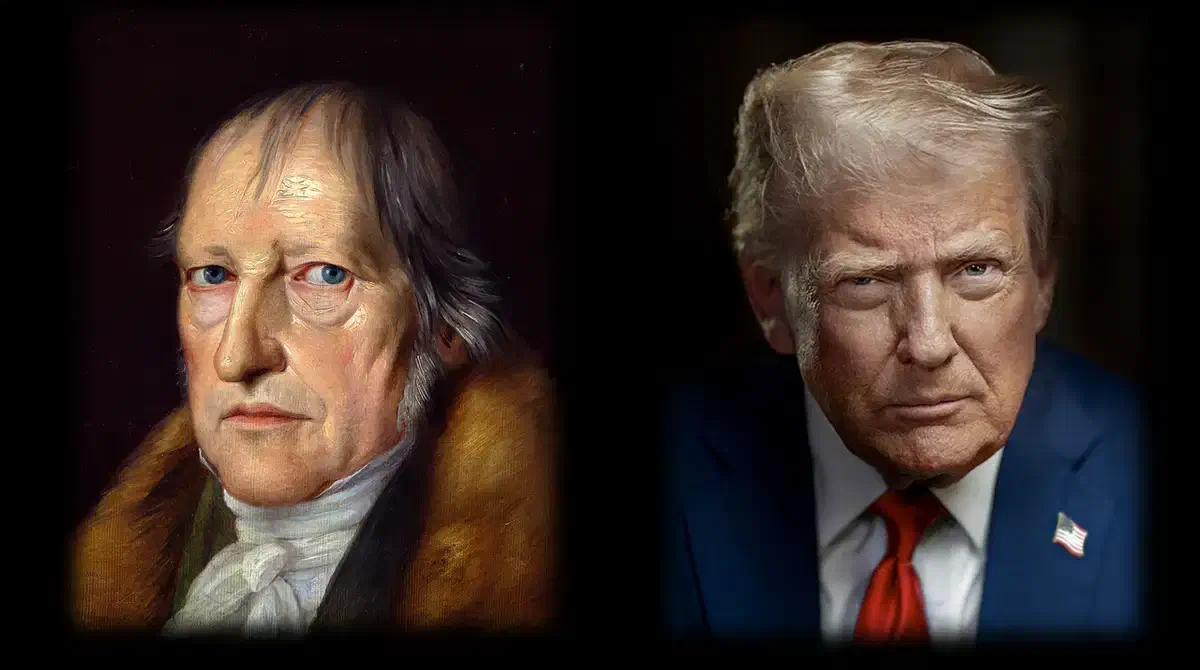
A mountain of abstraction still shapes how the powerful talk about civilisation, freedom and those left behind
In the spring of 1822, Georg Wilhelm Friedrich Hegel delivered a series of lectures at the University of Berlin that would outlive their immediate audience in ways he could not have imagined. The subject was the philosophy of world history. The conclusion, dressed in the forbidding armour of German idealism, was that the “Germanic spirit” represented the final, unsurpassable stage of human freedom. Africans, he argued, had no history worthy of the name. The transatlantic slave trade, properly understood, was a vehicle of progress. British rule in India was a favour to the colonised.
Readers today who wade through Hegel’s prose often emerge baffled. Where is the evidence? What could justify such rankings of whole peoples? The opacity of his writing—famously described by Bertrand Russell as “the most difficult to understand of all the great philosophers”—invites a harsh verdict: mountains of words, little logic, no proof. And yet the patterns of thought that Hegel helped to codify are very much alive. You can hear them, stripped of their philosophical drapery, in the rhetoric of Donald Trump, Pete Hegseth, Marco Rubio, Ben Shapiro, Bill Maher, Lindsey Graham and Mike Huckabee. The Hegelian architecture of history as a ladder, of civilisation as a gift to be bestowed, and of domination as a form of pedagogy, has become a habit of political speech. The name is forgotten. The structure remains.
The logic of the ladder#
Hegel’s system is a bold and terrible simplification. History is the progressive realisation of freedom, driven by a cosmic subject he called Spirit (Geist). Different peoples occupy different rungs on the ladder. The “Oriental” world (China, India, Persia) allows only one person to be free—the despot. The Greco-Roman world allows some to be free—citizens, but not slaves or women. The Germanic world, by which Hegel meant Protestant Europe, finally allows all humans to be free, because the principle of subjective freedom has become embedded in its institutions: the rational state, private property, and civil society.
Nothing in this schema is falsifiable. Hegel offered no demographic tables, no comparative economic data, no fieldwork in the Caribbean or the Punjab. His “evidence” was internal to his own system: a later stage of history resolves the contradictions of an earlier stage. That is not social science. It is a philosophical novel, written with the confidence of a man who had never left Europe.
And yet that novel gave intellectual dignity to a prejudice that was already ancient: the belief that my time and my place are the measure of all others. Hegel did not invent civilisational hierarchy. He merely supplied it with a metaphysics of progress, a justification that sounded like reason rather than whim.
The echo chamber#
Listen to Donald Trump promise to “make America great again”. The phrase implies a historical arc with America at its apex, a country whose institutions define the benchmark for everyone else. When Lindsey Graham speaks of American exceptionalism, he is not reciting Hegel. But he is performing the same move: a claim that one political order is the universal standard. When Mike Huckabee or Ben Shapiro contrasts “Judeo-Christian civilisation” with the alleged barbarism of others, the Hegelian ladder—with its ranking of peoples according to their capacity for freedom—is quietly reinstalled.
The civilising mission is a Hegelian trope. When Marco Rubio or Pete Hegseth argues that the United States must bring democracy to unfree places, by force if necessary, they are repeating the philosopher’s argument that domination can be a form of liberation. Hegel thought British rule in India was justified because Indians had not yet learned to be free. The language today is more polished—“democracy promotion”, “responsibility to protect”—but the underlying logic is unchanged: the advanced have a duty to advance the backward.
Even on the liberal side of the spectrum, Hegel’s ghost haunts the stage. Bill Maher, a critic of religion and a self-styled rationalist, often lectures non-Western cultures, particularly Muslim societies, for being “behind” on women’s rights, science or tolerance. The rhetorical is a linear timeline at the end of which stands the secular West, which is Hegelian to its core.
The paradox of the mountain of words#
How can a writer so dense, so impenetrable, so lacking in empirical warrant, be taken seriously as a thinker? The answer is not that Hegel was stupid. It is that he was doing something different from what modern readers expect. He was not testing hypotheses. He was constructing a conceptual architecture in which historical judgments could be made at all. His influence rests not on his colonial conclusions, which most today rightly reject, but on his tools: the idea that history has a directional logic, that societies develop through contradiction, and that freedom is realised not in isolation but in institutions.
Those tools have been used against Hegel himself. Karl Marx borrowed the dialectic and turned it on capitalism. Frantz Fanon, the great theorist of decolonisation, took the master‑slave dialectic and used it to understand the psychology of domination. C.L.R. James wrote a Marxist-Hegelian history of the Haitian revolution. Angela Davis, a student of Herbert Marcuse, combined Hegelian and Marxist thought to analyse the carceral state. These thinkers did not accept Hegel’s racial hierarchy. They used his method to dismantle exactly the kind of civilisational arrogance he had justified.
An uncomfortable legacy#
The persistence of Hegelian patterns in modern political rhetoric is not an argument for reading Hegel’s original texts. Most of the speakers named above have never opened the Philosophy of Right. But their assumptions about history, progress and the right to dominate are legacies of a philosophical tradition that Hegel shaped more than any other. To criticise those assumptions is to criticise Hegel, whether one knows it or not.
Reading dense German philosophy is not a recommended task, but paying attention to the hidden architecture of political speech is. When a politician tells you that a people “has no history”, that freedom must be “brought” to the unfree, or that civilisation is a gift from the advanced to the backward—pause. You are listening to Hegel’s mountain of words, compressed into a slogan. And a mountain, even when reduced to rubble, can still block the view.
References#
James, D., & Knappik, F. (2025). Hegel and Colonialism. Cambridge University Press.
This open-access Element is the first comprehensive study of Hegel's views on European colonialism. It systematically shows how Hegel's core concepts (freedom, the dialectic of lordship and bondage) are entangled with his justification of colonial violence, the enslavement of Africans, and British rule in India. The authors also examine the ambivalent legacy of Hegelianism, including how anti-colonial thinkers like C. L. R. James and Angela Davis transformed these tools.
🔗 https://www.cambridge.org/core/elements/hegel-and-colonialism/32A9CF7B07E54820F56081540662CFAEBernasconi, R. (2024). Hegel and Egypt's African element. Hegel Bulletin, 45(1), 6-22.
Bernasconi argues that Hegel's racist caricature of Africa is not incidental but integral to his dialectical account of world history. He shows that Hegel systematically excluded Africa from the development of Spirit, a move that serves to generate the very contradictions that allow for the rise of European civilisation.
🔗 https://www.cambridge.org/core/journals/hegel-bulletin/article/hegel-and-egypts-african-element/4ADA6583DC0E96DA7E4A77D1C9951C47Jaarte, M. (2024). Colonial slavery, the lord-bondsman dialectic, and the St Louis Hegelians. Hegel Bulletin, 45(1), 43-64.
This article examines how Hegel's lord-bondsman dialectic was later used by American Hegelians to justify colonial slavery. Crucially, Jaarte contends that recent scholarship, including work by Robert Bernasconi and Alison Stone, has convincingly shown that Hegel himself was a racist and a defender of colonialism, not merely a Eurocentric thinker.
🔗 https://www.cambridge.org/core/journals/hegel-bulletin/article/colonial-slavery-the-lordbondsman-dialectic-and-the-st-louis-hegelians/966FCF0C7BCB60CCE030FD0D35B41EFBBuck-Morss, S. (2022). Kleist and Haiti—Beyond Hegel. In Heinrich von Kleist: Literary and Philosophical Paradigms (pp. 308-328). Boydell & Brewer.
In her seminal essay "Hegel and Haiti," Buck-Morss argues that Hegel must have been aware of the Haitian Revolution through contemporary journals. She controversially claims that the master-slave dialectic implicitly critiques colonial slavery and that the revolution embodies universal freedom, a reading that has sparked significant debate.
🔗 https://www.cambridge.org/core/books/abs/heinrich-von-kleist/kleist-and-haitibeyond-hegel/BE0090CCC011D69DE52F74BCA5AC0F88Hoffheimer, M. H. (2001). Hegel, race, genocide. The Southern Journal of Philosophy, 39, 35-62.
This early and influential article directly confronts the relationship between Hegel's philosophy of history and the justifications it provides for racial hierarchy and colonial genocide. Hoffheimer traces how Hegel's systematic thought logically legitimises the destruction of "unfree" peoples in the name of progress.
🔗 https://doi.org/10.1111/j.2041-6962.2001.tb01841.xPurtschert, P. (2010). On the limit of spirit: Hegel's racism revisited. Philosophy & Social Criticism, 36(9), 1039-1051.
Purtschert shows that Hegel's remarks on Africa are not marginal but central to his philosophical project. Through close readings, she demonstrates how Hegel constructs Africa as the limit of Spirit, a necessary outside against which European modernity defines itself, with direct implications for postcolonial critique.
🔗 https://doi.org/10.1177/01914537103790Fanon, F. (2008). The Negro and Hegel. In Black Skin, White Masks (pp. 191-209). Grove Press. (Original work published 1952)
In this famous chapter, Fanon critically examines Hegel's master-slave dialectic and argues that it does not apply to the colonial situation. Because the colonised subject is not recognised as a human being by the coloniser, the mutual struggle for recognition that Hegel describes cannot even begin.
🔗 Full book hereIlieva, E. (2024). Notes on dialectics: C. L. R. James's Hegel. Hegel Bulletin, 45(2), 1-22.
This article explores how the Trinidadian Marxist C. L. R. James, in his Notes on Dialectics (1948), appropriated Hegel's most difficult text, the Science of Logic, for anticolonial thought. James used Hegel's dialectic to theorise the spontaneous self-organisation of the masses, linking the Haitian Revolution to the future liberation of Africa.
🔗 https://www.cambridge.org/core/journals/hegel-bulletin/article/notes-on-dialectics-c-l-r-jamess-hegel/C677E92967B6ACF756D9E0BB1C39ECE8Davis, A. Y. (2016). Lectures on Liberation. In Narrative of the Life of Frederick Douglass, an American Slave, Written by Himself: A New Critical Edition (pp. 151-176). City Lights Publishers. (Original lectures delivered 1969)
Davis's lectures, originally delivered at UCLA in 1969 and circulated as a pamphlet, offer a radical appropriation of Hegel's master-slave dialectic. She reads Douglass's fight with the slave-breaker Covey through a Hegelian lens, arguing that the slave can overturn the master's power by withdrawing recognition, thus enabling liberation.
🔗 Introduction in pdf formJohnson, R., & Gray, B. M. (2022). Phenomenology of Black Spirit. Edinburgh University Press.
Johnson and Gray stage a "parallel dialectic" between Hegel's Phenomenology of Spirit and major Black thinkers, including Frederick Douglass and Angela Davis. They argue that these thinkers do not simply apply Hegel but transform and critique his abstract dialectic through the lived experience of race and slavery.
🔗 https://edinburghuniversitypress.com/book-phenomenology-of-black-spirit.html