
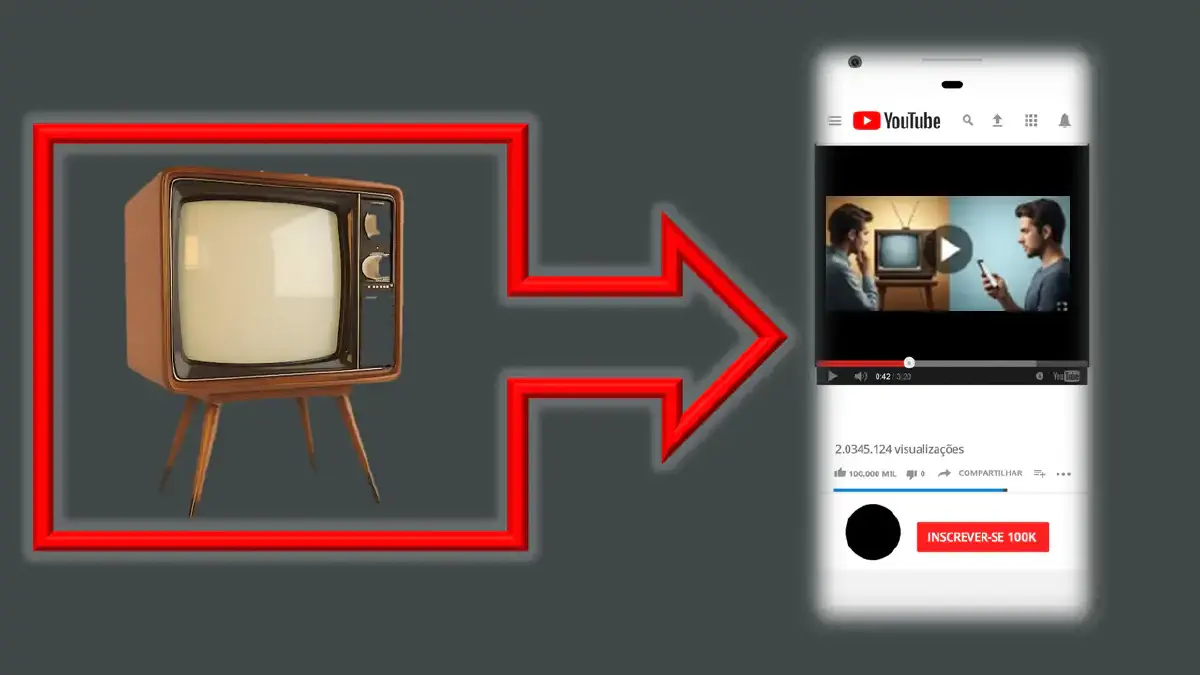
How private equity quietly bought the digital public square — and what it means for democracy
Leo Miller, 22, has never watched the nightly news. On a recent Tuesday evening in suburban Ohio, the family television sat dark while Leo stood in the kitchen, phone propped against a salt shaker, absorbing a 40-minute breakdown of a trade bill from "TechAnalysisPro"—a YouTuber with five million subscribers who also happened to be reviewing the latest smartphone at the same time. To Leo, this man is not a media personality. He is a friend: unfiltered, unsponsored, impossible to spin. What Leo does not know is that three months ago, TechAnalysisPro sold his content library and future production rights to a private equity firm in Manhattan. The script Leo found so refreshingly candid was vetted by a centralized legal team. The video's subtle pivot toward a particular economic framing was optimised by a data analytics firm owned by the same parent company. The lighting is still natural. The host still stumbles over a word, to seem real. But the opinion is managed inventory.
The digital revolution was supposed to end this kind of thing. Instead, it has produced a more efficient, more invisible, and far more profitable version of it.
The Death of the Legacy Monopoly#
For most of the 20th century, the barriers to media influence were physical: printing presses, broadcast licences, transmission towers. A handful of editors decided what constituted news, and the rest of the population received it. The internet dismantled that infrastructure—but the power it displaced did not disappear. It relocated.
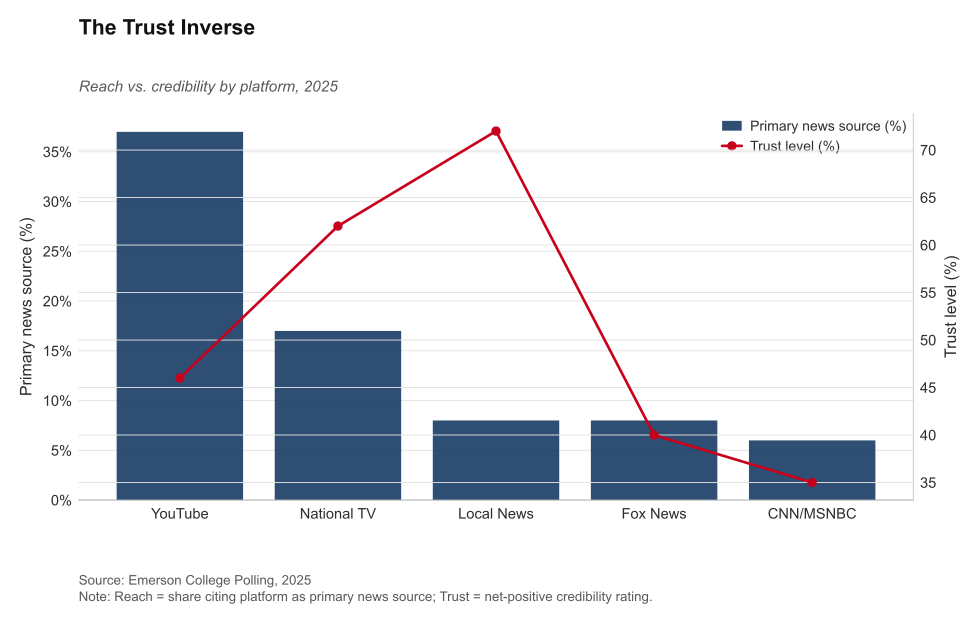
The migration was not merely one of platform but of trust. As polling from Emerson College confirmed in 2025, traditional institutions retain a veneer of credibility among older demographics but have largely failed to capture the attention of anyone born after 1995. That cohort does not distrust the YouTuber who explains geopolitics between product reviews; it trusts him precisely because he is not a network anchor. The psychological mechanism at work is the parasocial relationship—the illusion of intimacy created by years of direct-to-camera conversation. When a creator recommends a policy position, or an economic worldview, the brain does not process it as editorial opinion. It processes it as advice from a peer. The Trust Inverse Figure below illustrates this dynamic: It contrast "High Trust Levels" against "Main News Source %" across five media categories. It will visually demonstrate the "Trust Gap"—where traditional TV maintains higher perceived trust but significantly lower reach compared to YouTube and Social Media, which dominate the under-30 demographic.
For venture capital, this represented an extraordinary mispricing. The audience was already captive. The distribution infrastructure had been built at Google's and Meta's expense. All that remained was to acquire the assets and professionalise the output.
The Roll-Up Machine#
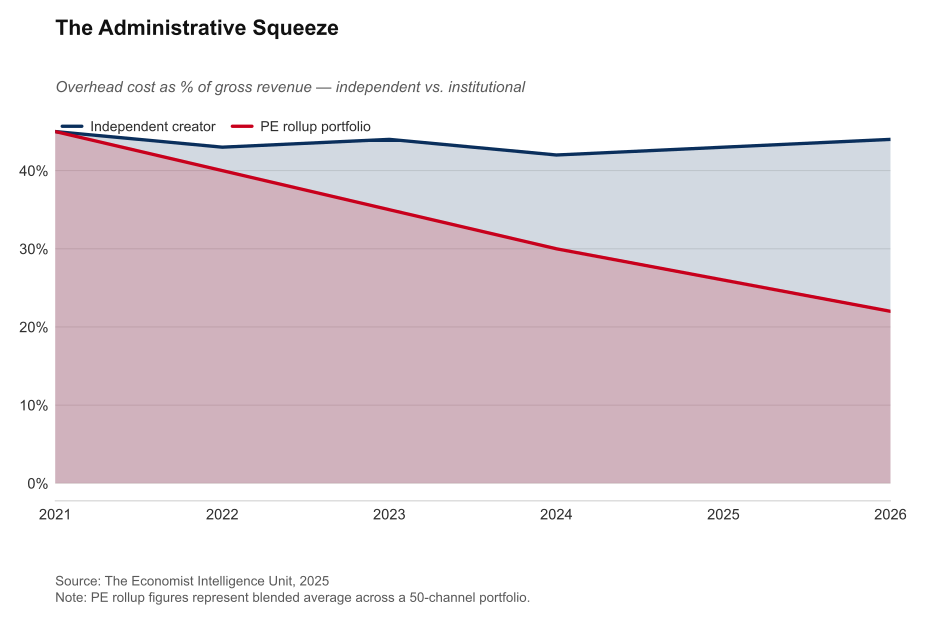
The instrument of acquisition is a strategy borrowed from industrial private equity: the roll-up. The logic is simple. An independent YouTube channel with ten million subscribers may trade at an EBITDA multiple of four to six times earnings. It must also maintain its own legal team, advertising department, video editors, and logistics for merchandise—overhead that consumes 40–50% of gross revenue. A consolidated media holding company, by contrast, can centralise those back-office functions across fifty channels, compressing costs dramatically and expanding margins. More importantly, it can command a valuation multiple of eleven to fifteen times earnings, because it now looks less like a personality-dependent content operation and more like a diversified media asset. The spread between those two multiples—the "multiple arbitrage"—is where the money is made, regardless of whether a single piece of content improves.
The Administrative Squeeze Figure illustrates the "Efficiency Objective." It shows a hypothetical reduction in administrative and logistics costs (percentage of total revenue) as independent creator projects are merged under a single Private Equity umbrella (e.g., Candle Media). The "Profit Gap" expands as the shared infrastructure lowers the cost-to-serve for billions of views.
The template was set early. When Rene Rechtman and his partners founded Moonbug Entertainment in 2018, they did not set out to make cartoons. They set out to build a machine. By acquiring "Cocomelon" and "Blippi"—low-budget channels already babysitting millions of toddlers—they assembled a content juggernaut. Three years later, Blackstone-backed Candle Media paid $3 billion for it. The founders walked away wealthy; Wall Street walked away with a proof of concept. The creator economy was no longer a collection of bedroom vloggers. It was the most efficient yield-generating asset class of the 21st century.
Similar logic drove the acquisition of Tastemade, the food and lifestyle media company, by Wonder, the food-delivery conglomerate, for $90 million. By owning the media through which consumers decide what to eat, the parent company controls the entire customer journey from impulse to delivery. This is the terminal evolution of the model: moving from selling audiences to advertisers to selling products to audiences—a closed loop in which the creative act is merely the mechanism of commercial capture.
Institutional owners also possess a structural advantage that individual creators cannot replicate: resilience to platform risk. A single creator can be financially devastated by an algorithmic change on YouTube. A conglomerate with fifty channels across children's entertainment, lifestyle, and financial commentary can absorb such shocks as routine portfolio volatility. That risk profile is precisely what attracts "dry powder" capital—the nearly $2 trillion currently held by private equity firms searching for yield in a saturated market.
The New Ministry of Truth#
The financial mechanics are relatively easy to trace. The political implications are harder to see, and harder to see is precisely the point.
Consider a politician who does not need to buy a television advertisement. Instead, through a chain of holding companies, she owns a stake in the YouTube channel that teaches your children their ABCs, the fitness influencer you follow for morning yoga, and the true-crime podcast you listen to during your commute. None of these channels will ever endorse her explicitly. They will not need to. The influence operates at the level of ambient framing—which economic assumptions go unquestioned, which social anxieties are treated as natural, which guests are invited for apparently candid conversations.
This is not necessarily a conspiracy of fabricated content. It is something more structural and, in many respects, more durable. When a venture capital firm acquires a successful YouTube channel, it rarely changes the face of the operation. It changes the incentives. Brand-safety guidelines replace editorial judgment. Performance metrics replace creative instinct. The spontaneity that built the audience is preserved as aesthetic; the independence that justified the trust is quietly retired.
The feedback loop is pervasive. Research on digital media mergers and acquisitions consistently finds that consolidated outlets shift toward "safe" viral content and away from investigative or controversial material that might unsettle institutional partners or advertisers. This systemic homogenisation is not the result of direct censorship. It is the result of rational actors responding to rational incentives—which makes it far more difficult to regulate or even name.
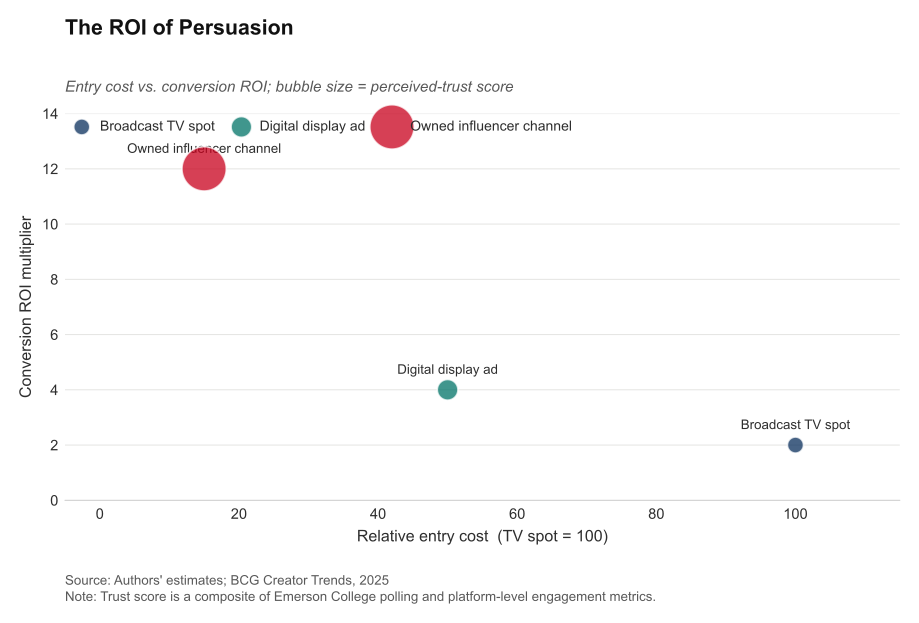
The cost-efficiency of this form of persuasion compounds the problem. In the 2024 American election cycle, billions were spent on traditional advertising with well-documented diminishing returns. A YouTube channel with 20 million subscribers can shape public sentiment through lifestyle alignment—the subtle weaving of economic or social narratives into ostensibly unrelated entertainment—for a fraction of that cost, and with a trust multiplier that broadcast television cannot approach. In the "best democracy money can buy," the most valuable asset is no longer the ability to speak loudly. It is the ability to filter quietly.
The ROI of Persuasion Figure shows the cost-effectiveness of different media types in influencing public opinion. The "Best Democracy Money Can Buy" visual. The X-axis represents "Entry Cost," and the Y-axis represents "Conversion ROI." Bubbles represent different media types (TV Spot, Influencer Partnership, Traditional Digital Ad). The size of the bubble represents "Consumer Trust %." This clearly shows why capital has migrated: Influencer partnerships occupy the "Golden Quadrant" of low cost, high trust, and high ROI.
Through advanced analytics and AI-driven content testing, conglomerate-owned channels can now iterate on narrative in real time, identifying which subtle framings resonate most with particular demographics or swing constituencies. This is not the crude propaganda of the 20th century. It is the professionalization of bias—a data-driven, continuously optimised soft power that operates beneath the threshold of conscious detection.
The Disappearing Middle#
The structural consequence of consolidation is the hollowing out of the independent creator class. Data from 2026 suggests a Pareto distribution that is growing more extreme: the top 1% of creators now account for an estimated 82% of all creator-economy revenue, up from 60% in 2022. The gap is not merely financial. Institutional owners invest in high-fidelity production, legal protection, and algorithmic promotion that an independent creator cannot replicate. The result is a "consolidation trap": to reach a mass audience, a creator must eventually sell to an aggregator, or be slowly buried by the superior distribution of the corporate alternative.
The independent creator is not disappearing because audiences stopped caring about authenticity. The independent creator is disappearing because authenticity itself has been industrialised. The lighting is still natural. The stumble is still in the script.
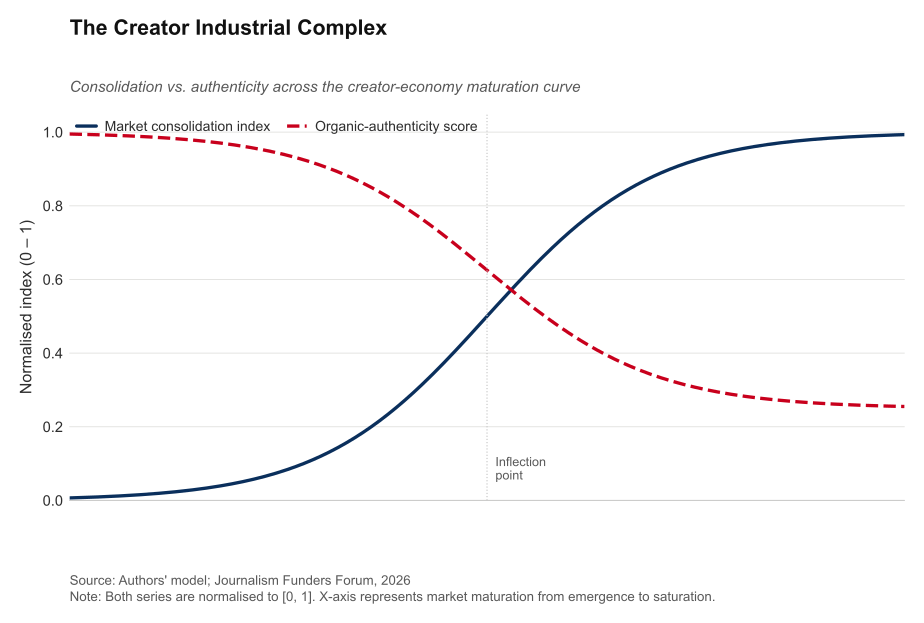
The Creator Industrial Complex (Market Maturation) Figure maps the transition from the "Organic Era" (pre-2020) to the "Consolidated Era" (2026). It charts the $252 billion market growth against the declining "Authenticity Variable"—represented by the centralization of IP ownership. It visualizes the moment when institutional viewing hours (Creator TV) surpass traditional network benchmarks.
Regulatory Failure#
Current antitrust frameworks are not equipped for this environment. Regulations focus on traditional market share—how many television stations a single entity controls. They have no vocabulary for "influence share" in a decentralised digital ecosystem. Because many creator acquisitions fall below the $100 million threshold that triggers mandatory federal review, thousands of transactions occur annually without public scrutiny, each one individually insignificant, collectively transformative.
The absence of a regulatory framework for digital media consolidation is not an oversight. It is a reflection of the pace at which the asset class has matured relative to the pace of legislative response. The creator economy as a formalised investment category barely existed in 2018; by 2025, it was a $250 billion industry. Congress has not caught up. It is not clear it is trying to.
The Path Forward#
If institutional capital continues to consolidate the creator economy at its current rate, the independent creator will likely be a marginal figure by the end of the decade. What remains will be a digital oligarchy—a series of walled gardens, each owned by a handful of investment firms, each projecting a calibrated version of reality to its assigned demographic.
The policy response, if there is one, must shift its focus from content moderation to ownership transparency. Debates about misinformation address the symptom; they do not address the structure. The structural question is who owns the channels through which information flows, and what interests those owners serve. Requiring public disclosure of beneficial ownership for channels above a given audience threshold would, at minimum, allow audiences to contextualise what they consume. Stricter capital-gains treatment of media roll-ups, or caps on the total audience reach any single ownership entity may control, would address the incentive more directly.
The gatekeepers have not gone. They have simply become invisible. The blue glow of the evening news has been replaced by the warm light of a home office and a face that feels like a friend. The editors in suits have been replaced by algorithms and holding companies that most audiences will never see and most regulators have not yet learned to name. The "best democracy money can buy" is no longer a slogan about campaign finance. It is a description of the information environment in which democratic choices are now made.
The hand on the cursor is invisible. That does not mean it is absent.
Infographic#
This infographic gives an overview of the series
References#
- BCG (Boston Consulting Group). (2025). Video Gaming and Creator Trends 2026.
- Emerson College Polling. (2025). Media Trust and Demographic Shifts in the US.
- PPC Land. (2026). Spotter Data and the Rise of Creator TV.
- The Economist Intelligence Unit. (2025). The Financialization of Digital Influence.
- Journalism Funders Forum. (2026). The Future of Independent Media in a Consolidated Era.