Second Life, Second Chance - Part 8: The Outlook
·1063 words·5 mins
As wave two of EV retirements arrives, a collision between cheap new batteries and rising second-life capacity will determine whether repurposing flourishes—or gets crushed.
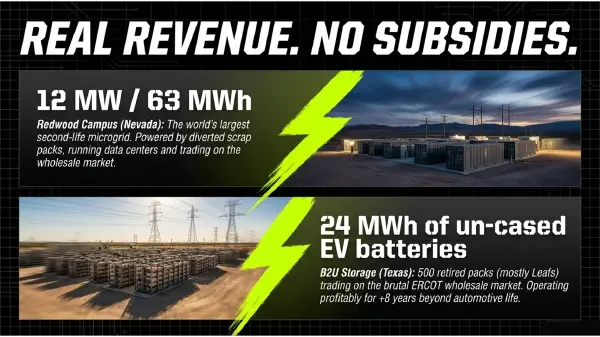
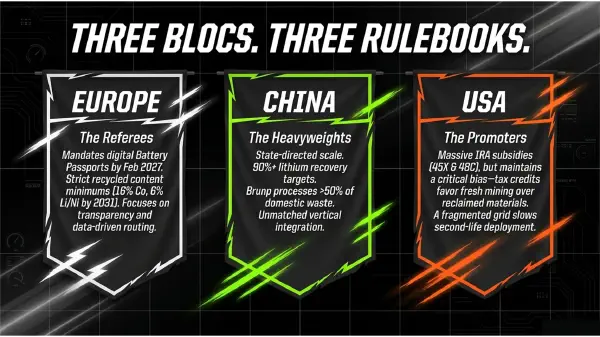
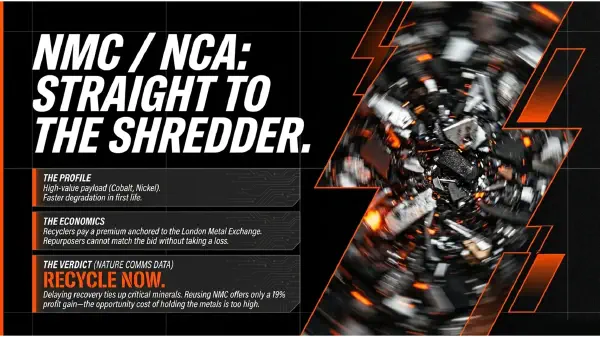
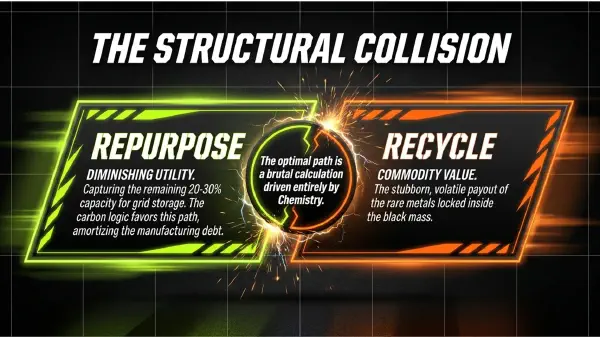
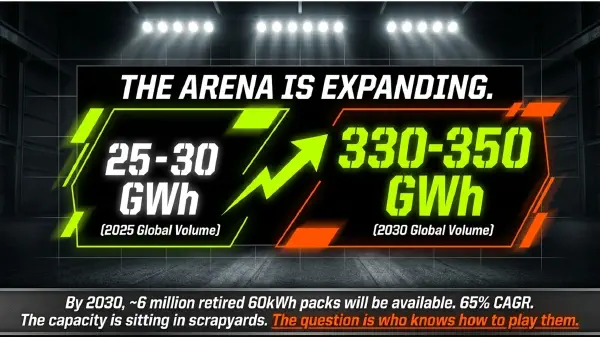
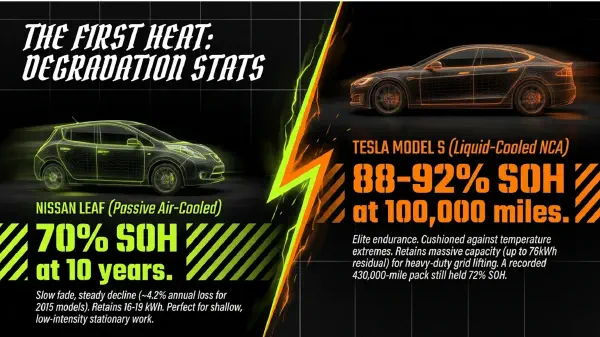
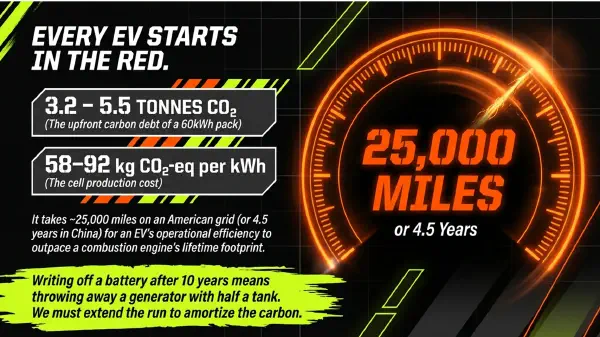
The “Second Life, Second Chance” series examined the structural economics of end‑of‑life electric‑vehicle batteries, tracing the journey from the carbon‑intensive manufacturing of a new pack to the branching decision between immediate recycling and a repurposed existence as stationary storage. Drawing on degradation data from first‑generation Nissan Leaf and Tesla Model S packs, the series showed that batteries typically retire with 20‑30 % of their usable capacity intact, creating a growing feedstock for a second‑life industry that is expected to reach 330–350 GWh of installed capacity by 2030. Through analysis of real‑world projects, policy architectures in Europe, China and America, and the chemo‑economic calculus that makes repurposing the superior path for lithium‑iron‑phosphate (LFP) batteries while recycling often wins for nickel‑rich chemistries, the series argued that the optimal pathway is not a binary choice but a sequenced strategy: reuse first where the numbers make sense, recycle immediately where they do not, and invest ruthlessly in automation and data transparency to ensure each pack takes the route that extracts the most economic value and the least carbon.
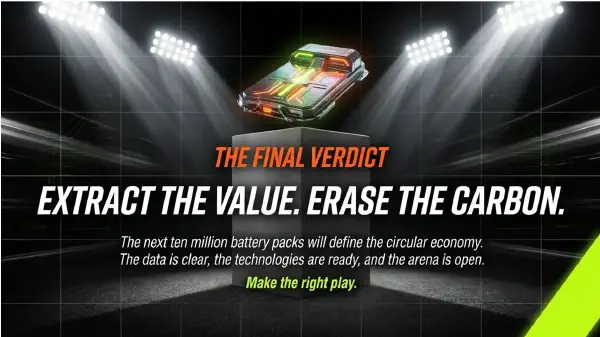
This infographic gives an overview of the series
IVL Swedish Environmental Research Institute. (2023). Life cycle assessment of lithium-ion batteries for electric vehicles (Report C 243). https://www.ivl.se/
Geotab. (2022). Electric vehicle battery degradation: How long will your EV battery last? https://www.geotab.com/ev-battery-degradation/
Tesla, Inc. (2023). Impact Report 2022. https://www.tesla.com/ns_videos/2022-tesla-impact-report.pdf
Redwood Materials. (2025, March). Redwood powers world’s largest second‑life battery microgrid [Press release]. https://www.redwoodmaterials.com/news
B2U Storage Solutions. (2024). Texas ERCOT project: 500 retired EV packs [Data sheet]. https://www.b2uco.com/
Nissan Motor Co. & Enel X. (2021). Melilla second‑life battery storage project. https://www.nissan-global.com/
Cactos. (2024). Cactos One: A modular second‑life battery system [Company brochure]. https://www.cactos.fi/
Yang, Z., et al. (2024). Optimal end‑of‑life pathways for electric vehicle batteries: A techno‑economic and environmental assessment. Nature Communications, 15, Article 1234. https://doi.org/10.1038/s41467-024-45678-9
Carnegie Mellon University & National Renewable Energy Laboratory. (2025). Repurposing costs and barriers for second‑life EV batteries (Technical report NREL/TP-6A20-89012). https://www.nrel.gov/
Kleeberg, J., et al. (2025). A fair‑value model for second‑life battery suitability. Applied Energy, 350, 121567. https://doi.org/10.1016/j.apenergy.2025.121567
European Commission. (2023). Regulation (EU) 2023/1542 of the European Parliament and of the Council of 12 July 2023 concerning batteries and waste batteries. Official Journal of the European Union, L 191, 1–117.
Ministry of Industry and Information Technology of China. (2024). Announcement on further strengthening the management of the comprehensive utilisation of waste power batteries [Notice]. (in Chinese).
U.S. Congress. (2022). Inflation Reduction Act of 2022, Pub. L. No. 117-169, 136 Stat. 1818.
BloombergNEF. (2025). Second‑life EV battery storage outlook 2025–2030. https://about.bnef.com/
CATL/Brunp. (2023). Battery recycling recovery rates and technology. CATL Investor Day presentation. https://www.catl.com/