The upfront emissions of an electric-car battery are substantial—and shrinking. But the fastest way to amortise them is to keep the battery working long after the car is scrapped.
EVERY ELECTRIC VEHICLE starts its life with a carbon hangover. Before a single kilometre is driven, the lithium-ion battery that powers it has already generated a pile of greenhouse-gas emissions, mostly from the energy-intensive processes of mining, refining and cell manufacturing. This “carbon debt” is the inconvenient truth behind the green number-plate.
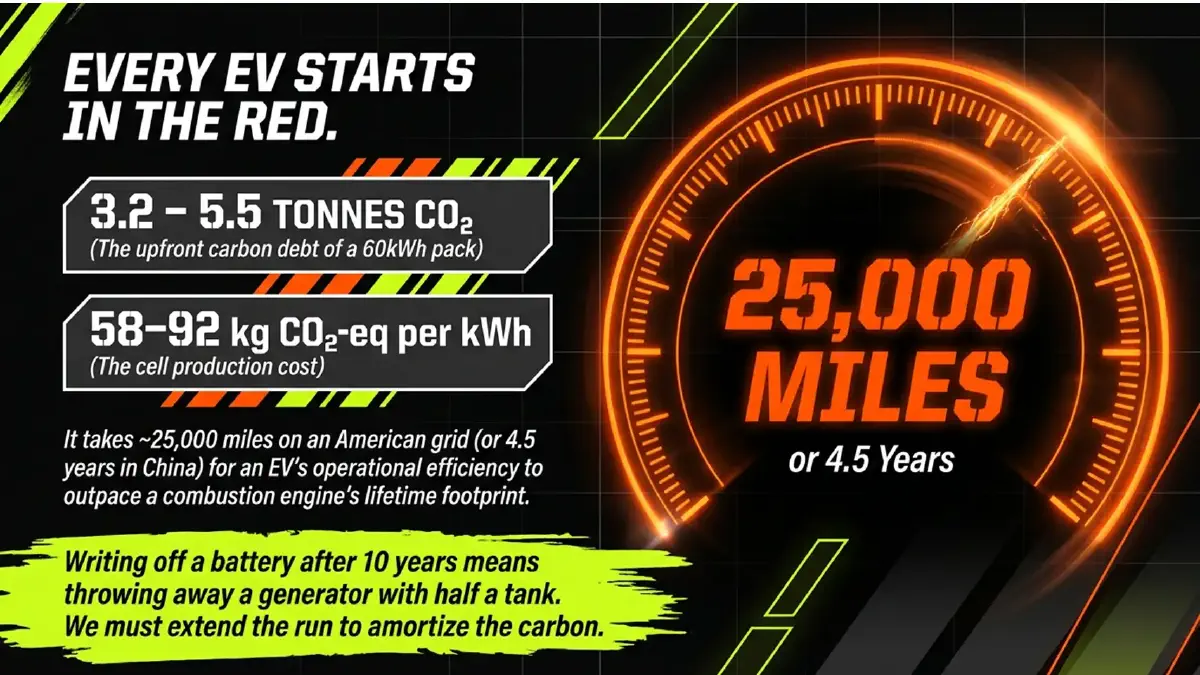
The numbers are striking. Producing one kilowatt-hour (kWh) of battery capacity typically emits between 58 kg and 92 kg of carbon-dioxide equivalent (CO₂‑eq), according to lifecycle analyses reviewed by the IVL Swedish Environmental Research Institute. An optimised lithium-iron-phosphate (LFP) cell can lower that to around 37 kg CO₂‑eq kWh⁻¹, while for a high‑nickel NMC900 chemistry it is roughly 44 kg. A typical 60 kWh battery pack—the size found in a mid‑range family saloon—therefore starts life with an embodied carbon burden of somewhere between 3.2 tonnes and 5.5 tonnes.
[FIGURE: Carbon footprint of battery production (CO2 per kWh) over years]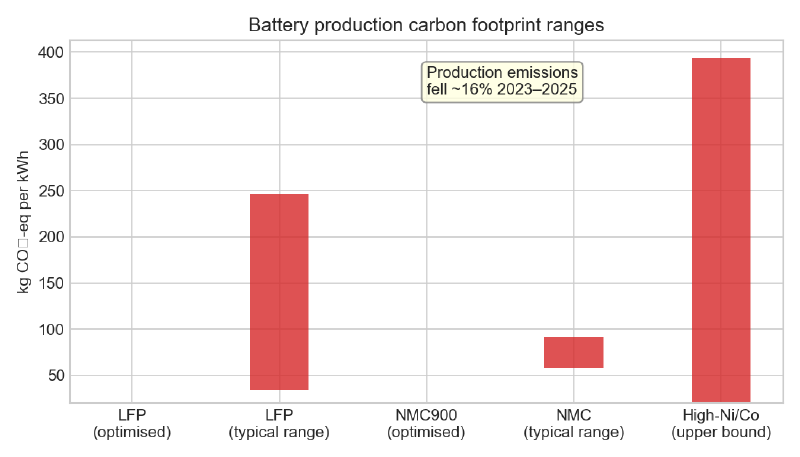
That is not a small number. It equates to burning roughly 1,400 litres of petrol, or the annual emissions from an average passenger car. In fact, manufacturing an EV currently generates about 40% more CO₂ than producing a comparable internal-combustion-engine vehicle. For all the marketing talk of “zero-emission driving”, the truth is that a new EV begins its journey deep in carbon arrears.
Yet there are two powerful reasons not to despair. The first is that the debt is being paid down faster than many critics acknowledge. Once on the road, an EV’s operational efficiency quickly closes the gap. In America, where the grid is still relatively carbon‑intensive, the break‑even mileage—the point at which the total lifecycle emissions of an EV drop below those of a petrol‑powered equivalent—is reached after about 25,000 miles (40,000 km). In China, with its coal‑heavy electricity mix, it takes around 4.5 years of average driving. In Europe, where cleaner grids prevail, the payback is even swifter.
The second reason is that battery production itself is becoming cleaner at an impressive pace. Between 2023 and 2025, the carbon intensity of cell manufacturing fell by roughly 16%, driven by gigafactory scale, improved energy efficiency and the increasing share of renewable power in industrial hubs such as northern Sweden and southern China. If current trends continue, the “embodied carbon” of a 60 kWh pack could fall below 2.5 tonnes by the end of the decade, further accelerating the climate case for electrification.
Nonetheless, a tonne of CO₂ emitted today is a tonne that stays in the atmosphere for centuries. So the question becomes: once the battery has served its purpose in a car, can the carbon already spent be put to more good use? The answer lies in what happens after the vehicle’s life ends.
The second life pays down the debt
Most EV batteries are retired from automotive use not because they are dead, but because their capacity has slipped below roughly 70-80% of the original rating—the threshold at which range anxiety becomes unacceptable for drivers. In a 60 kWh pack, that still leaves 12-18 kWh of usable storage. That may be too little for a car, but it is more than enough for stationary applications: storing solar power for an evening peak, buffering a fast-charging station, or keeping a data centre running during grid outages.
By giving the battery a “second life” as stationary storage, the carbon spent on its manufacture is amortised over a longer useful life and many more megawatt‑hours of energy throughput. Every additional kilowatt‑hour of renewable energy shifted from midday to evening displaces fossil‑fuel generation, and every cycle the ageing pack completes makes the initial carbon investment look smaller per unit of service delivered.
Thus, the most important climate metric for an EV battery may not be how far it takes a car on a single charge, but how many tonnes of CO₂ it avoids in its entire working existence—including the years spent in a warehouse, quietly balancing the grid.
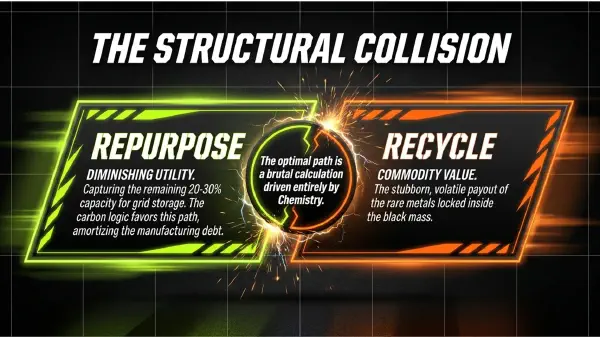
This, in essence, is the structural‑economics problem at the heart of the EV revolution. Should a retired pack be dismantled and its materials recycled, destroying the embodied energy but recovering valuable metals? Or should it first be repurposed for stationary storage, extracting more energy services before it is finally sent for material recovery? The answer depends on chemistry, labour costs and the value of the minerals inside—but the carbon logic points firmly toward a second chapter.
If the battery is the most expensive and carbon‑intensive component of an electric car, then writing it off after just eight or ten years on the road is akin to throwing away a diesel generator that still has half a tank of fuel. The climate—and, increasingly, the balance‑sheet—will reward those who squeeze every available watt‑hour from it.
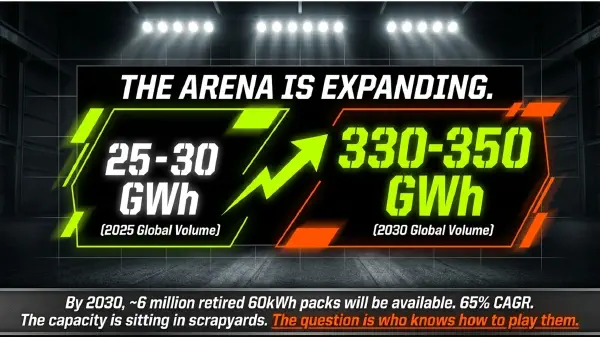
And there are plenty of candidates. More than 100,000 EVs will be taken off American roads in 2026 alone. Their batteries, most still carrying 20-30% of their original capacity, represent a distributed, ready‑made storage fleet. The race to harness them has already begun.
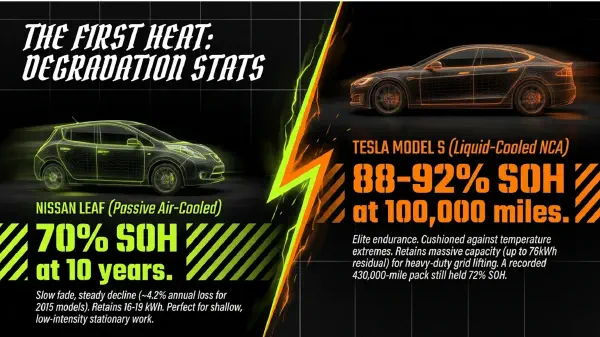
Next in the series: When an EV battery “dies”—real‑world degradation data from the first generation of Nissan Leaf and Tesla Model S packs.