First-generation electric cars are now old enough to reveal how their batteries age. The data hold the key to whether a second life is viable.
BY THE TIME an electric car is scrapped, its battery is almost never actually dead. It is merely tired—unable to deliver the range a driver demands but still capable of storing and dispatching useful amounts of energy. For the first generation of mass‑market electric vehicles, those ageing packs are now providing a trove of empirical data on exactly how much capacity remains when the wheels stop turning. And the numbers are better than many feared.
The two archetypes of the early EV era could hardly be more different in their battery management. The Nissan Leaf, launched in 2010, relied on a 24 kWh lithium‑manganese‑oxide pack with no active thermal management—just passive air cooling. The Tesla Model S, arriving in 2012, used a liquid‑cooled nickel‑cobalt‑aluminium (NCA) pack and sophisticated software to keep cells in a narrow temperature band. Their degradation trajectories reflect that engineering gap, and together they bookend the possibilities for second‑life applications.
The Leaf: slow fade, then shallow decline
Data from hundreds of early Leafs show an initial capacity loss that is noticeable but not catastrophic. In the first year of operation, most packs shed between 2% and 5% of their original capacity, a decline that drivers typically experience as a few kilometres shaved off a full charge. Over the next four years, the rate settles into a steady 2‑3% loss annually. By year five, a typical 24 kWh Leaf retains between 70% and 80% of its state‑of‑health (SOH). A 2015 model‑year Leaf degrades at about 4.2% per year—roughly double the rate of an equivalent Model S—and after a decade, around 70% of the original capacity remains.
That still leaves 16‑19 kWh of usable storage in a pack that was designed for automotive duty. It is not enough for the school run with the heater on, but it is more than many stationary storage applications require.
The Model S: liquid‑cooled endurance
Tesla’s liquid‑cooled architecture proved transformative. In the first 50,000 miles (roughly four years of average American driving), Model S packs typically lose 5‑8% of capacity. At 100,000 miles—a milestone many electric cars are now passing—the pack retains between 88% and 92% of its original rating. Tesla’s own fleet data, reported in its annual impact reports, suggests that at 200,000 miles the average loss is just 12%. One well‑documented outlier, a Model S that covered 430,000 miles, still showed 72% SOH when tested.
This is the difference that thermal engineering makes. Where the Leaf’s passive‑cooled cells endure wider temperature swings that accelerate chemical ageing, the Model S cushions its cells against the extremes, preserving both capacity and the structural integrity needed for a second tour of duty.
[FIGURE: Battery degradation trajectories for Nissan Leaf and Tesla Model S]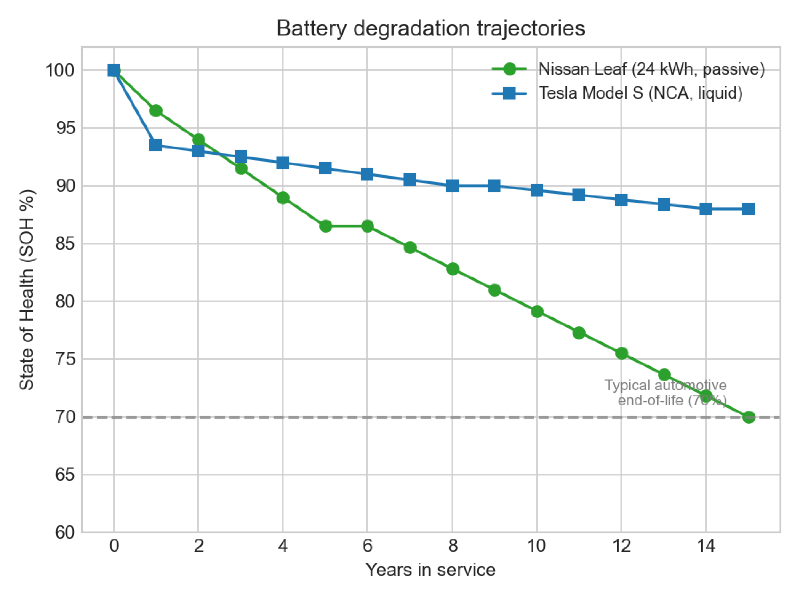
What “end of life” really means
Automotive end‑of‑life is conventionally defined as the point at which a battery can no longer deliver 70‑80% of its original capacity—the threshold below which range anxiety becomes a commercial liability. For a Leaf, that moment arrives at roughly 8‑12 years depending on climate and charging habits. For a Model S, it may not arrive until the third decade of service, long after the rest of the car has depreciated to scrap value.
But those thresholds are arbitrary when the battery is unplugged from the vehicle. A pack with 70% SOH still has 30% of its original storage capacity available; a 60 kWh pack at that level provides 18 kWh of dispatchable energy, enough to power an average British home for two days or to smooth a factory’s afternoon demand peak. The question is no longer whether such a battery can drive a car, but whether it can earn a return as stationary storage.
The feedstock for a second‑life industry
When the first mass‑market EVs reach the scrapyard, they do not arrive empty. A Leaf retired at 75% SOH delivers roughly 18 kWh of residual storage; a Model S retired at 90% SOH (after, say, 150,000 miles) offers a remarkable 76 kWh—more than a brand‑new Leaf ever had. Multiply that by the estimated 100,000 EVs that will be retired annually in America from 2026, and the potential stock of second‑life capacity rises into the gigawatt‑hours.
But capacity alone does not equal a viable business. The round‑trip efficiency, the rate of further degradation in stationary service, and the cost of disassembly, testing and reassembly all determine whether a used pack is an asset or a liability. Those are the questions the next articles will address.
Next: The second‑life marketplace—from pilots to gigawatt‑hours, who is repurposing EV batteries at scale and what are they paying?