From an airport in Rome to a data centre in the Nevada desert, five projects show that repurposed EV batteries are no longer a curiosity—they are earning real money.
THE SKEPTIC’S question about second‑life batteries has always been simple: “Does it actually work?” Pilots and white papers are abundant, but hard‑nosed investors want to see steel in the ground and a plausible return. The following five projects—spanning three continents, multiple battery chemistries and a range of business models—provide the most convincing answer yet. Together they demonstrate that repurposed packs can perform reliably in applications from grid backup to factory peak‑shaving, often at a cost that new batteries cannot match.
[FIGURE: Energy capacity of major second‑life battery deployments]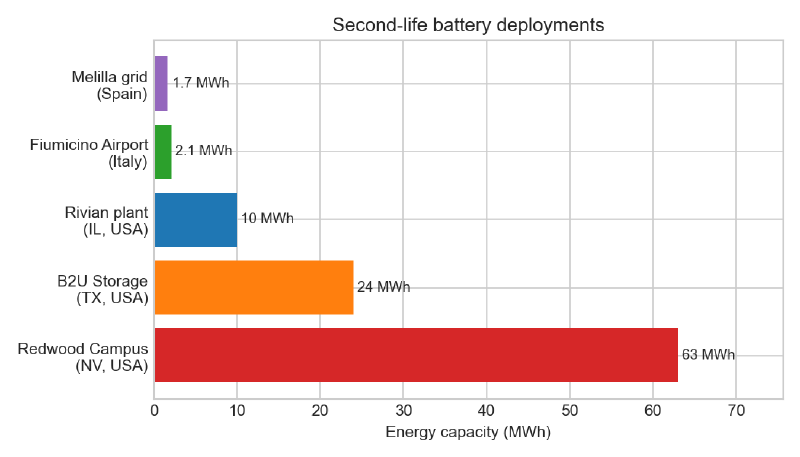
Redwood Materials Campus Microgrid, Nevada 12 MW / 63 MWh
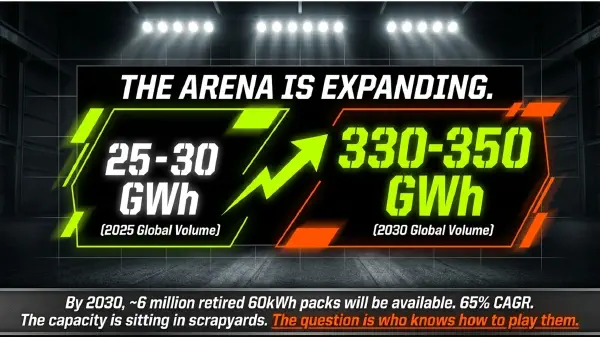
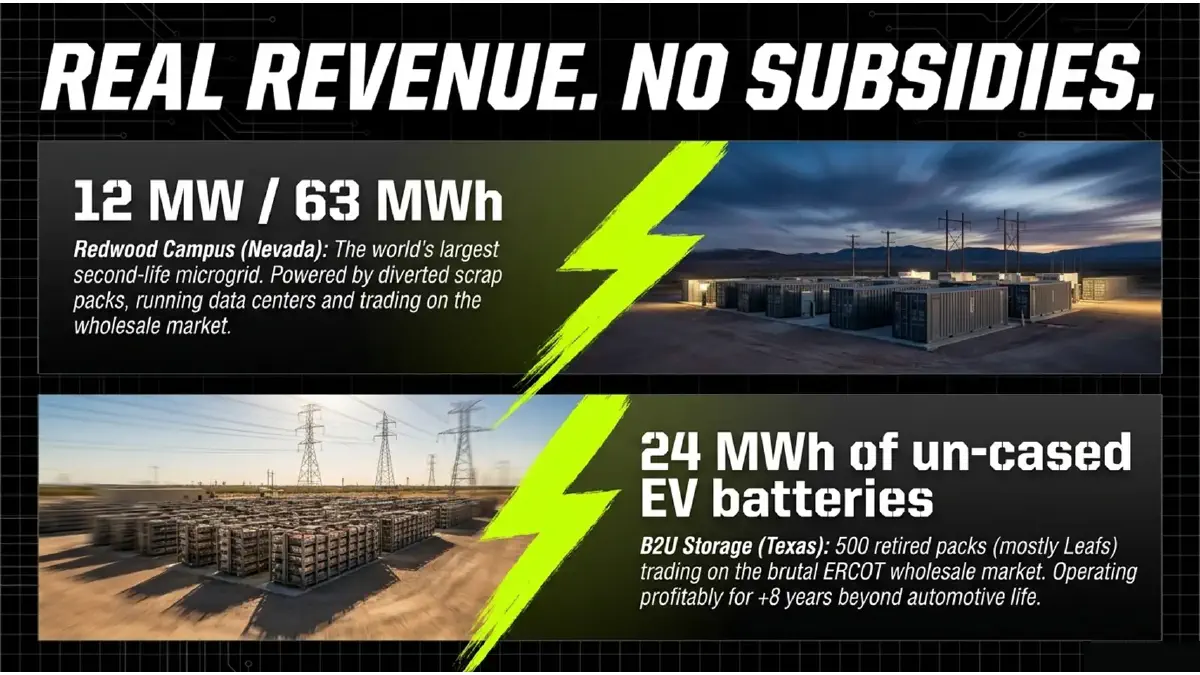
The largest second‑life battery installation in the world sits behind the headquarters of Redwood Materials, the company founded by Tesla co‑founder JB Straubel. The system stores 63 MWh of energy in thousands of repurposed EV packs—some from Tesla, some from Nissan, some from Ford—that arrived at Redwood’s gates destined for the shredder but were diverted when testing showed they still held substantial capacity. The microgrid powers a data centre, charges electric trucks and trades surplus energy into the Nevada wholesale market. It is at once a revenue‑generating asset and a living advertisement for the company’s thesis that most batteries should have a second act. Redwood now receives more than 20 GWh of end‑of‑life batteries annually and expects to deploy at least 5 GWh per year of additional second‑life capacity as the wave of retirements accelerates.
B2U Storage Solutions, Texas 500 packs / 24 MWh
On a sun‑baked lot in West Texas, 500 retired EV packs—mostly from Nissan Leafs and Honda Claritys—sit on metal racks with their original automotive casings intact. Proprietary software manages them as a single dispatchable storage asset, compensating for the varying states of health of individual packs. The system operates in the ERCOT market, charging when midday solar pushes prices to near‑zero and discharging during the evening peak. B2U claims the packs can continue this service for at least eight years beyond their automotive retirement. The project is a landmark not just for its scale but for its message: second‑life storage can compete in one of the most ruthless electricity markets in the world without subsidies.
Rivian‑Redwood Plant Storage, Illinois 100+ packs / 10 MWh
When electric truck manufacturer Rivian wanted to buffer the electricity demand of its assembly plant in Normal, Illinois, it did not order new batteries. Instead, it sent more than 100 of its own retired prototype and early‑production packs to Redwood Materials, which tested, graded and reassembled them into a 10 MWh storage system. The installation now smooths the factory’s load and shaves peak demand charges, saving the company money while providing a closed‑loop demonstration of circular manufacturing. The plant runs on batteries that were born on its own production line—a narrative that has not gone unnoticed by Rivian’s sustainability‑conscious customers.
Fiumicino Airport, Rome 84 Leaf packs / 2.1 MWh
If there is an environment more security‑conscious and risk‑averse than an international airport, it is hard to name. Yet Rome’s Leonardo da Vinci–Fiumicino Airport has quietly installed 84 second‑life Nissan Leaf packs as a 2.1 MWh energy‑storage system. The batteries provide emergency backup power and help manage the airport’s substantial electricity demand. The project, led by Enel in partnership with Nissan, subjects the packs to rigorous safety testing and continuous monitoring. That it has operated without incident at one of Europe’s busiest transport hubs is a powerful riposte to those who argue that second‑life batteries cannot be trusted in critical infrastructure.
Melilla Grid‑Island, Spain 48 used + 30 new Leaf packs / 4 MW / 1.7 MWh
The Spanish enclave of Melilla sits on the North African coast and is electrically isolated from the mainland grid. For its 90,000 residents, a blackout is not an inconvenience but a potential emergency. To reinforce the city’s diesel‑powered grid, Enel and Endesa installed a hybrid battery system: 48 used Nissan Leaf packs combined with 30 new ones, providing 4 MW of power and 1.7 MWh of storage. The used packs, having completed their driving duties elsewhere, now provide fast‑response frequency regulation and backup capacity. The project demonstrates how second‑life batteries can play a vital role in grid‑edge and island applications, where reliability is paramount and the alternative—new diesel generators—is both expensive and carbon‑intensive.
What these projects prove
Across these five installations, key patterns emerge. First, second‑life batteries rarely compete directly with utility‑scale new‑build storage on price per megawatt‑hour alone; rather, they create value in applications where the combination of modest upfront cost, deferred capital expenditure and sustainability credentials outweighs the marginal efficiency advantage of fresh cells. Second, the successful projects share a common feature: sophisticated software that monitors and manages packs individually, compensating for uneven degradation. Third, the market is maturing from subsidised pilots into economically self‑standing infrastructure, with Redwood and B2U already operating in wholesale power markets on commercial terms.
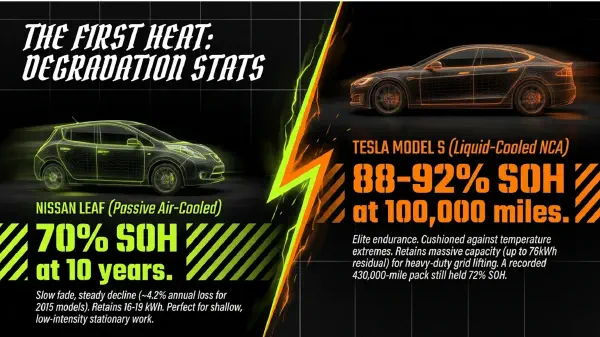
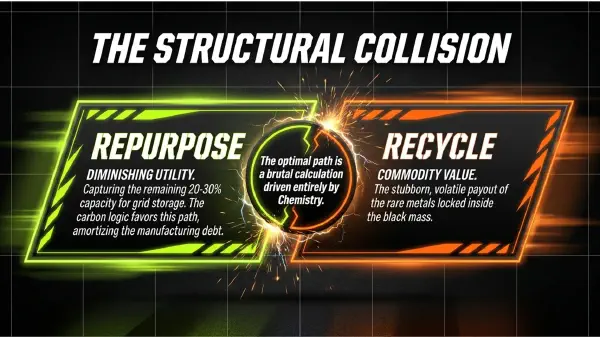
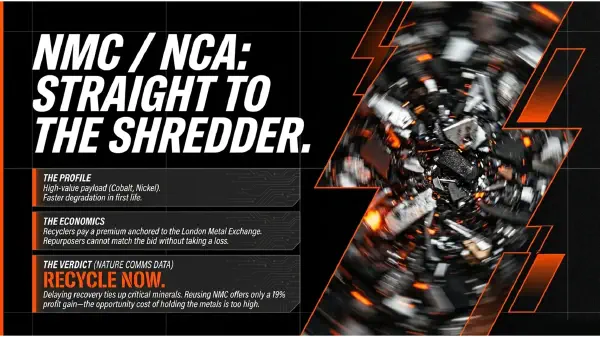
The limitations are equally instructive. Most successful deployments use shorter‑range, passively‑cooled Leaf packs in shallow‑cycling applications, where the modest remaining capacity and slower response times are not a liability. High‑performance NMC packs from premium vehicles, with their more valuable metal content, are more likely to take the recycling route unless a specific high‑value application justifies the repurposing cost. The market is learning, pack by pack, which chemistry belongs where.
The next article will step back to examine the outlook: as wave two of EV retirements arrives and new LFP batteries plunge in price, can the second‑life industry still flourish?
Next: The outlook—what the data tell us about the next 10 million packs.