

The peace dividend, that post-Cold War chimera, has not merely been spent; its accounts have been forcibly closed. For the better part of two decades, Western democracies operated under the comforting delusion that military supremacy could be maintained on a budget, subsidised by the technological inheritance of the Cold War and the assumption that interstate war was a historical relic. The data from 2025 and 2026 irrevocably shatters this premise. The global economy has undergone a profound structural metamorphosis, transitioning from a peacetime optimization of supply chains to an industrial-scale war economy.
World military expenditure reached an unprecedented $2,887 billion in 2025, an increase of 2.9 percent in real terms over the previous year. This marks the eleventh consecutive year of growth, bringing the global military burden to 2.5 percent of global gross domestic product (GDP)—its highest level since 2009. To grasp the sheer velocity of this macroeconomic shift, one need only look back a decade: over the 2016–2025 period, global defense spending escalated by a staggering 41 percent. Today, the average global citizen unwittingly contributes $352 annually to the machinery of war.
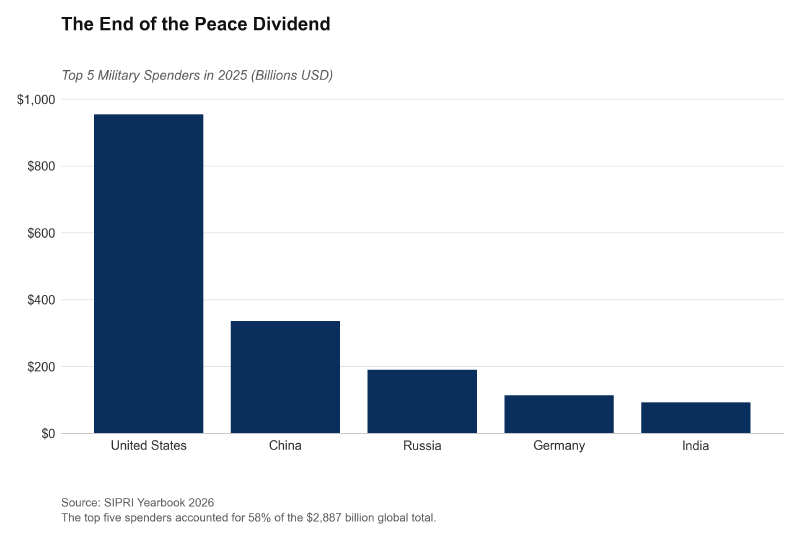
The distribution of this capital reveals a rigidly hierarchical system. The top five spenders in 2025—the United States, China, Russia, Germany, and India—accounted for 58 percent of all global military expenditure. Yet, beneath these headline figures lies a complex web of structural incentives, bureaucratic alchemy, and systemic feedback loops that guarantee this expenditure will remain permanently elevated.
Europe’s Rude Awakening and Bureaucratic Alchemy#
Nowhere is the structural shift more violently apparent than in Europe. Total military expenditure on the continent surged by 14 percent in 2025, reaching $864 billion—the sharpest annual growth in Central and Western Europe since the end of the Cold War. Driven by the protracted attritional warfare in Ukraine and the creeping realization that the American security umbrella is no longer a geopolitical absolute, Europe has been forced into rapid rearmament.
However, the mechanism driving this surge is not purely a response to Russian aggression; it is deeply embedded in the alliance's new institutional strictures. In June 2025, NATO member states agreed to a radical new military spending target: a dizzying 5.0 percent of GDP by 2035. This mandate fundamentally rewrites the social contract of European welfare states, demanding a reallocation of capital on a scale unseen since the 1950s.
Faced with the political impossibility of gutting domestic social spending to buy howitzers, European bureaucrats have resorted to creative accounting. Under the new NATO guidelines, while a minimum of 3.5 percent of GDP must be allocated to core military spending, the remaining 1.5 percent can be directed toward "defence and security-related spending". This loophole establishes a perverse structural incentive. The boundaries between core military readiness and civilian infrastructure have been deliberately blurred, allowing member states to reclassify non-military activities to meet highly politicized targets.
Italy provides the most glaring example of this systemic arbitrage, reportedly attempting in 2025 to include the costs of building a civilian suspension bridge to Sicily within its military-related expenditure. By redefining poured concrete as strategic deterrence, governments can claim compliance without enhancing actual lethality. This dynamic is falsifiable: if spending targets are met through infrastructure reclassification rather than munitions procurement, the stated goal of increased operational capacity is mathematically void, resulting in inflated budgets that distort assessments of the actual balance of forces.
The Fiscal Rubicon: Germany’s Debt Brake#
If Italy relies on accounting sleight-of-hand, Germany has opted for structural reform. In 2025, Berlin became the world’s fourth-largest military spender, allocating $114 billion to defense—a massive 24 percent year-on-year increase that pushed its military burden to 2.3 percent of GDP, exceeding the 2.0 percent threshold for the first time since 1990. Germany’s ultimate pledge to reach 3.5 percent of GDP by 2029 requires capital that simply does not exist within its traditional framework of fiscal austerity.
To bypass this, the German government engineered a systemic bypass of its own constitution. The state expanded the use of off-budget mechanisms, explicitly altering its famed "debt brake," which historically limited the government's budget deficit to 0.35 percent of GDP. Crucially, military spending above 1.0 percent of GDP is now excluded from this cap, allowing the state to finance rearmament directly through borrowing. This feedback loop guarantees that the German defense industry will be continuously fed by sovereign debt, decoupling military modernization from the constraints of domestic tax revenues.
The Indo-Pacific Arms Dynamic#
While Europe scrambles to rebuild atrophied industrial bases, the Indo-Pacific is engaged in a sustained, high-technology arms race governed by the dictates of geography and superpower rivalry. Spending in Asia and Oceania rose by 8.1 percent to $681 billion in 2025. China, the world's second-largest spender, allocated an estimated $336 billion to its military. This sustained investment drives a localized security dilemma: as Beijing modernizes, its neighbors are structurally compelled to match its capabilities.
Taiwan exemplifies this mechanism of forced expenditure. In 2025, Taipei’s military budget spiked by 14 percent to $18.2 billion, the largest year-on-year increase since at least 1988. This surge is a direct response not only to the intensification of People's Liberation Army (PLA) military drills but also to external pressure from Washington. Following demands from U.S. President Donald Trump that Taiwan increase its military spending to a staggering 10 percent of GDP, Taipei pledged to push its spending toward 5.0 percent of GDP by 2030.
Similarly, South Korea allocated $47.8 billion to defense in 2025, driven by the structural necessity of funding its "three-axis" deterrence system—missile defense, pre-emptive strike, and retaliatory capabilities—against an increasingly volatile North Korea. In South Asia, India maintained its position as the world's fifth-largest spender at $92.1 billion. Neighboring Pakistan matched this systemic pressure, increasing its budget by 11 percent to $11.9 billion, heavily driven by new orders for Chinese aircraft and missiles.
The Paradox of the American Hegemon#
The most analytically fascinating anomaly in the 2025 data is the United States. Amidst a global explosion in rearmament, U.S. military spending actually declined by 7.5 percent in real terms to $954 billion. Yet, the U.S. still commands a colossal 33 percent of the global total.
This contraction does not signal a retreat, but rather a ruthless prioritization of capital. The United States is shedding the financial deadweight of two decades of counterinsurgency to focus capital intensely on high-end, strategic deterrence in the Indo-Pacific and the Middle East. In 2025, the U.S. allocated $9.9 billion solely to the Columbia-class nuclear submarine program, and another $13.9 billion to the conventionally armed Virginia-class submarine program.
This creates a new structural reality for the global defense market: the United States will increasingly monopolize the highest tiers of technological development (nuclear modernization, advanced autonomous systems, and space-based assets), while aggressively pushing its allies to finance and construct the conventional armor, artillery, and short-range interceptors required for regional defense. The U.S. is weaponizing its alliances, demanding that client states assume the macroeconomic burden of their own immediate security.
The Rebirth of the Iron Triangle#
This macroeconomic surge has fundamentally rewired the global defense industry. During the post-Cold War drawdown of the 1990s, the "Iron Triangle"—the symbiotic relationship between defense contractors, military leadership, and government legislators—was widely decried as a collusive monopoly that drove up costs. Today, this triangle has been rehabilitated from a social evil into a national security imperative.
Governments realize that acquiring next-generation, network-centric weapons is too complex and expensive to be managed by adversarial contracting. The modern defense market requires massive up-front capital investments that only state actors can underwrite. Consequently, the relationship between the state and the defense industry has transitioned from confrontation to integration. Policies promoting "Smart Acquisition," public-private partnerships, and integrated project teams are now the norm. The state no longer merely buys weapons; it subsidises the financial risk of the corporations building them.
This has resulted in an aggressively consolidated market. The defense-industrial hierarchy is incredibly narrow at the top. The five mega-primes of the U.S. defense sector—Lockheed Martin, Boeing, Northrop Grumman, General Dynamics, and Raytheon—dominate the global ecosystem. As lead systems integrators, these firms manage vast supply chains that stretch across the globe, subordinating smaller, second-tier European and Asian companies into niche roles. The massive influx of capital in 2025 and 2026 will not democratize the defense industry; it will further entrench the oligopoly of these mega-primes, who alone possess the scale to absorb the billions of dollars flowing from European and Asian treasuries.
The Opportunity Cost of Survival#
The structural shift toward a global war economy relies on a brutal macroeconomic trade-off. The $2,887 billion burned on the altar of deterrence in 2025 carries profound opportunity costs. Analytical data models routinely highlight the asymmetry of global priorities: the United Nations Sustainable Development Goal (SDG) for global education could be fully financed with well under 10 percent of annual global military spending. Eliminating extreme poverty and world hunger entirely would cost just over 10 percent of this total.
These statistics are not moral judgements; they are cold economic realities. The capital consumed by the production of Virginia-class submarines and drone swarms is capital diverted from civilian infrastructure, public health, and commercial innovation. Yet, in the current geopolitical paradigm, states view military expenditure not as a discretionary luxury, but as the foundational prerequisite for sovereignty.
The global defense industry has entered an era of permanent mobilization. Propelled by inviolable NATO spending targets, debt-financed procurement, and the strategic demands of multipolar containment, defense budgets will continue to capture an expanding share of global GDP. The peace dividend is a closed chapter of economic history; the era of industrial-scale attrition has begun.