

The Hardware Trap and the Drone Age
In the 1980s, the American defense economist Thomas Callaghan Jr. coined the term "structural disarmament" to describe a fatal paradox in modern military procurement. As weapon systems become increasingly sophisticated, their development and production costs accelerate at a rate that vastly outpaces baseline defense budgets. This compels modern militaries to buy fewer and fewer units over time, resulting in forces that possess exquisite technological superiority but fundamentally lack the volume necessary to sustain high-intensity, attritional combat.
For decades, Western defense ministries accepted this trade-off, investing their capital into highly complex, low-volume platforms—stealth fighters, nuclear submarines, and multi-million-dollar interceptor missiles. The logic relied on a comforting assumption: that future wars would be decided by a handful of precision strikes, and that any incoming threats would be similarly scarce, sophisticated, and symmetrical.
The battlefields of the 2020s have violently corrected this assumption. From the rugged mountains of the Caucasus to the oil refineries of the Persian Gulf, a new paradigm has emerged, characterized by the democratization of lethality. Adversaries have discovered that they do not need to match Western technological sophistication; they only need to exploit its price tag. This is the essence of the "hardware trap": an inescapable economic feedback loop where a state bleeds itself dry by using Ferrari-priced interceptors to shoot down moped-priced drones.
The Canary in the Coal Mine: Nagorno-Karabakh
The structural inversion of modern warfare was first conclusively demonstrated during the 2020 Nagorno-Karabakh conflict. To the uninitiated, the war was a localized territorial dispute. To the military strategist, it was the first war in human history won primarily through the application of unmanned aerial systems (UAS).
Armenian forces entered the conflict relying heavily on legacy Soviet-era armor and entrenched fortifications, protected by ground-based air defense systems. Azerbaijan completely bypassed this traditional defensive architecture from the sky. Utilizing a combination of Turkish Bayraktar TB2 medium-altitude drones and Israeli-made Harop and Skystriker loitering munitions, Baku methodically dismantled the Armenian ground forces.
The most alarming revelation from the Caucasus was not merely that tanks were vulnerable, but that the very systems designed to protect them were systematically hunted and destroyed. Armenian air defenses, notably the 9K33 Osa surface-to-air missile batteries, were decisively neutralized by top-attack munitions. The key to this victory was a revolution in sensors, not just shooters. By networking commercial and military-grade optics, Azerbaijani forces achieved continuous surveillance, turning the battlefield into a transparent kill box.
The strategic takeaway was profound. A fleet of relatively cheap drones could achieve local air superiority and inflict catastrophic losses on a heavily mechanized, conventional army. The conflict proved that the barrier to entry for precise, devastating airpower had plummeted, allowing small- and medium-sized nations to project lethal force without the crippling expense of maintaining manned combat aviation fleets.
The Arithmetic of Interception
Despite the warnings of 2020, Western defense primes remained deeply incentivized to optimize for a business model that produces low-volume, high-margin interceptors. These engineering marvels are designed to hit a bullet with a bullet, but their deployment against mass-produced, low-margin strike assets creates a ruinous economic asymmetry.
This theoretical peril became a stark, empirical reality during the 2026 war between the United States, Israel, and the Islamic Republic of Iran. On February 28, 2026, the United States and Israel launched Operations Epic Fury and Roaring Lion, initiating a massive decapitation strike against Iranian leadership and infrastructure. The initial strikes were highly effective, neutralizing Supreme Leader Ayatollah Ali Khamenei and devastating the Islamic Revolutionary Guard Corps (IRGC) command and control. The U.S. executive branch triumphantly declared that Iran's air force was in ruins and its ability to launch missiles was dramatically curtailed.
Yet, the decapitation of a regime does not instantly vaporize its distributed, decentralized arsenals. Stripped of its traditional command structure, Iran and its regional proxies engaged in a relentless campaign of horizontal escalation. Tehran's retaliation, dubbed Operation True Promise IV, exposed the mathematical limits of American and Israeli defensive depth.
Rather than seeking to penetrate Western defenses with a handful of highly sophisticated weapons, Tehran sought to drown them. Over the course of 41 days, the Iranian axis targeted seven Arab countries with an astonishing 6,413 missiles and drones. Iran maintained a daily fire rate of approximately 15 to 30 ballistic missiles paired with 50 to 100 one-way attack drones. This was not a singular shock; it was a sustained industrial assault designed to exhaust Western magazines.
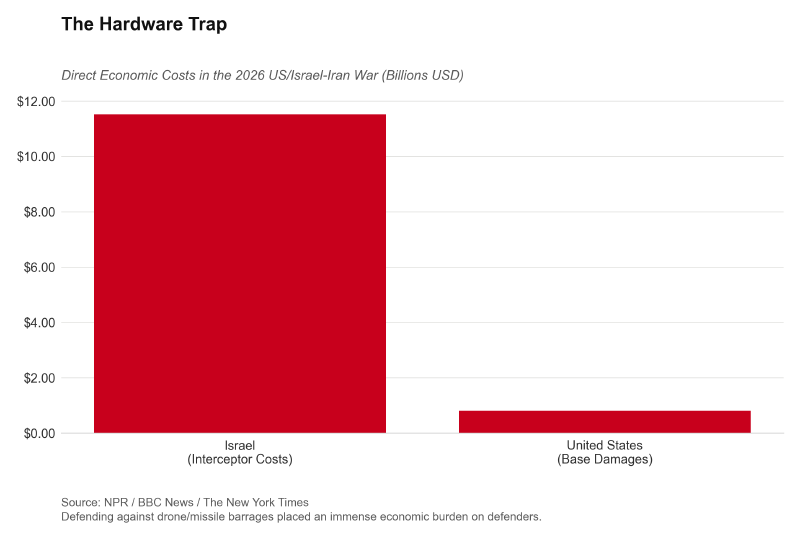
This sustained tempo forced a brutal burn rate on allied interceptor stockpiles. In merely the first 36 hours of the war, the United States and Israel consumed over 3,000 advanced munitions. Defending against these daily barrages placed an immense economic burden on the defenders. Intercepting a crude, mass-produced Shahed drone with a multi-million-dollar Patriot or Arrow missile results in a technical victory but a macroeconomic defeat.
The asymmetric costs were staggering. The sheer volume of the swarm ensured that some munitions invariably leaked through the defensive net. The United States suffered an estimated $800 million in direct damages to its military bases across the Middle East. More critically, Iran specifically targeted the high-end sensors that underpin the allied air defense network. The destruction of two highly advanced American early-warning radars—the AN/FPS-132 in Qatar and the AN/TPS-59 in Bahrain—highlighted a severe vulnerability. As defense analysts grimly noted, the primary strategic concern was not just the financial "mineral bill" of losing these exquisite radars, but the extreme fragility of their highly concentrated supply chains and the extensive, multi-year timelines required to manufacture replacements.
The Proliferation of the Swarm
The 2026 conflict also underscored how the proliferation of unmanned technology has empowered non-state actors to impose state-level strategic costs. The Iranian 'Axis of Resistance'—comprising Hezbollah in Lebanon, the Houthis in Yemen, and the Popular Mobilization Forces (PMF) in Iraq—seamlessly integrated into the assault, acting as force multipliers. The PMF launched continuous drone strikes against U.S. targets in Iraq and Kuwait, while the Houthis escalated ballistic missile fire against southern Israel and threatened critical maritime chokepoints in the Red Sea.
Crucially, the barrier to entry for this type of attritional warfare has vanished. By the time of the conflict, intelligence estimates indicated that at least 23 distinct non-state actors globally had successfully purchased or modified commercial off-the-shelf unmanned aerial systems for surveillance and lethal attack capabilities.
The integration of civilian technology into the kill chain has inverted the traditional defense acquisition model. In the maritime domain, combatants retrofitted civilian speedboats into satellite-guided unmanned surface vessels using commercial satellite internet systems like Starlink, enabling them to strike high-value naval targets hundreds of kilometers away. This hybridization of commercial hardware and military explosives allows militias and proxy groups to field bespoke cruise missiles at a fraction of the cost of a traditional defense contractor.
Procurement at the Speed of Software
The democratization of lethality is not solely a hardware problem; it is fundamentally driven by a software asymmetry. The traditional Western acquisition process is entirely unsuited for the iteration speeds required in the drone age.
When the United States military sets out to acquire a new unmanned system, the process is bound by rigid, bureaucratic protocols. Requirements are gathered over years, reflecting the operational environments of past conflicts rather than the realities of the present. For example, drone contracts awarded by the U.S. military in 2018 were based on requirements formulated during counterinsurgency operations in Iraq and Afghanistan. By the time those systems are fielded, the operational realities they were designed for have vanished.
In stark contrast, the development cycles witnessed on the frontlines of Ukraine and the Middle East operate on the timeline of weeks, not years. Combatants continually iterate their software to overcome electronic warfare (EW) jamming and GPS spoofing. When radio links are severed, software developers implement "terminal guidance" driven by machine vision and artificial intelligence. This allows a cheap, mass-produced drone to visually lock onto a target—such as a multi-million-dollar radar dish or an armored personnel carrier—and autonomously complete its strike, completely independent of external navigation signals.
This software-defined warfare effectively obsoletes legacy defense systems. A multi-billion-dollar air defense network can be rendered ineffective overnight by a software patch coded by a startup in a decentralized innovation hub. To counter the saturation of attack drones, combatants are now fielding "drone interceptors"—fixed-wing or quadcopter UAS specifically programmed to fly at high altitudes and autonomously collide with incoming loitering munitions. This approach hints at the only viable long-term solution to the hardware trap: fighting cheap mass with cheap mass.
Escaping the Hardware Trap
The strategic reality of the 2026 war is unavoidable: a military architecture built upon the premise of low-volume, exquisite defense cannot survive a high-volume, attritional war. No amount of sovereign wealth can mathematically sustain an interception strategy where the defender is structurally compelled to spend a hundred times more per engagement than the attacker.
Furthermore, the United States faces its own offensive hardware trap. In executing strikes against hardened Iranian targets, the U.S. drew heavily upon its pre-war stockpile of roughly 4,000 Tomahawk cruise missiles, expending over 1,000 Joint Air-to-Surface Standoff Missiles (JASSM) in the first four weeks of the war alone. Replacing these high-end munitions exposes the bottleneck of the Western defense-industrial base. While the U.S. defense sector has the capacity to scale up JASSM-ER production to roughly 860 units annually, this output pales in comparison to the thousands of drones an adversary can manufacture in a single month using commercial supply chains.
To escape the hardware trap, the global defense industry must radically shift its production incentives and operational doctrine. Western militaries must acknowledge that survival on the modern battlefield requires masking forces from an omnipresent canopy of thermal and infrared sensors, employing multispectral decoys, and utilizing aggressive electronic warfare to blind the adversary.
More importantly, the future of integrated air and missile defense cannot rely exclusively on firing sophisticated interceptor missiles from siloed batteries. It demands a holistic embrace of non-kinetic effectors—directed energy weapons and high-power microwaves—alongside the institutionalized mass production of attritable, autonomous systems.
Until the Western defense-industrial base figures out how to drive the cost of a defensive kill down to parity with the cost of the incoming threat, it will remain captive to the hardware trap. The enduring lesson of the 2026 war is that in an era of democratized lethality, an exquisite defense is merely a more expensive, slower path to defeat.