

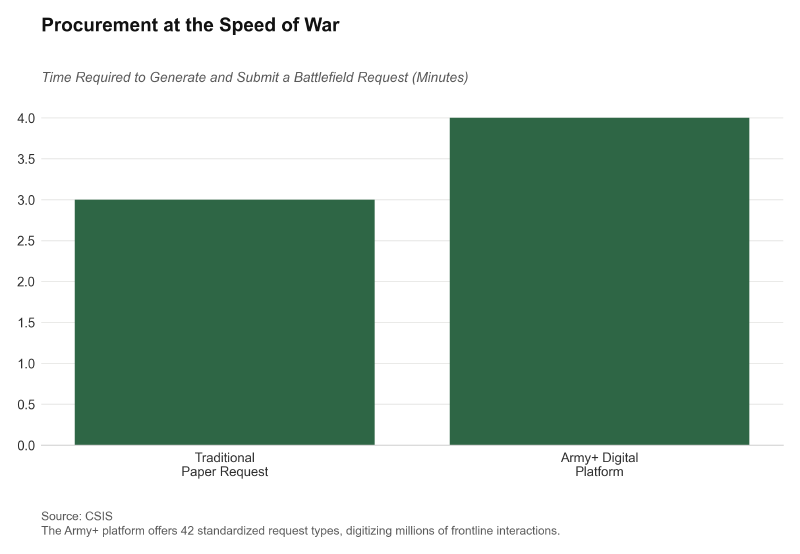
Procurement at the Speed of War#
To understand the systemic failure of traditional Western defense procurement, one must examine its relationship with time. Built during the post-Cold War era of unquestioned technological supremacy, the acquisition bureaucracies of the United States and Europe operate under the assumption that time is a luxury the state can afford. The standard procurement cycle—conceptualization, requirement gathering, competitive bidding, development, testing, and eventual fielding—is a rigidly sequenced mechanism designed primarily to minimize financial risk and distribute political patronage, rather than to rapidly generate combat lethality.
When the United States military formulates requirements for a new unmanned system, the process routinely takes years, reflecting the operational environments of past conflicts rather than the fluid realities of the present. By the time these exquisite, multi-million-dollar platforms exit the factory floor, the electronic warfare (EW) landscape they were designed to penetrate has entirely fundamentally altered. In an era of high-intensity, software-defined warfare, this bureaucratic friction is not merely an administrative annoyance; it is a structural vector of vulnerability.
The battlefields of Ukraine have violently dismantled this peacetime paradigm. Forced into a war of national survival against an adversary possessing overwhelming quantitative superiority, Kyiv recognized early that it could not out-produce Russia in raw tonnage. Instead, it had to out-iterate it. To achieve this, Ukraine engineered a radical metamorphosis of its defense-industrial base, transitioning from a bloated, centralized, Soviet-legacy conglomerate into a highly agile, digitized ecosystem. This transformation was driven by two groundbreaking systemic innovations: a macroeconomic funding mechanism known as the "Danish Model," and a digital logistics architecture that directly wired the trenches to the factory floor.
The Capital-Capacity Paradox#
Over the initial years of the Russian invasion, Ukraine’s domestic defense sector experienced an unprecedented industrial expansion. In 2022, the country’s annual defense production capacity stood at a modest $1 billion. By early 2024, propelled by an explosion of domestic start-ups and wartime deregulation, that capacity had surged to roughly $20 billion.
However, this industrial triumph birthed a severe macroeconomic paradox. While Ukrainian factories possessed the physical capacity to produce $20 billion worth of weapon systems, the financially exhausted Ukrainian state budget could only afford to procure approximately $6 billion. As Ukraine’s then-Minister of Strategic Industries Oleksandr Kamyshin bluntly observed, the state was forced to leave two-thirds of its domestic manufacturing capacity dormant simply because it lacked the sovereign liquidity to issue contracts.
Simultaneously, the traditional pipeline of Western military assistance was seizing up. Partner nations had largely exhausted their transferable stockpiles of legacy equipment, and Western defense mega-primes—optimized for low-volume, high-margin production—were structurally incapable of scaling their manufacturing lines at a pace commensurate with Ukraine’s attritional burn rate. Capital was trapped in sluggish Western bureaucracies, while vital manufacturing capacity sat idle in Ukraine.
The Danish Bypass#
The solution to this market failure emerged through a novel mechanism of international defense cooperation pioneered by Copenhagen. Rather than using its defense budget to buy weapons from its own domestic contractors or American mega-primes, Denmark opted to inject its capital directly into the Ukrainian defense-industrial base.
The "Danish Model" functions as a highly efficient, multi-stage bypass of the traditional procurement bottleneck. The process begins with the Ukrainian General Staff identifying an acute capability gap on the frontline. The Ministry of Defense matches this operational demand with a vetted domestic manufacturer capable of rapid production. The partner nation then directly funds that specific contract.
The mechanism proved its efficacy almost instantly. Denmark’s initial tranche of €50 million financed the domestic production of 18 Bohdana self-propelled howitzers. Bypassing the multi-year delays inherent in Western foreign military sales (FMS), these heavy artillery systems rolled off the Ukrainian production lines and were delivered to frontline units within a staggering two months of the agreement being signed.
By establishing a direct financial conduit between allied treasuries and Ukrainian assembly lines, the Danish Model institutionalized a highly falsifiable economic reality: capital deployed at the point of geographic need yields faster, cheaper lethality than capital routed through foreign intermediaries. The model has since scaled aggressively. In 2024, approximately $400 million flowed through this mechanism; by 2025, that volume had exploded to $6 billion, effectively doubling the purchasing power of the Ukrainian Ministry of Defense. Multilateral partners—including Sweden, Norway, Canada, and the European Union (utilizing revenues from frozen Russian assets)—anticipate funneling up to $10 billion through these localized procurement mechanisms in 2026.
The model has also proven remarkably adaptable. While Denmark routed its funds through the Ukrainian state apparatus, the Netherlands evolved the architecture by signing contracts directly with Ukrainian drone manufacturers. This variant addresses a critical bottleneck in wartime production: cash flow. Direct Dutch contracting allows for massive pre-payments—often reaching 50 to 70 percent of the total contract value—providing Ukrainian start-ups with the vital working capital required to aggressively scale their supply chains. Crucially, the system has not sacrificed accountability for speed; the mechanism successfully passed a rigorous joint audit conducted by Deloitte Denmark and the Ukrainian Ministry of Defense, proving that transparent, rules-based procurement can be sustained even under the pressures of martial law.
The Digital Nervous System: Army+#
Solving the macroeconomic funding gap was only half of the equation. A defense-industrial base is fundamentally an information processing system; its output is only as effective as the data it receives from the end-user. In the traditional Western model, the transmission of battlefield feedback to defense contractors is a sluggish, multi-year process mediated by layers of procurement bureaucracy.
Ukraine chose to eliminate the bureaucracy entirely through relentless digitization. Historically, the Ukrainian military suffered from a paralyzing reliance on Soviet-era paperwork, processing an estimated 20 million physical, paper-based requests annually. In the fast-paced environment of drone warfare—where the half-life of a tactical innovation is measured in weeks—this analog friction was deadly.
The state's response was the deployment of "Army+", an encrypted, mobile application designed to act as the digital nervous system of the Armed Forces. The platform standardized frontline administration, offering soldiers 42 distinct, digitized request types that can be generated, cryptographically signed, and submitted through a secure ID-based system in a matter of minutes. Commanders can review and batch-approve up to 40 requests simultaneously from a smartphone, entirely eliminating the logistical lag of physical signatures.
Yet, the true strategic value of Army+ extends far beyond administrative efficiency. The platform transformed the smartphone into a mass data-aggregation tool. The Ministry of Defense instituted regular, app-based surveys, capturing real-time, granular feedback from hundreds of thousands of warfighters across the front. This effectively solved the principal-agent problem of military procurement, allowing central planners to base resource allocation on the lived, empirical realities of the trenches rather than the theoretical assumptions of generals in the capital.
Closing the Feedback Loop: DOT-Chain Defence#
The apex of Ukraine’s procurement revolution is the integration of the soldier directly into the industrial design cycle. The Ministry of Defense engineered a seamless digital linkage between the Army+ frontline application and "DOT-Chain Defence," a fully digitized, state-run military procurement and logistics marketplace.
In this integrated ecosystem, when a frontline operator encounters a technological failure—such as a reconnaissance drone falling victim to a newly deployed Russian GPS-spoofing frequency—they do not file a paper report to their commanding officer. Instead, the soldier opens Army+, inputs the drone’s serial number, selects the specific malfunction from a standardized drop-down menu, and submits the data.
This operational feedback bypasses the military chain of command entirely and is instantly transmitted to the manufacturer's digital dashboard within the DOT-Chain system. The manufacturer receives high-fidelity, geolocated data regarding their hardware's failure in real-time. If clarification is needed, the contractor can communicate directly with the frontline operator via a secure, closed-loop messenger to diagnose the EW interference and push a software patch.
This is the essence of forward-deployed engineering. It allows Ukrainian developers to iterate their electronic warfare countermeasures and optical-recognition targeting algorithms in days rather than years. It acknowledges a fundamental reality of modern conflict: the hardware of a drone is merely a cheap, commoditized vessel. The true weapon is the software orchestration layer, and the victor is the force that can update that software faster than the adversary can adapt.
Furthermore, DOT-Chain Defence operates as a transparent, data-driven marketplace. By digitizing every transaction from selection to final delivery, the system aggregates disparate tactical demands into massive, consolidated orders. This provides Ukrainian defense contractors with the predictable, high-volume demand signals they require to invest in expanded assembly lines. It also eradicates the informational silos that previously allowed combat units to unknowingly procure obsolete systems; DOT-Chain provides a centralized repository of "truth" regarding which technologies are currently surviving on the battlefield and which are failing.
Remarkably, this vast digital ecosystem was built to exacting international security standards. In 2025, DOT-Chain Defence passed the U.S. National Institute of Standards and Technology (NIST) Risk Management Framework assessment, ensuring that its cyber defenses meet the stringent benchmarks required by the Pentagon and the CIA.
The New Bureaucracy of War#
The transformation of the Ukrainian defense sector provides a stark, empirical lesson for the rest of the world. In the 21st century, digitization must be treated not as an administrative upgrade, but as a core warfighting capability.
The traditional defense-industrial model relies on the state acting as a highly centralized, omniscient purchaser, dictating specifications to a handful of consolidated mega-primes. Ukraine has proven that in an environment of rapid technological disruption, the state must instead act as a platform. By building the digital infrastructure (DOT-Chain) and establishing the regulatory framework (the Danish Model), the government enables thousands of decentralized, autonomous actors—from frontline squads to garage-based drone start-ups—to interact, iterate, and transact at the speed of the market.
As global defense budgets swell to record highs, Western nations are pouring hundreds of billions of dollars into legacy procurement architectures that are structurally incapable of fielding technology relevant to the modern battlefield. Until the West abandons its peacetime illusion that it can out-spend the pace of software innovation, its defense industrial base will remain captive to its own bureaucratic inertia. The enduring lesson of the Ukrainian procurement revolution is that capital without velocity is obsolete, and the most decisive weapon on the modern battlefield is the speed of the feedback loop.