

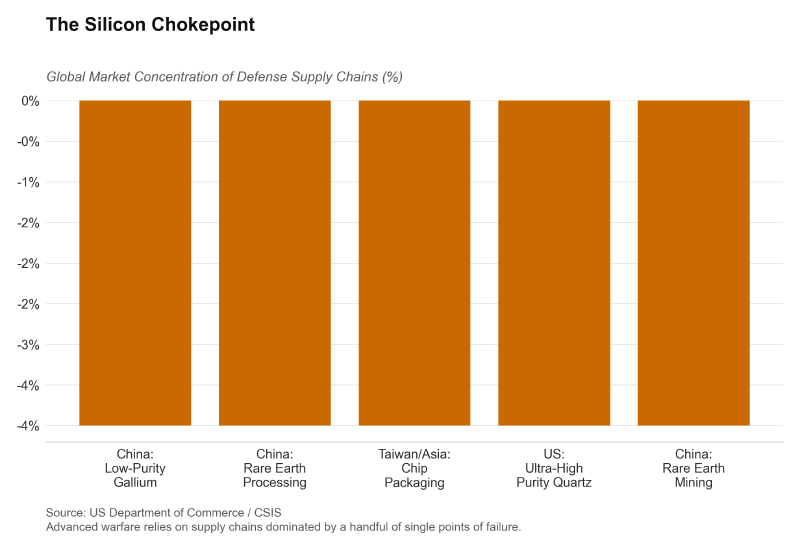
The Silicon Chokepoint#
When a modern cruise missile strikes its target, or a drone swarm autonomously navigates a contested electronic warfare environment, the kinetic detonation is merely the final punctuation mark of a vastly more complex, invisible chain of events. The true weapon of modern warfare is not the explosive yield or the aerodynamic airframe; it is the algorithmic intelligence guiding it. This intelligence is etched onto microscopic slivers of silicon, bathed in ultra-pure chemicals, and doped with exotic rare-earth minerals that the average citizen cannot spell, let alone locate on a map.
For the past three decades, the global defense industry, blinded by the peace dividend and the pursuit of extreme commercial efficiency, outsourced the physical creation of this cognitive architecture to the most cost-effective nodes of the globalized market. The result is a grand strategic peril that is only now being fully understood in the halls of Western defense ministries: a military-industrial complex capable of designing the future of warfare, but structurally incapable of building it without the consent of its primary geopolitical adversaries. Modern high-intensity conflict is defined by systemic supply chain vulnerabilities hidden deep within the foundational layers of microelectronics and raw materials.
The Apex of Fragility: The Microelectronics Ecosystem#
The foundational paradox of American defense technology lies in the structure of the microelectronics supply chain. The United States is the undisputed sovereign of semiconductor design and intellectual property, commanding 53 percent of global semiconductor device revenue. American firms design the most sophisticated integrated circuits on the planet. Yet, the physical manifestation of these designs occurs almost entirely offshore.
The global semiconductor market has fractured into highly specialized silos. "Fabless" companies design chips, "Foundries" manufacture them, and specialized facilities assemble, test, and package them. Today, only 12 percent of global front-end fabrication and a paltry 2 percent of assembly, test, and packaging (AT&P) take place within the United States. The apex of this manufacturing hierarchy is Taiwan, which currently controls 65 percent of the global foundry market and 58 percent of the outsourced assembly and testing market.
When the strategic calculus shifts to the leading-edge nodes—the 5-nanometer and 3-nanometer chips required to run the advanced artificial intelligence systems and autonomous target recognition algorithms of the modern battlefield—the concentration becomes absolute. The Taiwan Semiconductor Manufacturing Company (TSMC) alone accounts for an estimated 90 percent of the world’s production of leading-edge logic and micro chips. By 2024, the state of the art advanced to 3-nanometer architectures, essentially all of which are manufactured in Taiwan.
From a systems perspective, the entire cognitive capacity of the Western defense establishment rests on a geographic fault line. The United States and Europe are utterly dependent on an island that Beijing explicitly claims and actively threatens with military blockade or invasion. If access to Taiwanese foundries were severed, the United States could not simply shift production to domestic facilities. Replicating Taiwan's fabrication capacity is a logistical nightmare; modern fabs cost upwards of $20 billion and require years to construct, calibrate, and staff with a hyper-specialized labor force that the U.S. has allowed to atrophy. The $52 billion authorized by the CHIPS and Science Act of 2022 is a necessary down payment, but subsidies alone cannot instantly recreate the symbiotic clusters of suppliers, chemical vendors, and engineering talent that exist in Hsinchu or Tainan.
The Geological Base: Quartz and the Illusion of Autarky#
Yet, even if the West miraculously duplicated Taiwan's fabrication capacity overnight, it would immediately collide with a deeper, geological chokepoint. Semiconductors require highly specific raw materials to be manufactured at scale. The United States does control one vital node at the very base of the supply chain: ultra-high purity quartz (HPQ). HPQ is the principal raw material for producing the silicon crucibles used to melt and shape semiconductor ingots. The Spruce Pine mine in North Carolina is an irreplaceable geological anomaly, supplying approximately 70 percent of the global market for HPQ. When Hurricane Helene flooded Spruce Pine in September 2024, halting operations at Sibelco and The Quartz Corp., the entire global semiconductor industry was forced to confront the terrifying fragility of its base material.
However, possessing the quartz for the crucible does not solve the problem of the exotic minerals required to actually make the chips function under the extreme stresses of combat. In almost every other elemental category, the West is thoroughly outmatched.
The focus on raw extraction is a frequent analytical error made by policymakers. The true bottleneck is processing and refining. China maintains roughly 60 percent of the world’s rare earth mining production, but far more critically, it controls an overwhelming 90 percent of global processing and refining capacity. Rare earth elements (REEs) like neodymium, dysprosium, and praseodymium are non-negotiable inputs for the permanent magnets embedded in F-35 fighter jets, Virginia-class submarines, precision-guided munitions, and the electric motors of modern naval vessels.
Building a mine is merely an exercise in moving earth; building a rare earth processing facility is a multi-billion-dollar exercise in advanced metallurgy, complex chemistry, and hazardous waste management. For decades, Western nations, driven by strict domestic environmental regulations and a relentless pursuit of lower marginal costs, gladly outsourced the environmentally toxic and highly subsidized processing of rare earths to China. Beijing deliberately absorbed these externalities, using massive state subsidies to drive international competitors into bankruptcy and consolidate global market share. Today, an adversary does not need to mine the rock if it owns the only refinery on earth capable of turning that rock into a usable military component.
Gallium, Germanium, and the Asymmetric Trade War#
The weaponization of this processing monopoly has already transitioned from a theoretical threat to a demonstrated reality. Consider gallium, an element that has rapidly become the cornerstone of modern electronic warfare. Gallium is essential for producing gallium nitride (GaN) wide-bandgap semiconductors. Unlike traditional silicon, GaN chips are prized for their extreme resistance to high temperatures and their ability to handle immense voltages and high-frequency signals with minimal power loss. They are the functional bedrock of modern Active Electronically Scanned Array (AESA) radars, 5G telecommunications networks, and advanced missile defense interceptors.
China accounts for a staggering 99 percent of global low-purity gallium production. Gallium is not mined directly; it is extracted as a byproduct of bauxite (aluminum) mining. Because Chinese firms dominate the worldwide bauxite processing facilities required to isolate it, they hold a near-absolute monopoly on the raw material. Alarmingly, the United States has recovered zero unrefined gallium from domestic sources since 1987.
Similarly, germanium is highly prized for its thermal resistance and electron mobility, making it a vital substitute for silicon in high-performance electronics, infrared imaging systems, and fiber optics. China controls approximately 68 percent of global germanium production, largely extracting it as a byproduct of its massive zinc-refining industry.
In August 2023, Beijing abruptly imposed export controls on both gallium and germanium. By restricting the flow of these strategic materials, Beijing demonstrated a highly falsifiable reality: it possesses the unilateral capacity to starve the Western defense-industrial base of the very elements required to construct its next-generation deterrence networks. This is the definition of "disruption potential"—a scenario where supply is highly concentrated in a strategic competitor, and there are few to no readily available substitutes.
The Chemistry of Vulnerability#
Beyond the exotic metals, the chemical supply chain that enables semiconductor manufacturing is equally brittle and localized. To turn a raw silicon wafer into a functional semiconductor, manufacturers must dissolve specific, microscopic patterns into the silicon using hydrogen fluoride (HF). HF is derived from mining fluorite, commonly known as fluorspar. While the United States benefits from the fact that Mexico’s Las Cuevas mine generates 18 percent of global fluorspar production, China remains the source of roughly 63 percent of the global supply and dominates HF production.
Furthermore, the intricate photolithography process relies heavily on highly specialized photoresist polymers. Here, another monopoly exists, albeit an allied one. Japanese companies control over 70 percent of the global export market for photographic chemical preparations, and some estimates suggest that as much as 90 percent of the world's highest-end photoresist is produced in Japan.
The overarching defense-industrial system is therefore characterized by a sequence of single points of failure. The loss of any one node—whether through geopolitical coercion in Beijing, an earthquake in Taiwan, or a localized market failure in Japan—triggers a cascading halt in global weapons production. The modern defense contractor is less a builder of weapons than an assembler of global vulnerabilities.
The 2026 Executive Order and Friend-Shoring#
The structural reality of these vulnerabilities has forced a fundamental recalculation of U.S. economic statecraft. For years, the U.S. government acknowledged the problem but relied on slow-moving interagency reviews and long-term tax incentives. However, the sheer velocity of the global rearmament cycle, coupled with the outbreak of high-intensity conflict in 2026, required an immediate doctrinal shift.
On January 14, 2026, President Donald J. Trump issued a decisive Proclamation and Executive Order titled "Adjusting Imports of Processed Critical Minerals and Their Derivative Products into the United States". The order represents a profound conceptual shift in Washington. It formally acknowledges that processed critical minerals are not niche commercial commodities, but the foundational pillars of national, economic, and energy security, embedded across the entirety of the defense industrial base. The executive order highlights that the United States is completely dependent on imports for 12 critical minerals and reliant on foreign sources for more than half of its consumption of an additional 29.
Crucially, the 2026 directive abandons the impossible and economically ruinous dream of absolute American autarky. Instead, it aggressively codifies the strategy of "friend-shoring" or "ally-shoring". The mandate instructs the Secretary of Commerce and the U.S. Trade Representative to coordinate and lead negotiations on bilateral agreements with allied nations to address national security risks arising from concentrated imports.
The goal is to rapidly build a parallel processing and refining infrastructure outside of China's jurisdiction, utilizing the geographic and diplomatic advantages of the Western Hemisphere. The hemisphere presents immediate, untapped opportunities to bypass the Asian chokepoint. Brazil holds massive bauxite reserves, ranking as the world's fourth-largest producer, while Jamaica possesses an estimated 2 billion metric tons of high-quality bauxite. The challenge is no longer locating the ore; it is funding the processing capacity to recover gallium locally. Similarly, Canada and Mexico already possess significant germanium and fluorspar capabilities, respectively, and benefit from close trade integration with the United States through the United States-Mexico-Canada Agreement (USMCA). By tying critical mineral security to global partnerships, the United States is attempting to construct a resilient, redundant supply web that cannot be unilaterally severed by Beijing.
The Price of Strategic Independence#
The defense industry must shed its legacy biases and accept the harsh realities of the silicon age. A military is no longer measured solely by the tonnage of its warships, the armor of its tanks, or the thrust of its jet engines; it is measured by the resilience of the chemical refineries and semiconductor packaging facilities that birth its algorithms. The false dichotomy between hardware and software has been violently erased. If the silicon ceases to flow, the defense industrial base halts.
If the West cannot guarantee the continuous, secure flow of gallium, germanium, ultra-high purity quartz, and processed rare earths, its multi-billion-dollar investments in autonomous drone swarms and network-centric warfare are nothing more than elaborate, unfunded liabilities. The silicon chokepoint is the ultimate strategic vulnerability of the 21st century. Overcoming it will require not just vast capital expenditure, but a ruthless, sustained reorganization of the global industrial hierarchy. Security is no longer just about shipyards and assembly lines; it is about the obscure, highly concentrated mineral processing plants that provide the DNA of modern deterrence.