
Decoding the Defense Budget#
Evaluating the financial cost of national defense requires analytical tools far sharper than the broad macroeconomic comparisons favored by politicians. When debating military expenditures, observers frequently note that current American defense spending constitutes a smaller percentage of the national economy than it did during the peak of the Cold War. In the 1960s, national defense spending typically consumed eight to nine percent of the gross domestic product, whereas the current figure hovers around four and a half percent. Conversely, critics often point out that the United States accounts for nearly half of the aggregate global military spending, dwarfing the combined budgets of rising powers like China and Russia. While these observations are factually correct, they offer remarkably little utility for those attempting to frame actual defense policy choices. A sophisticated understanding of military resource allocation demands that we look deeper than aggregate historical figures. We must decode the budget by examining precisely how defense dollars are translated into combat power, logistical support, and technological innovation.
The Architecture of Defense Appropriations#
To grasp the true cost of war and peace, one must first understand the bureaucratic structures that dictate how funds are authorized and spent. The national security budget, officially known as the 050 function in federal parlance, encompasses the Department of Defense as well as the nuclear weapons activities of the Department of Energy and the operations of the intelligence community,. It is vital to distinguish between budget authority, which represents a new legal power granted by Congress to enter into contracts, and outlays, which represent the actual writing of checks by the national treasury. Because the procurement of large military assets, such as aircraft carriers or fighter squadrons, takes years to complete, outlays consistently lag behind budget authority,.
The Pentagon constructs its budget through a rigorous framework known as the planning, programming, budgeting, and execution system. This multi stage methodology translates the broad objectives of the National Security Strategy into concrete program objective memoranda,. These documents ultimately yield the Future Years Defense Program, a five year financial blueprint that provides a level of transparency largely unparalleled in other federal agencies,. However, the official presentation of this budget is often organized by military service (Army, Navy, Air Force) or by broad appropriation titles (Military Personnel, Operations and Maintenance, Procurement). While administratively convenient, these categories fail to illuminate the actual costs of specific military missions.
To correct this bureaucratic opacity, former Secretary of Defense Robert McNamara introduced a system that divided spending by functional programs. McNamara's taxonomy grouped expenditures into broad areas such as strategic nuclear capabilities, main combat forces, mobility forces, and intelligence. Although this provided a better sense of how national objectives translated into costs, the categories remained too broad to facilitate granular policy analysis,. For instance, many military units are tasked with both conventional and nuclear missions, making their exact financial categorization highly ambiguous.
The Toll of Ongoing Operations#
A complete accounting of defense resources must also address the staggering financial burden of active military operations, which are funded through wartime supplemental appropriations. By late 2008, the United States had allocated nearly 600 billion dollars for operations in Iraq and 150 billion dollars for Afghanistan, alongside 50 billion dollars for domestic security efforts. These supplemental funds cover the incremental costs of war, representing the expenditures required above and beyond the normal peacetime salaries and training of the troops involved.
Strikingly, the incremental cost of deploying a single service member in recent conflicts has exceeded 500,000 dollars annually. This astronomical figure highlights a historical failure by the Pentagon to accurately forecast deployment costs. The expense is driven not merely by combat, but by the necessity of constructing high technology facilities in austere environments, the rapid wear and tear on complex equipment, the urgent procurement of specialized armor such as Mine Resistant Ambush Protected vehicles, and the unprecedented reliance on private contractors. In Iraq, the ratio of contractors to uniformed personnel reached one to one, a figure two and a half times higher than in any previous large scale conflict.
The Kaufmann Unit Cost Methodology#
If the official bureaucratic categories and the sheer scale of wartime supplementals obscure the true price of military capability, how can policymakers evaluate proposed changes to the armed forces? The most analytically powerful solution is the unit cost methodology developed by the late William Kaufmann, a scholar and long serving Pentagon advisor,. Kaufmann recognized that all defense activities, from research and development to medical care, ultimately exist to support the frontline combat formations.
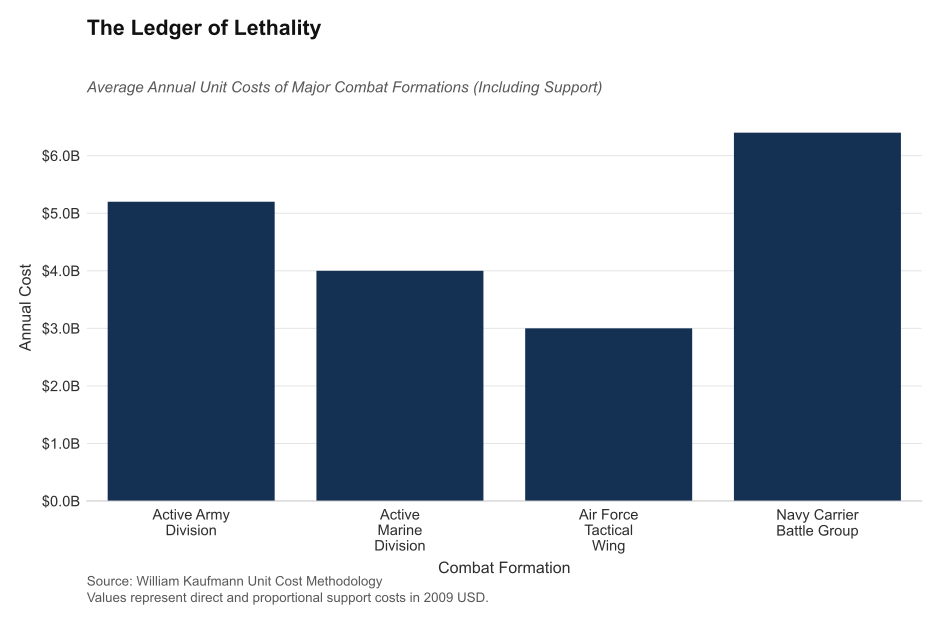
Kaufmann proposed breaking down the entire defense budget by the cost of main combat units. He calculated the total price of an active Army division, a Marine tactical air wing, or a Navy carrier battle group by distributing the vast overhead costs of the military directly to the primary formations they sustain,. For example, an active Army division contains roughly 16,000 to 18,000 soldiers. However, Kaufmann's method accounts for the fact that at least 40,000 personnel are actually required to sustain that division once all logistical, administrative, and intelligence support structures are factored into the equation.
By dividing the total budget of a combat capability category by the number of units fielded, Kaufmann generated an average annual cost per unit. Expressed in 2009 dollars, Kaufmann's calculations reveal that an active Army division requires approximately 5.2 billion dollars annually, an Air Force tactical air wing demands 3.0 billion dollars, and a Navy carrier battle group consumes a staggering 6.4 billion dollars,. This bottom up unit cost approach forces policymakers to understand the true financial burdens of military power. If a politician proposes adding two divisions to the Army, Kaufmann's framework clarifies that the cost will exceed 10 billion dollars annually, requiring substantial cuts to other domains, such as the elimination of two carrier battle groups or three fighter wings, to maintain a flat budget. While Kaufmann's method slightly overestimates the savings achieved from force reductions by assuming that central oversight and research costs will fall in perfect tandem with troop cuts, it remains the most reliable tool for bounding financial expectations,.
Predicting Procurement and Cost Growth#
Complementing Kaufmann's top down structural analysis is the bottom up costing methodology employed by the Congressional Budget Office,. When evaluating the long term fiscal health of the defense establishment, the Congressional Budget Office does not simply accept the Pentagon's inherently optimistic price estimates for future weapons systems. Instead, defense economists apply historical cost growth models,.
History demonstrates that military hardware is exceptionally prone to budget overruns. On average, weapons cost twenty to fifty percent more to acquire than initially forecast. Space vehicles and ground combat platforms often exceed early estimates by seventy percent. To predict the true future cost of a fighter aircraft, analysts utilize sophisticated regression models that factor in the aircraft's physical performance characteristics. Variables such as maximum speed, engine thrust to weight ratios, the proportion of advanced composite materials in the airframe, and the technological maturity of the avionics software are plotted against decades of historical procurement data. This rigorous arithmetic provides an intellectual safeguard against the wishful thinking that frequently plagues defense procurement,.
Furthermore, the Congressional Budget Office tracks the relentless growth of operations and maintenance costs,. Even in peacetime, the cost of operating military equipment and supporting personnel grows by roughly three percent annually above the rate of inflation. This systemic cost growth is driven heavily by escalating military health care expenditures and the environmental cleanup required at aging or closed military installations. Consequently, maintaining a static military force structure requires a budget that continually expands in real terms.
The Cost of Military Readiness#
A substantial portion of any modern defense budget is entirely consumed by the immediate demands of military readiness. Readiness is defined officially as the ability of the armed forces to deploy quickly and perform initially in their designed military contingencies. This metric represents the near term capacity for combat, and maintaining it requires massive ongoing investments in personnel compensation, rigorous training programs, and the continuous repair of equipment,. Readiness essentially competes for funding with long term modernization efforts. Every dollar spent on fuel for training flights or spare parts for armored vehicles is a dollar unavailable for the research and development of next generation technologies.
Assessing the true state of military readiness requires parsing complex data regarding the human element of the armed forces,. During protracted conflicts, the strain on military personnel becomes the most critical vulnerability in the defense posture. For instance, evaluating personnel readiness involves scrutinizing the percentage of recruits holding high school diplomas and their performance on aptitude tests,. While the overall quality of the American military remains remarkably high compared to the conscript armies of the 1970s, sustained wartime operations have forced compromises. In recent years, the military has had to grant increased numbers of moral waivers for recruits with criminal histories, and it has faced concerning trends in divorce and suicide rates among active duty troops,. These human costs directly impact the budgetary requirements for military healthcare, retention bonuses, and specialized recruiting efforts.
Furthermore, the logistical demands of wartime operations severely degrade the equipment readiness of the force. While the United States may maintain vast aggregate inventories of tanks and helicopters, specific high demand items, such as up-armored vehicles or specialized transport trucks, frequently face acute shortages. The rapid deterioration of this equipment in harsh combat environments forces the defense budget to absorb massive reset and repair costs, further squeezing the funds available for future procurement. Therefore, any rigorous analysis of defense spending must account not only for the purchase price of hardware, but for the exorbitant costs of maintaining the human and material readiness required to wage modern war,.
The Arithmetic of Applied Strategy#
The true value of these budgeting frameworks lies in their application to concrete strategic dilemmas. By utilizing cost benefit analysis, leaders can rigorously evaluate the most efficient methods for projecting national power.
Consider the challenge of destroying one hundred fixed aimpoints in a hostile nation. Planners must choose between deploying stealthy penetrating bombers, such as the B-2, or relying on older standoff aircraft, such as the B-52, firing long range cruise missiles. Assume that delivering two hundred munitions in a single sudden salvo is required to maximize shock value and prevent retaliation. Accomplishing this mission would require ten B-2 bombers dropping cheap gravity bombs or twenty B-52 aircraft firing expensive cruise missiles. Factoring in the marginal production cost of the aircraft and the price of the munitions, the stealth bomber option costs roughly 8.5 billion dollars,. In contrast, the B-52 fleet equipped with cruise missiles costs approximately 5.2 billion dollars,. While operational costs over a thirty year lifespan largely equalize the two options, this arithmetic forces planners to justify whether the unique capabilities of stealth technology are truly necessary for a given strategic effect,.
A similar calculus governs the basing of naval assets. The United States relies heavily on its attack submarine fleet to maintain a covert forward presence in critical waterways such as the Western Pacific and the Persian Gulf. However, nuclear submarines based on the continental United States spend the vast majority of their operational time simply transiting the oceans. A submarine stationed in California can maintain a continuous presence in Asian waters for only about thirty six days a year. By contrast, a submarine forward deployed to the island of Guam can remain on station for roughly 106 days annually.
By applying financial mathematics, the strategic advantage becomes overwhelmingly clear. Purchasing and operating a single submarine from Guam costs approximately 140 million dollars annually when the procurement price is amortized over the vessel's service life. Achieving the exact same level of military presence using submarines based on the mainland would require three vessels, costing a total of 360 million dollars per year. While other factors, such as the vulnerability of forward bases to preemptive attack, must be considered, the raw financial data heavily favors forward deployment,.
The Global Context and the Rise of China#
Ultimately, the science of defense budgeting must be situated within the broader context of international relations and the balance of power. The United States seeks a massive qualitative advantage over any potential adversary, aiming not for a fair fight but for absolute military supremacy. This strategy of overwhelming dominance, designed to enhance deterrence and minimize American casualties during conflict, is inherently expensive,. It also demands a defense establishment capable of operating globally, necessitating vast investments in naval power and strategic airlift,.
This global posture is increasingly challenged by the rapid military modernization of the People's Republic of China. Evaluating the true scale of the Chinese threat requires analysts to look beyond Beijing's official defense budget figures. In 2007, China reported a military budget of roughly 47 billion dollars. However, due to limited transparency, this figure omitted crucial categories of expenditure that are standard in Western defense accounting, including foreign arms purchases, military research and development, and the maintenance of paramilitary forces.
When independent analysts correct these omissions, the actual budget expands by 15 billion to 20 billion dollars. Furthermore, because a developing economy like China can feed, house, and pay its soldiers far more cheaply than a Western nation, straight currency exchange rates severely distort the comparison. Adjusting for purchasing power parity reveals that China's actual military resource allocation is two to three times higher than its official claims. By 2007, the true value of China's defense spending likely approached 150 billion dollars. While still dwarfed by American expenditures, the sheer scale and rapid acceleration of this investment command intense strategic scrutiny,.
Conclusion#
The science of defense budgeting is not an exercise in basic accounting. It is the fundamental discipline required to translate national treasure into effective military power. By demanding transparent methodologies, calculating the true lifecycle costs of combat formations, and anticipating the inevitable growth in procurement and operational expenses, policymakers can avoid the catastrophic errors of wishful thinking. The ledger of lethality is unforgiving, and only through rigorous, systematic analysis can a nation ensure that its armed forces remain both fiscally sustainable and overwhelmingly lethal.