
The Arithmetic of Attrition Predicting the Unpredictable#
Warfare is frequently romanticized as a contest of human courage, cunning leadership, and strategic genius. To the lay observer, the battlefield appears to be a domain of utter chaos, governed entirely by the unpredictable collision of human wills. Yet the brutal reality is that combat is equally governed by mathematics, physics, and rigorous logistical constraints. When nations prepare to fight one another, they routinely possess contradictory expectations regarding the likely duration and ultimate outcome of the war. As the Australian historian Geoffrey Blainey has acutely noted, it is doubtful whether any war since the eighteenth century was ever begun with the belief by both sides that it would evolve into a long and bloody struggle. Defeat, much like a protracted quagmire, is almost always unintended.
The inherent difficulty of predicting the victor in a military conflict stems from the fact that war depends heavily on variables that resist easy quantification. The quality of leadership, the psychological shock of tactical surprise, and the untested performance of new weapons systems all conspire to obscure the future. Historical data sets compiled by the United States Army Concepts Analysis Agency demonstrate just how elusive certainty can be. In historical battles where countries possessed roughly comparable military capabilities, meaning neither side held more than a fifty percent edge in material inputs, the attacker still emerged victorious in fifty eight percent of the engagements. The attacking forces rarely fought to a stalemate, which occurred in only seven percent of cases, and the defender prevailed only thirty five percent of the time. Benefiting immensely from tactical surprise and innovative operational concepts, the attacking force usually won, demonstrating that an overwhelming material advantage is not always a strict prerequisite for victory.
Furthermore, even when an attacking country possesses a significant numerical or material advantage, victory remains far from assured. Historical analysis reveals that an attacking force with an estimated advantage between fifty percent and two hundred percent over its opponent won only sixty three percent of the time. Even with an advantage exceeding two hundred percent, the attacker triumphed in only seventy four percent of historical cases. This profound difficulty in measuring military balances accurately helps to explain the volatile dynamics of international arms races. Because a monumental initial advantage is required to provide any real confidence of victory, rival nations locked in geopolitical grievances frequently spiral into escalating military buildups.
The Necessity of Formal Arithmetic#
If the business of predicting the results of war is so profoundly difficult, why should policymakers and defense analysts bother with the enterprise of modeling combat at all? The answer lies in the stark reality that we cannot avoid making predictions even if we wish to do so. As the Brookings Institution scholar Joshua Epstein has convincingly argued, everyone who forms an opinion on whether a given war should be fought is effectively predicting its outcome. Whether a policymaker models the conflict mathematically and systematically, or anecdotally and impressionistically, they are operating from a set of expectations about the likely course of battle. Without such a predictive framework, there would be no logical way to decide if a war is worth fighting, if one hundred thousand or five hundred thousand troops are required, or if the national industrial base must be mobilized for a protracted struggle.
The policy question is therefore not whether we should use simplified constructs for predicting battlefield outcomes. We all do, and indeed we all must. The true issue is whether we choose to rely upon vague, impressionistic guesswork or upon a more rigorous and formal mathematical approach. The supreme advantage of formal modeling is that it forces leaders to make their underlying assumptions explicit. It demands that politicians and generals justify their strategic optimism using historical, technical, and operational data rather than mere ideological fervor. While formal models rarely predict exact outcomes, establishing plausible lower and upper bounds for expected casualties and equipment losses is an essential intellectual safeguard.
The Century Old Foundations of Lanchester#
To understand how defense analysts simulate warfare, it is necessary to examine the foundational arithmetic of combat. The logical starting point is the set of formulas known as the Lanchester equations. Formulated a century ago by a British engineer, these equations offer the distinct advantage of mathematical simplicity. While modern warfare is vastly more complex than the conflicts of Lanchester's era, abstracting combat into two basic forms provides invaluable insight into the dynamics of attrition. The two primary variants of the Lanchester equations describe direct fire and indirect fire.
The direct fire equation is best understood by imagining two rows of eighteenth century soldiers lined up and firing rifles directly at specific, visible individuals on the opposing side. This model assumes there is no concealment, and it effectively represents scenarios like historical naval gunnery exchanges or certain types of aerial dogfighting. In this mathematical environment, the rate at which one army loses soldiers is directly proportional to the number of enemy soldiers firing at them and the effectiveness of the enemy weapons. The calculus derivation of this dynamic yields a fascinating and ruthless result known as the square law. The mathematical advantage tilts heavily toward the numerically superior force.
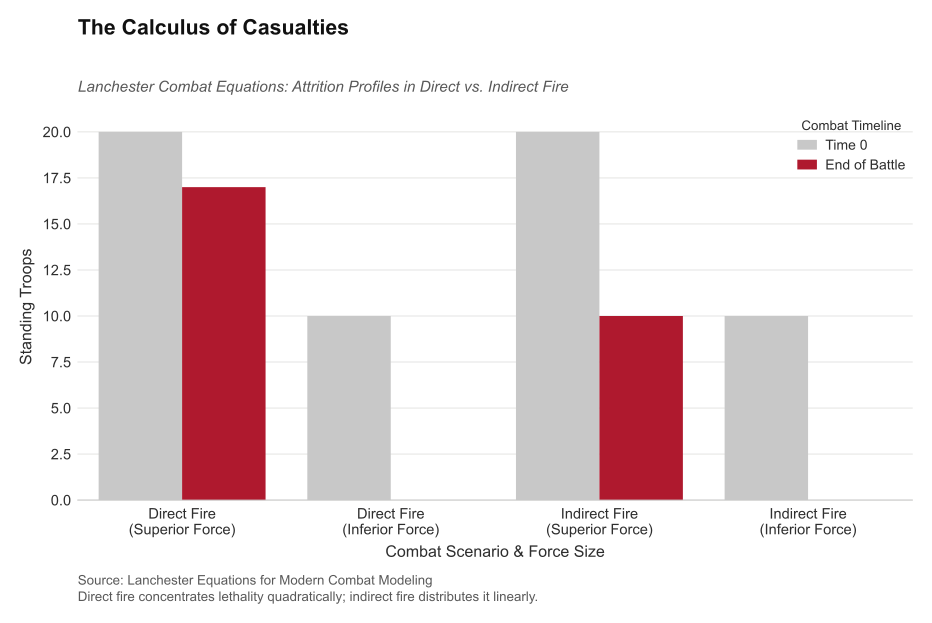
Consider a theoretical engagement where Army A begins with ten soldiers and Army B begins with twenty soldiers. Assuming the weapons on both sides are equally effective, the Lanchester direct fire equation calculates the remaining troops by squaring the initial force sizes. The square of ten is one hundred, and the square of twenty is four hundred. By subtracting the smaller square from the larger square, we are left with three hundred. The square root of three hundred is approximately seventeen. Therefore, by the time Army A is completely annihilated, Army B will still have seventeen soldiers standing. Army B loses just three soldiers in the process of wiping out the entire enemy force. In a direct fire scenario, a numerical advantage is overwhelmingly decisive, because every soldier in the smaller army faces the concentrated fire of multiple enemies, while the soldiers in the larger army face only a fraction of incoming fire.
However, modern warfare rarely resembles a Revolutionary War musket line. Soldiers take cover, and weapons are frequently fired to barrage a general area rather than to strike a specific, visible individual. This reality requires the Lanchester indirect fire equation. In this mathematical model, the likelihood that a force will suffer casualties is driven by three variables. The first two are the effectiveness of the enemy weapons and the sheer number of enemy forces firing those weapons. The critical third variable is the density of the targeted troops on the battlefield. Having a larger army provides a commander with more shooters, but it simultaneously provides the enemy artillery with a much larger and denser target.
Because the density of troops alters the calculus, the indirect fire equation does not grant an exponential square law advantage to the larger force. Instead, the mathematics are strictly linear. If Army A starts with ten soldiers and Army B begins with twenty, and their weapons are equally effective, they will lose personnel at the exact same absolute rate. When Army A has been reduced to zero, Army B will have exactly ten soldiers left. While the larger army still wins, the victory is far less disproportionate than in the direct fire scenario. Consequently, in indirect fire engagements, the technological effectiveness of the weaponry becomes just as important mathematically as a sheer quantitative advantage in manpower. If the smaller Army A possessed weapons that were slightly more than twice as lethal as those of Army B, the smaller army would actually win the engagement.
Modernizing the Math for Heavy Mechanized Combat#
While the Lanchester equations provide a vital conceptual foundation, analyzing modern mechanized warfare requires more sophisticated tools. Prior to the 1991 Gulf War, scholars utilizing databases developed for assessing the North Atlantic Treaty Organization and Warsaw Pact balance created highly effective new frameworks. Two of the most prominent unclassified models are the attrition and expansion model developed by Richard Kugler and Barry Posen, and the adaptive dynamic model developed by Joshua Epstein. These models are less complex than the highly classified, data heavy computer programs utilized by the Pentagon, yet they offer incredible analytical transparency and have historically proven just as accurate.
Both the Kugler Posen and the Epstein models discard the simple counting of individual soldiers in favor of a metric known as the armored division equivalent. This metric translates the sheer quantity of armored formations and the qualitative sophistication of their equipment into a single standardized number, using a modern American heavy division as the baseline value of one point zero.
The Kugler Posen framework is optimized for calculating attrition in a scenario where a military force is attempting to hold a static front against an all out enemy assault. It assumes that provided a defender can reinforce its losses and maintain an adequate ratio of forces to geographic space, it can hold the line. The Epstein model challenges the strict reliance on static spatial ratios. Epstein allows for the tactical possibility that a defending army might execute an organized withdrawal. By trading geographic space for time, a defender can improve its tactical position and significantly slow the rate at which it absorbs casualties.
Crucially, both models possess the mathematical architecture necessary to integrate the devastating effects of modern airpower. They assume that ground attack aircraft flying close air support missions are capable of dropping a specific number of munitions per daily sortie. Each munition is assigned a probability of kill reflecting the statistical likelihood that it will strike and destroy a major enemy ground vehicle. By knowing the typical number of vehicles within an armored division, analysts can translate the daily destruction wrought from the sky directly into lost armored division equivalents on the ground, thereby linking the air campaign and the ground campaign mathematically. The models then require the analyst to estimate a combat exchange ratio, a proportionality factor that dictates how many units the defender will lose for every unit lost by the attacker. This ratio serves as the mathematical proxy for the respective quality of the troops, the sophistication of their tactics, and the nature of the terrain.
The Laboratory of the Desert#
The true value of these analytical models was vividly demonstrated during Operation Desert Storm in 1991. The Pentagon, relying on highly elaborate and classified computer simulations, was reportedly prepared for up to thirty thousand American casualties. Outside analysts utilizing the simpler Kugler Posen and Epstein frameworks predicted a short, decisive conflict with significantly lower casualties, generally ranging from three thousand to sixteen thousand dead and wounded. In the actual event, the American forces suffered an astonishingly low one hundred and forty seven combat deaths. While all models overestimated the bloodshed, the simple, transparent models proved vastly superior to the Pentagon bureaucracy in predicting the order of magnitude of the victory.
To understand how the arithmetic of the Gulf War functioned, one must apply the concept of armored division equivalents to the historical data. The American led coalition placed the equivalent of roughly ten heavy armored divisions into the theater prior to the outbreak of ground hostilities. The Iraqi military initially fielded thousands of tanks and armored personnel carriers, but they were subjected to a relentless multi week air campaign. Coalition precision guided munitions and traditional bombs destroyed approximately three thousand three hundred major Iraqi vehicles from the sky before the ground invasion even commenced,.
After subtracting the equipment annihilated during the air war, analysts calculated that the Iraqi military possessed roughly five point six divisions worth of surviving hardware. However, because Soviet export equipment and Iraqi training were vastly inferior to Western standards, this figure had to be adjusted qualitatively. By dividing the surviving force structure in half to account for this qualitative gap, analysts determined that Iraq wielded a combat power of just two point eight armored division equivalents.
When the ground war finally commenced, the mathematical reality was devastating for Iraq. The coalition enjoyed a combat exchange ratio of approximately thirty to one, meaning the Iraqis lost thirty times as much combat power as the Americans in every engagement. This was a staggering historical anomaly. Prior to Desert Storm, defense analysts had utilized the Arab Israeli conflicts as their baseline, where the technologically superior Israeli forces typically achieved exchange ratios of three to one or five to one.
Operating the model iteratively, day by day, illustrates the rout. Assuming the coalition forces lost a historically minimal zero point one percent of their strength daily, their numerical loss equated to zero point zero one armored division equivalents on the first day. Multiplying this by the thirty to one exchange ratio dictates that Iraq lost zero point three armored division equivalents in ground combat on that exact same day. Simultaneously, the ongoing air war destroyed hundreds of additional Iraqi vehicles daily, translating to further fractional losses in their division equivalents. Over the four days of the ground campaign, the cumulative losses for the coalition were a mathematically trivial zero point zero four armored division equivalents. Iraq, conversely, lost the equivalent of one point three four armored divisions in just ninety six hours, representing the destruction of over three thousand pieces of heavy weaponry. The arithmetic of attrition rendered Saddam Hussein's defeat an absolute physical inevitability.
The Infantry and the Complex City#
While the models discussed above are uniquely suited for mechanized warfare on open terrain, not all wars are fought with tanks in the desert. Urban environments and complex jungles require an analytical framework focused on the foot soldier. The late United States Army Colonel Trevor Dupuy developed a highly effective methodology for modeling infantry warfare. While less sophisticated than the Epstein model in its treatment of airpower, the Dupuy model excels at incorporating the friction of the battlefield.
Dupuy's framework centers on calculating a total power figure for each opposing army. This power figure is the mathematical product of the sheer size of the fielded force multiplied by the qualitative superiority of the troops. This baseline capability is then further modified by coefficients that account for the degree of tactical surprise achieved by the attacker, and the benefits of concealment, complex terrain, and prepared fortifications enjoyed by the defender. The daily casualties for each side are subsequently estimated by multiplying the total troop strength by a baseline daily attrition rate, and then modifying that product by the ratio of the two competing power figures.
The historical accuracy of the Dupuy model can be tested against the 1989 United States invasion of Panama. The American forces numbered twenty two thousand five hundred personnel, including elite Army Rangers and Navy Seals. Affording the American troops a three to one qualitative advantage over the Panamanian defense forces, and a further twenty percent mathematical bonus for the overwhelming surprise of the nighttime airborne assault, the American power score reached approximately eighty thousand. Panama fielded about eight thousand five hundred troops. Because they were fighting on the defensive within complex urban and jungle terrain, their baseline capability was doubled, giving them a power score of nearly twenty thousand.
The resulting power ratio provided the United States with a four to one advantage. Applying Dupuy's casualty formulas to a two day conflict, the arithmetic predicts roughly one hundred and twelve American casualties, including about twenty fatalities. For the Panamanian forces, the model predicts six hundred and eighty casualties, with approximately one hundred and seventy fatalities. These mathematical projections track remarkably well with the actual historical bloodshed, proving the utility of the framework for short, intense infantry engagements.
This exact methodology was also utilized by independent analysts to forecast the human cost of the 2003 invasion of Iraq. Assuming a coalition force of two hundred and fifty thousand troops with a three to one qualitative advantage, the American power score was enormous. If one hundred thousand Iraqi troops chose to fight, and their defensive posture in urban terrain doubled their effectiveness, the relative power ratio remained heavily skewed toward the Americans. Assuming the invasion phase lasted ten days, the Dupuy formulas bounded the worst case expectations at roughly fifteen thousand American casualties, including up to three thousand dead.
As history records, the conventional invasion phase was vastly faster and less bloody than the worst case projections. However, the ensuing protracted insurgency ultimately claimed over four thousand American lives. This highlights a crucial limitation of the science of war. Traditional combat models are highly effective at predicting the attrition of standing armies, but they are exceptionally difficult to use productively when modeling counterinsurgency. When the precise size of the enemy force is completely unknown, and when the enemy possesses the ability to constantly regenerate their numbers through shadowy recruiting networks, the standard equations of attrition break down.
The True Value of Imperfect Arithmetic#
The ultimate thesis derived from the study of military modeling is not that mathematics can offer perfect clairvoyance. War is fundamentally a human endeavor, subject to the unpredictable variations of morale, friction, and sheer chance. Predicting the outcome of classic large scale military engagements is an incredibly taxing intellectual exercise, and predicting the exact trajectory of irregular combat is nearly impossible.
Yet, abandoning the science of war in favor of pure intuition invites strategic disaster. Simple, unclassified models force politicians and generals to translate vague patriotic rhetoric into quantifiable assumptions. They demand that leaders specify exactly how capable they believe their own troops to be, how much punishment they expect the enemy to absorb, and how long they assume the logistical supply lines can be sustained. By demanding transparent models, analysts can establish highly reliable upper and lower bounds for the cost of a conflict in both national treasure and human blood. Military analysis will always remain an imprecise science, but systematic study grounded in the arithmetic of attrition is absolutely essential to prevent leaders from committing a nation to a catastrophic conflict based upon wishful thinking.