
The Logistical Realities of Power Projection#
The famous military adage notes that while civilians think strategy, generals think logistics, an observation that is only a slight exaggeration of the truth. To the lay observer, what separates the armed forces of the United States from all others is a massive budget that procures stealth bombers, precision munitions, nuclear submarines, and satellite constellations. While those technological assets are undeniably significant, they do not constitute the true distinguishing characteristic of American military supremacy. What fundamentally separates the United States from every other nation is its unparalleled capacity to deploy, operate, and sustain massive military formations anywhere in the world indefinitely.
Combat units possess little inherent utility unless a battle miraculously comes directly to their home garrisons. Even when fighting on familiar terrain, executing tactical mobility requires rigorous attention to the supply chain. For expeditionary warfare, supply trucks, mobile depots, and transport ships are just as critical to victory as the most advanced laser guided bombs. Without the physical means to project power, the most sophisticated military strategy remains nothing more than a theoretical exercise. Understanding the mathematical and physical constraints of logistics is therefore crucial to understanding how modern warfare is actually waged.
The Staggering Anatomy of Modern Deployment#
Moving a modern military force across oceans is a staggering endeavor. Other nations occasionally attempt to move several thousand troops over a period of months, and they frequently encounter severe logistical paralysis in the process. The United States, by contrast, routinely plans to relocate between a quarter million and a half million troops, alongside their vehicles and life support systems, within a comparable timeframe.
To grasp the magnitude of such an operation, one must discard abstract strategic concepts and think in terms of raw urban geography. Preparing for a major overseas conflict is the logistical equivalent of uprooting a mid sized city, such as Washington, District of Columbia, and moving its entire population and infrastructure halfway across the globe.
The historical precedent of Operation Desert Storm illustrates this reality perfectly. In the autumn and winter of 1990, the United States transported half a million personnel and over one hundred thousand vehicles to the Persian Gulf. Accompanying this force were ten million tons of supplies. The arithmetic of this deployment is breathtaking. The ledger included more than six million tons of petroleum products shipped directly from the United States, three million tons of bulk supplies such as ammunition and spare parts, and one million tons of water. Furthermore, these figures would have been substantially higher had the host nation of Saudi Arabia not provided massive local support. Every single day, Saudi Arabia supplied the coalition with a quarter million meals and two million gallons of potable water. Regional partners also supplied the Air Force alone with up to fifteen million gallons of fuel daily, which translates to roughly fifty thousand tons.
The Arithmetic of Mass and Tonnage#
To analyze policy options and transport requirements for future conflicts, defense planners must break down these aggregate national statistics into the precise weights of specific combat units. The physical mass of the modern military is immense.
A standard American heavy armored or mechanized division, comprising roughly eighteen thousand soldiers, weighs approximately 110,000 tons. A light infantry division of eleven thousand troops is considerably more agile, weighing in at 17,000 tons. The 82nd Airborne Division, with just over thirteen thousand personnel, weighs 27,000 tons, while the 101st Air Assault Division approaches 36,000 tons. At the higher echelons of command, the supporting Army Corps structure required to coordinate and sustain several divisions adds another 99,000 tons of equipment and personnel.
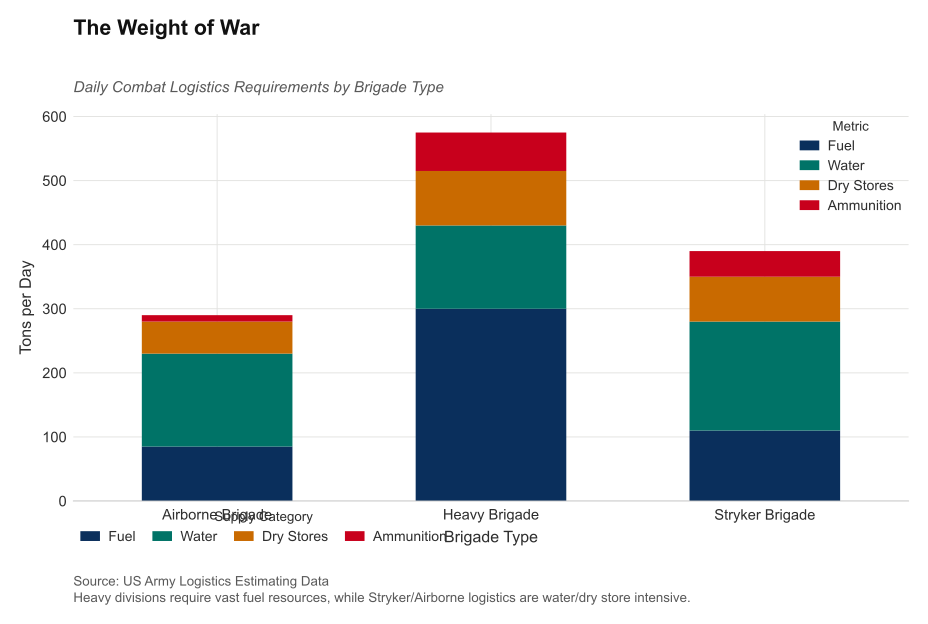
Moving these forces to the theater of operations is only the first phase of the logistical challenge. Once deployed and engaged in combat, these units consume resources at an astonishing rate. A heavy armored brigade consisting of roughly 3,100 soldiers requires 600 tons of supplies every single day. This daily intake is strictly partitioned into 300 tons of fuel, 130 tons of water, 85 tons of dry stores, and 60 tons of ammunition.
Lighter forces consume less, but their requirements remain substantial. An airborne brigade of about 3,400 soldiers requires 300 tons daily, heavily skewed toward water at 145 tons, with 85 tons of fuel and 10 tons of ammunition. A medium weight Stryker brigade requires 400 tons of daily supply, including 110 tons of fuel and 170 tons of water.
Because a standard heavy division contains three to four combat brigades plus extensive support elements, the aggregate daily consumption of an engaged division reaches approximately 3,000 tons.
The Overland Artery and the Trucking Challenge#
While intercontinental ships and aircraft deliver these mountains of supplies to secure rear area logistical hubs, moving the material to the frontline requires tactical overland transport. In rare instances, troops can be supplied directly from the United States, but it is standard practice to establish massive theater depots and ferry supplies forward via propeller driven C-130 aircraft, transport helicopters, and most importantly, massive fleets of cargo trucks.
In environments like the flat deserts of the Middle East, where the United States enjoys complete aerial supremacy, overland trucking appears relatively straightforward. However, complex geography and enemy opposition can quickly turn tactical resupply into a strategic nightmare. A classic logistical analysis conducted by Joshua Epstein in the 1980s evaluated the hypothetical challenge of Soviet forces attempting to invade Iran through the mountains of Afghanistan. Epstein demonstrated that funneling massive armies through restricted mountain passes creates severe limitations. Off road movement becomes impossible, constraining the invader to a few predictable roads that are highly vulnerable to sabotage, aerial bombardment, and ambush.
The basic mathematics of truck transport reveal the vulnerability of overland supply lines. Standard military cargo trucks carry payloads ranging from five to ten tons. Therefore, supplying a single heavy brigade requires dispatching approximately one hundred trucks every day. A major theater operation involving twenty brigades and their supporting elements requires between 1,000 and 4,000 truckloads of logistics support daily, depending on the intensity of the fighting.
If these thousands of vehicles must travel along a single major arterial road, a mathematical bottleneck quickly forms. A major highway can theoretically process 2,000 military truckloads a day, but achieving this throughput requires dispatching a fresh, armed convoy of twenty trucks every fifteen minutes, continuously, twenty four hours a day. Maintaining such a relentless pace is only feasible if the vehicles are in pristine mechanical condition, if the roads are cleared of civilian traffic, if the bridges remain intact, and if dedicated engineering crews are constantly repairing the asphalt. To execute these demanding operations, the military requires a massive human footprint. The Army fields roughly twice as many personnel dedicated to general support missions as it does to main combat formations, yet even this massive commitment is often insufficient, forcing the military to hire tens of thousands of private contractors to maintain the flow of supplies.
The Aerial Bridge and Air Force Logistics#
Air Force combat wings present a different logistical profile because the fighter jets are naturally capable of deploying themselves across oceans. Planners do not need to calculate cargo space for the combat aircraft, but the supporting infrastructure required to keep them flying is tremendously heavy.
Deploying an Air Force combat wing of seventy two fighter aircraft requires moving between 1,500 and 2,000 personnel, along with 1,000 to 2,000 tons of ground support equipment. This equipment includes aircraft maintenance tools, runway repair gear, missile defenses, and command and control systems,. Once engaged in daily combat operations, this single wing will expend 100 to 200 tons of munitions and consume up to 3,500 tons of aviation fuel every day.
Meeting these requirements relies on strategic airlift. During Operation Desert Storm, the United States maintained an average of seventy intercontinental cargo flights to the Middle East every day. Delivery rates averaged 1,700 tons per day early in the deployment, peaking at 3,600 tons per day in January 1991.
The aircraft performing this strategic lift are marvels of modern engineering, yet they are bound by the strict physics of aviation. The C-5 Galaxy transport aircraft can carry 61 tons of cargo and fly for approximately eight hours,. The newer C-17 Globemaster can carry 45 tons for over twelve hours,. However, maximizing cargo weight comes at the direct expense of fuel capacity and range.
Consider the workhorse of tactical airlift, the C-130 Hercules. The aircraft weighs 85,000 pounds when empty and has a maximum allowable takeoff weight of 155,000 pounds. Its fuel tanks can hold 60,000 pounds of aviation fuel. If planners load the aircraft with 25,000 pounds of cargo, they can safely add 45,000 pounds of fuel, granting the plane a range of about 2,700 nautical miles. If the payload is reduced by 10,000 pounds, to 15,000 pounds total, then 10,000 more pounds of fuel could be loaded aboard, translating into two more hours and 600 more nautical miles of flight.
For larger aircraft, the calculus scales up but remains structurally identical. A C-17 has a maximum takeoff weight of 290 tons and a maximum cargo capacity of 65 tons. Reducing the payload of a C-17 from sixty five tons to thirty five tons allows the addition of thirty more tons of fuel. This adjustment permits about four more hours of flight, or 2,000 additional miles of range, highlighting the constant mathematical tradeoffs planners must negotiate when bridging intercontinental distances.
Sealift, Bottlenecks, and the Fiction of Maximum Throughput#
While airlift is essential for delivering personnel, sensitive electronics, helicopters, and high value ammunition, it is sealift that moves the sheer mass of modern armies. The heaviest materials, including vehicles, fuel, water, mobile depots, and bulk ammunition, must travel across the ocean surface.
The backbone of this capability is the roll on and roll off ship. These specialized vessels can sail at impressive speeds of 28 to 30 miles per hour. Most carry average payloads of 15,000 to 20,000 tons of equipment, and they can be loaded in three to four days and unloaded in two to three. Because a single heavy division requires 100,000 tons of initial equipment and supplies, moving an entire division typically demands two to six large ships, depending on the specific weight of the formation. The United States maintains a fleet of about twenty large roll on and roll off ships, alongside other sealift assets, giving it a theoretical capacity to transport roughly 30,000 tons of military equipment per day to overseas destinations.
However, the theoretical mathematics of transport frequently collide with the physical bottlenecks of global infrastructure. In practice, deployments are often dramatically slower than ship speeds and aircraft capacities would imply. The primary constraints occur at the receiving ports and airfields abroad. Even reasonably large, modern airfields struggle to process much more than 1,000 tons of equipment and supplies daily. Without access to at least three or four major ports and airfields in the destination theater, maximum deployment rates are impossible to attain.
A rigorous analysis by Professor Alan Kuperman evaluating possible military responses to the 1994 Rwanda genocide demonstrates these constraints perfectly. Kuperman calculated that utilizing the two major airfields at Kigali and Entebbe, Uganda, the United States would have struggled to deploy more than 800 tons of equipment and supplies a day. Taking into account the delays in initiating the operation and navigating local infrastructure, deploying a single reinforced brigade of 6,000 troops and 10,000 tons of equipment would have required a minimum of three weeks. The brutal reality of logistics dictates that projecting power takes weeks or months, completely invalidating the notion of instantaneous global intervention unless substantial forces are already based nearby.
The Strategic Anchor of Overseas Basing#
Because intercontinental transportation is slow, constrained, and phenomenally expensive, maintaining a global network of forward military bases remains an absolute strategic necessity. The United States maintains its primary overseas footprints in three critical zones, Europe, East Asia and the Western Pacific, and the broader Middle East.
These bases serve multiple functions that are indispensable for power projection. Major logistics hubs, such as Ramstein Air Base in Germany or the vast complex of facilities in Kuwait, are vital for receiving massive surges of personnel and supplies during a crisis,,. They provide the infrastructure needed to transfer material from massive strategic ships and planes to smaller tactical vehicles, significantly reducing the bottleneck effects at regional ports. Combat air bases, such as Kadena on the island of Okinawa or Osan in South Korea, are essential because tactical combat aircraft operate most effectively when based within 500 miles of their operational theaters,,.
The financial and operational logic of these bases is profound. Consider the homeporting of a United States Navy aircraft carrier battle group in Yokosuka, Japan. A carrier stationed in the United States can only maintain a forward deployed presence in the Western Pacific about twenty to twenty five percent of the time, due to the time required for ocean transit, crew recovery, training, and maintenance overhauls. To achieve the exact same level of continuous forward deterrence provided by the single carrier based in Japan, the Navy would need to operate roughly five carriers from the American mainland. Given the staggering procurement and operational costs of an aircraft carrier battle group, attempting to project naval power across the Pacific without a forward base in Japan could increase costs by up to twenty five billion dollars annually.
Conclusion#
The science of logistics demands a rigorous acknowledgment of physical limitations. Power projection is not an abstract exercise in diplomatic will, but a grueling mathematical contest against the constraints of tonnage, fuel consumption, and infrastructure capacity. A nation can possess the most sophisticated stealth technology and precision weaponry in human history, but if it lacks the cargo ships to transport them, the truck convoys to supply them, and the forward bases to host them, its military power remains an illusion. It is only by mastering the brutal arithmetic of distance and mass that national security strategy can be translated into actual lethality on the battlefield.