
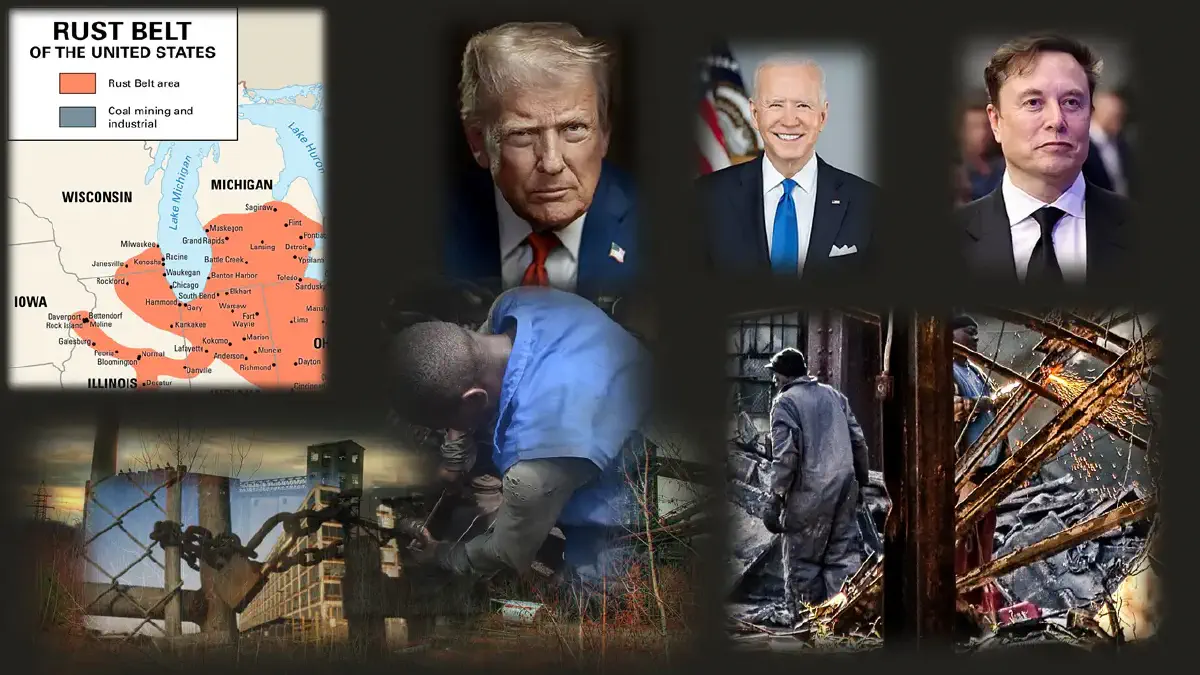
Trump, and before him Biden, have spent years bemoaning the rust belt, offering performative sympathy for closed factories and laid-off workers. But let’s be clear: the U.S. caused its own undoing.
It was Nixon, the first US president to visit China in 1972, and Clinton who aggressively pushed for its WTO entry in 2001. For decades, both Republicans and Democrats, representing corporate America, viewed China as the ultimate golden goose: the world’s largest factory floor, complete with cheap labor, lax environmental regulations, and 1.5 billion potential consumers.
Then, the U.S. woke up to a reality check. Chinese goods weren't just everywhere; they were cheaper, and in many cases, objectively better engineered than American products. Now, Washington responds by slapping tariff upon tariff. It makes you wonder: what ever happened to the sacred doctrine of "free trade"? Or has the game always been about kicking away the ladder once you've reached the top?
Offshoring manufacturing isn't a new sin; it’s a textbook lesson in "competitive advantage." The Western corporate playbook was simple: We own the intellectual property, the design, and the know-how. You build it using your cheap oppressed labor and subsidized, carbon-heavy energy, emitting harmful industrial waste. We don't care. A pure "Not In My Backyard" capitalism.
This text book recipe worked precisely as intended in Mexico. Mexico played by the rules, never crossed the line and it never mutated into a rival industrial superpower.
So, what went wrong with the China strategy? The twist is that China refused to stay in the box the West built for it. It didn’t content itself with being a mindless assembly line; it climbed the value chain, moving from only manufacturing Western designs to designing its own products with its own intellectual property. In 2011, Elon Musk famously laughed off the idea that the Chinese automaker BYD could ever compete with Tesla, dismissively asking, "Have you seen their car?" By 2026, nobody is laughing. BYD surpassed Tesla as the world’s largest EV seller, moving 2.26 million pure electric vehicles compared to Tesla's 1.64 million, capturing nearly a fifth of the global market.
Meanwhile, American legacy automakers have always relied on a cozy relationship with Washington’s revolving doors to shield them from reality. Look back at the 1973 oil crisis: when Japanese fuel-efficient and reliable cars rightfully conquered a market saturated by bloated American "land yachts," Detroit simply lobbied Congress. The result? The U.S. government bullied Japan into a "Voluntary Export Restraint" agreement in 1981. Fast forward to 2008, and Washington handed a $79.7 billion TARP lifeline to GM and Chrysler. The latest episode in this saga is a desperate, bipartisan panic to permanently ban Chinese-connected vehicles from entering the U.S. market entirely.
While the government keeps building the walls higher, automotive executives are laughing all the way to the bank. During the post-2008 bailout era, executive bonuses were briefly paused while the Treasury held the reins. But the moment the government exited in late 2013, the corporate feeding frenzy resumed. Between 2013 and 2022, Big Three CEO pay skyrocketed by 40%, fueled by $250 billion in combined profits and $66 billion funneled into stock buybacks and dividends. By 2025, the payouts reached grotesque heights: Elon Musk’s amortized stock package sat at a staggering $8.8 billion a year, Rivian's RJ Scaringe brought in hundreds of millions, and GM's Mary Barra pocketed $29.9 million.
Compare that corporate windfall to the factory floor, where the real hourly wages for American autoworkers have actually dropped by nearly 20% since 2008 due to concessions and stripped cost-of-living adjustments.
Ultimately, what we are watching is a cheap, badly written political drama. Politicians weep crocodile tears for the unemployed American worker and blame China for everything, while corporate boardrooms rake in record-breaking fortunes by design. It is a hypocrisy that is getting entirely too difficult to stomach.
References#
- Tan, Y. (2021). How the WTO changed China: The mixed legacy of economic engagement. Foreign Affairs, 100(2), 90–102.
- Clinton, W. J. (2000). Speech on China WTO Agreement. White House Office of the Press Secretary.
- Global Electric Vehicle Market Share Report: Calendar Year 2025 Data. (2026). Automotive News Research & CleanTechnica Industry Review.
- BYD Company Limited. (2026). Annual Announcement of Sales Volume & Corporate Performance for 2025. Hong Kong Stock Exchange.
- Tesla, Inc. (2026). Fourth Quarter and Full Year 2025 Financial Results and Q4 Delivery Report. SEC Filing Form 8-K.
- Feenstra, R. C. (1984). Voluntary export restraint in U.S. autos, 1980–1981: Quality, employment, and welfare effects. In The Structure and Evolution of Recent U.S. Trade Policy (pp. 35-59). University of Chicago Press.
- U.S. International Trade Commission (USITC). (1985). A Review of Recent Developments in the U.S. Automobile Industry Including the Effects of the Voluntary Export Restraint Agreements. (USITC Publication No. 1733).
- U.S. Department of the Treasury. (2015). Troubled Asset Relief Program (TARP): Automotive Industry Financing Program Report. Office of Financial Stability.
- Goolsbee, A. D., & Krueger, A. B. (2015). A retrospective look at the 2008–2009 bailout of the domestic auto industry. Journal of Economic Perspectives, 29(2), 3-24.
- Mishel, L., & Kandra, J. (2023). CEO pay has soared 1,200% since 1978: Coinciding with UAW contract parameters and auto worker wage compression. Economic Policy Institute (EPI) Briefing Paper.
- Minchin, T. J. (2024). A new labor movement? Assessing the worker upsurge in the contemporary U.S. Labor History, 65(4), 433-456.
- General Motors Company. (2026). Notice of 2026 Annual Meeting of Shareholders and Proxy Statement (Schedule 14A) [Executive Compensation Metrics for FY2025]. U.S. Securities and Exchange Commission.
- Tesla, Inc. (2026). Notice of 2026 Annual Meeting of Stockholders and Proxy Statement. [Amortized Options Valuation Review]. U.S. Securities and Exchange Commission.
- Rivian Automotive, Inc. (2026). Definitive Proxy Statement (Form DEF 14A) [CEO Performance Stock Units]. U.S. Securities and Exchange Commission.
- U.S. Department of Commerce, Bureau of Industry and Security (BIS). (2025). Notice of Proposed Rulemaking (NPRM): Securing the Information and Communications Technology and Services Supply Chain: Connected Vehicles. Federal Register.
- Bown, C. P. (2026). Negotiating a win-win end to the lose-lose US-China trade war over technology and critical minerals. Peterson Institute for International Economics Working Paper, (26-5).
- Tesla's Musk Laughs at BYD [Video]. YouTube (2011). https://www.youtube.com/watch?v=_9ftbRWqkj0