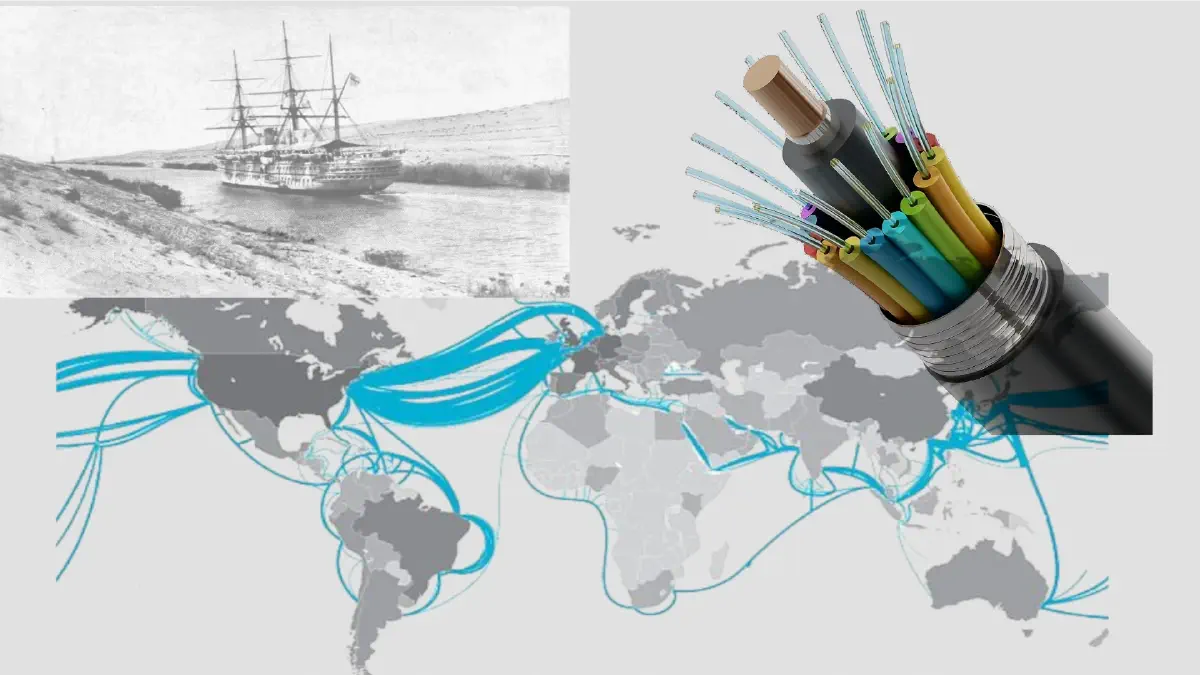
In the autumn of 1882, a British fleet bombarded Alexandria, landed an expeditionary force and, within weeks, occupied the Suez Canal. The waterway was not British territory—it lay in Egypt, a province of the Ottoman Empire—but its control conferred something more valuable than acres of sand: the power to decide who could move between Europe and Asia. A century and a half later, the canal remains a chokepoint, but the real strangleholds on global movement have migrated. They are no longer made of earth and concrete; they are made of code, servers, and submarine fibre. And their gatekeepers are no longer empires; they are three American companies, one satellite magnate, and a handful of tech giants that own the cables beneath the oceans.
The story of how the world moved from Suez to the server rack is not a tale of technological inevitability. It is a story of power, jurisdiction, and a quiet transfer of sovereignty that has gone largely unnoticed—until a war, a sanction, or a chief executive’s whim reveals that a state no longer owns the infrastructure it depends on. This is the first in a series examining the new infrastructure rentiers: the private, foreign-registered monopolies that now lease the foundational layer of modern statehood. And it begins with the ghosts of the canals and railways that once defined imperial reach.
The logic of the chokepoint#
For centuries, geography was destiny. Great powers measured their influence by their ability to choke the arteries of global commerce. The Suez Canal, opened in 1869, instantly became the most prized geopolitical asset of the age, shortening the London-to-Bombay voyage by 40%. Britain, which had initially opposed the project, moved to seize it when the Egyptian khedive fell into debt. The canal’s controlling company was a private Anglo-French venture, but its strategic value was so immense that the British government considered it a national interest. The canal was not merely a tollbooth; it was a weapon. In both world wars, its denial to the enemy was a central strategic objective.
The pattern repeated everywhere. The Panama Canal, completed in 1914, gave the United States a two-ocean navy and the ability to strangle trade between the Atlantic and the Pacific. The transcontinental railways of the 19th century—the Trans-Siberian, the Canadian Pacific, the American Union Pacific—were instruments of state-building and territorial control, often financed and granted monopoly rights by governments. Deep-water ports like Singapore and Rotterdam became the nodes through which containerised trade had to pass. To be sovereign was, in large part, to own or control the physical gateways through which goods, armies, and information moved.
Ownership mattered because control was binary: a canal could be blocked, a railway could be severed, a port could be closed. The legal framework was territorial. The infrastructure sat inside a state’s borders, and its sovereignty was exercised through physical presence—soldiers, locks, customs houses. Even when foreign powers held concessions, the ultimate lever was tangible. Today, that tangibility has evaporated.
The chokepoint migrates to the cloud#
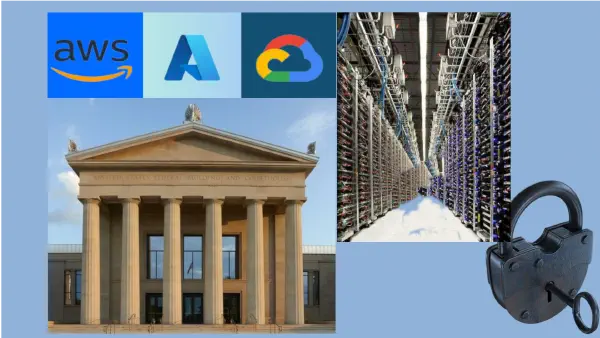
The foundational infrastructure of the 21st century is not a canal but a data centre. The modern state runs on software: tax collection, welfare payments, health records, police databases, military logistics, diplomatic cables—all of it lives on servers. And those servers are increasingly not in government basements but in the rented racks of “hyperscale” cloud providers. Three American firms—Amazon Web Services (AWS), Microsoft Azure, and Google Cloud—together command 62% of the global cloud infrastructure market (see Figure 1). Their combined hyperscale data-centre capacity accounts for 58% of the world’s total, and more than half of that capacity sits on American soil.
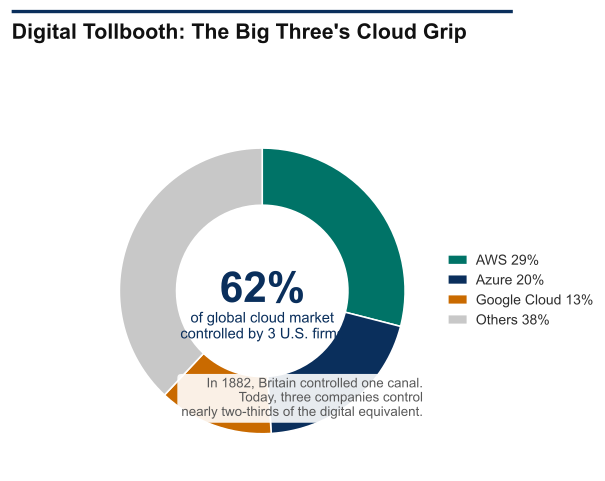
The numbers are staggering. In the third quarter of 2025 alone, AWS generated $33bn in revenue, more than the entire defence budget of most European nations. Microsoft’s commercial cloud unit brought in $49.1bn. Google Cloud, though still a distant third, is growing at over 30% a year, fuelled by a $155bn backlog of signed contracts and a surge in AI workloads. These three companies are not simply vendors; they are landlords of the digital realm. And they are subject to the laws of the country where they are domiciled: the United States.
This matters because the legal architecture that surrounds cloud infrastructure is radically different from the one that governed physical chokepoints. Under the 2018 Clarifying Lawful Overseas Use of Data Act (CLOUD Act), American law enforcement can compel U.S.-based tech companies to hand over data stored on their servers, regardless of where in the world that server happens to be located. The act also allows the U.S. government to block a provider from notifying the customer—say, a foreign ministry—that its data has been accessed. In a territorial world, a British official’s filing cabinet in Whitehall was safe from American eyes. In a cloud-first world, that filing cabinet is a folder on Azure, and its privacy hinges on the goodwill of a company incorporated in Redmond, Washington.
This jurisdictional reach turns commercial dependency into strategic vulnerability. A state that runs its tax system on AWS, its defence communications on Azure, and its citizen records on Google Cloud has, in effect, granted a foreign power a potential kill switch. The switch need never be thrown to alter behaviour; the mere possibility of remote termination changes the calculus of sovereignty. As a senior European diplomat privately puts it, “We are now tenants in our own country.”
The cables on the ocean floor#
Beneath the cloud lies the physical layer that is even more invisible and even more concentrated: the submarine fibre-optic cables that carry 95% of intercontinental data. Every email between Berlin and New York, every SWIFT payment between Tokyo and London, every video call from Lagos to Paris travels along a cable thinner than a garden hose, lying on the seabed. Some $10 trillion in daily financial transactions traverse these cables.
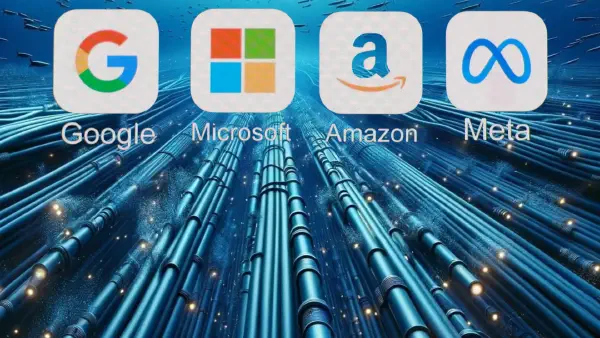
For most of the internet’s history, these cables were laid and owned by consortia of national telecoms operators—entities that, however commercially minded, were subject to regulation and political pressure from their home governments. That model has been turned inside out. Today, the Big Four American tech firms—Google, Meta, Microsoft, and Amazon—control an estimated 71% of global undersea cable capacity. Google alone has invested in more than 20 cable systems, including the Curie cable linking the U.S. to Chile and the Grace Hopper cable connecting North America to Europe. Meta is planning Waterworth, a 40,000-kilometre cable that will circle the globe and be fully owned by the company—a project expected to cost several billion dollars.
The cables represent a new kind of imperial infrastructure, built not by navies but by corporate balance sheets. From 2025 to 2027, global submarine-cable investment is projected to reach $13bn, nearly double the figure for the previous three years. Almost all of that growth comes from the hyperscalers. Governments, even wealthy ones, are simply not in the game. When Britain’s Royal Navy once laid undersea telegraph cables as a tool of empire, it did so with strategic intent. When Google lays a cable, it does so to lower latency for its advertising and cloud business. But the outcome—centralised control over the nervous system of the global economy—is the same.
Space as the final tollbooth#
If the cloud and the cables were not enough, the third pillar of digital chokepoints hovers 550 kilometres overhead. SpaceX’s Starlink constellation has grown from a prototype to a globe-spanning network of more than 8,600 active satellites, with a licence for 12,000 and ambitions for over 30,000. No other company—and no other country—comes close. Starlink already provides internet connectivity to rural communities, maritime fleets, and, most critically, militaries.
Ukraine’s armed forces have relied on Starlink for drone operations, artillery coordination, and battlefield communication since the early days of the Russian invasion. The service was so vital that the U.S. Department of Defence formalised its procurement through a $150m Foreign Military Sale. And yet the entire network depends on the decisions of a single individual, Elon Musk, who has not been shy about wielding his power. In 2023 he acknowledged withholding Starlink coverage to prevent a Ukrainian attack on a Russian naval fleet, citing concerns about escalation. Whatever one thinks of that decision, it illustrates the point: a private citizen, with no electoral mandate and no treaty obligation, can unilaterally determine the communications capacity of a sovereign state at war.
This is not merely a question of individual personality. It is a structural transformation. Satellite constellations, like cloud servers and submarine cables, are capital-intensive assets with enormous barriers to entry. The companies that dominate them enjoy first-mover advantages that quickly become unassailable. Starlink’s constellation is not just the largest; it is the cheapest and most rapidly deployable. A nation that wishes to build its own equivalent would need billions of dollars, years of launch campaigns, and spectrum rights that are already allocated. Most will not even try. Instead, they will rent connectivity from a California-based firm, praying that the landlord remains friendly.
The Westphalian hangover#
The modern state system was born in 1648 with the Peace of Westphalia, which established the principle of territorial sovereignty: each ruler has supreme authority within his own borders, and no outside power may interfere. For nearly four centuries, that principle has been the bedrock of international law, diplomacy, and war. But it rested on an assumption that the infrastructure of statehood—the things a government needed to govern—was physically within its territory and thus under its jurisdiction.
That assumption is now false. When a defence ministry hosts its “mission-critical” systems—aircraft coordination, situational awareness, military-pay platforms—on U.S. clouds, as Canada’s National Defence does, the border between state sovereignty and corporate tenancy dissolves. When every one of the Netherlands’ 1,722 public-sector websites is found to rely on a U.S. cloud service, and 60% of its institutional cloud use goes through Microsoft alone, the Dutch government is not entirely Dutch. It is a user interface on top of an American-owned architecture.
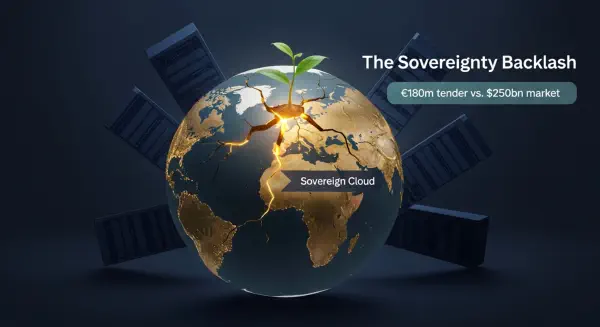
The European Union has begun to recognise the danger. It has launched a €180m tender for a “sovereign cloud,” and analysts project the global sovereign-cloud market will exceed $250bn by 2028. But the gap between ambition and reality is vast. Building a competitive cloud stack requires not just money but network effects, technical talent, and a customer base that trusts it enough to migrate. Europe’s Gaia-X initiative, launched with fanfare in 2020, has struggled to deliver a genuinely European alternative to AWS or Azure. Most “sovereign cloud” offerings are, in practice, local data centres managed by one of the Big Three—an arrangement that keeps data physically within a country’s borders but leaves ultimate control in American hands.
The Infrastructure Rentiers thus present a paradox: the very tools that make modern governance efficient and responsive are also the instruments of its potential subjugation. The digital tollbooths are not manned by soldiers in uniform but by algorithms and terms-of-service agreements. A state that wants to escape them faces a choice between digital isolation and permanent tenancy. Neither is compatible with the Westphalian ideal.
From canal to code#
When Britain seized the Suez Canal, it did not pretend that the waterway was merely a commercial asset. It was a lever of empire, and it was treated as such. The lesson of the canal age is that chokepoints are never neutral; they confer power on those who control them, and that power will eventually be used. The question for the 21st century is whether the nations that now lease their digital souls from a handful of American firms have grasped the nature of their bargain.
In the articles that follow, we will dissect each layer of the new infrastructure—hyperscale cloud, low-Earth orbit satellites, and submarine cables—in forensic detail. We will map the extent of state dependency, from the Cabinet Office to the battlefield, and we will ask whether a sovereign remedy exists. For the moment, it is enough to note that the ghosts of Suez have not vanished. They have merely changed their address.