On a moonless night in the Donbas, a Ukrainian drone operator stares at a tablet. The feed from the reconnaissance quadcopter is crisp, the latency barely perceptible. He taps a coordinate, and an artillery battery 20 kilometres away adjusts its aim. The entire kill chain—spot, locate, strike—depends on a white dish the size of a pizza box, bolted to the roof of a battered pickup truck. That dish talks to a satellite 550 kilometres above the earth, one of thousands in a constellation called Starlink. If the connection were cut, the operator would be blind. His unit would revert to radios and runners. The front line, in a very real sense, is held together by a Californian entrepreneur’s network.
This is not hyperbole. When Ukraine’s armed forces scrambled to restore communications after Russia’s invasion destroyed terrestrial networks, it was Starlink that filled the void. The terminals multiplied by the tens of thousands. Commanders coordinated counter-offensives over Starlink’s low-latency link. Drones streamed video. Families in occupied villages sent messages on encrypted apps. The system became so essential that the United States government, recognising its battlefield significance, formalised a $150 million Foreign Military Sale to procure and sustain the service. And yet, throughout 2023 and beyond, the fate of Ukraine’s connectivity hung on the decisions of a single private citizen—Elon Musk—who acknowledged withholding coverage to prevent a planned Ukrainian attack on Russian naval vessels, citing fears of nuclear escalation. The episode crystallised a disquieting truth: in the new geography of power, a corporation can veto the military operations of a sovereign state.
The Orbital Tollbooth#
Low-Earth orbit (LEO) has become the third pillar of digital chokepoints, alongside the cloud and the submarine cable. The logic is the same: an asset that provides an irreplaceable service—here, high-speed, low-latency internet anywhere on the planet—is concentrated in the hands of a few actors, and the dominant one is American. While several companies have launched or plan to launch LEO broadband constellations, the reality on the ground (and in the sky) is a Starlink near-monopoly.
By October 2025, SpaceX had lofted more than 10,000 Starlink satellites into orbit, with 8,624 still functioning and 8,608 operationally active. Of those, 7,455 were in their correct orbital slots and delivering service. The numbers are difficult to grasp visually, but a chart helps.
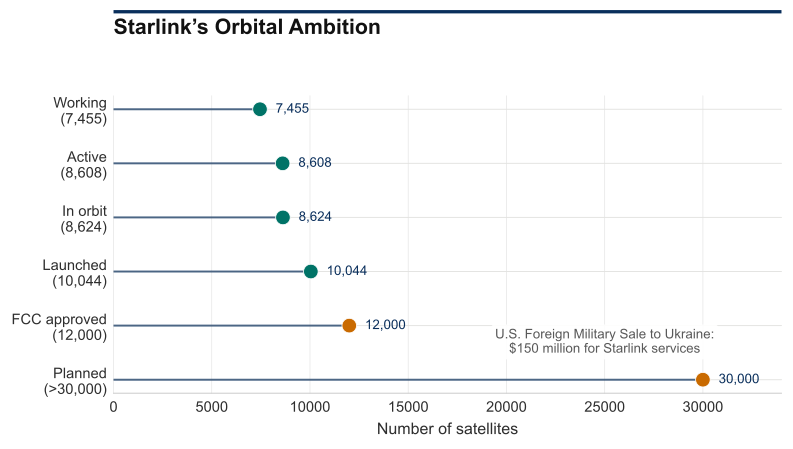
The lollipop stems stretch from what has already been accomplished—over 10,000 launched, 7,455 working—to the magnitude of what is permitted and planned. The Federal Communications Commission (FCC) has licensed SpaceX for 12,000 satellites; the company’s filings gesture towards an eventual constellation of more than 30,000. To put that in context, the total number of satellites orbiting Earth before Starlink began launching was roughly 2,000. SpaceX alone now outnumbers the rest of humanity’s space hardware by a factor of four.
The network effect is already overwhelming. Starlink’s nearest rival, the UK/India-backed OneWeb, has a constellation of around 600 satellites—a fraction of the size, with less capacity and higher latency. Amazon’s Project Kuiper, often cited as a potential competitor, had launched only a handful of test satellites by late 2025. China’s Guowang project and the EU’s IRIS² remain blueprints. For any state or military that needs reliable, global connectivity today, Starlink is the sole credible option. It is, in effect, the AWS of orbit: a first mover whose head start widens every month.
The Satellite and the State#
To understand why this matters for sovereignty, one must first understand what LEO constellations do differently. Traditional geostationary satellites sit 35,786 kilometres above the equator. They offer broad coverage but suffer from high latency—the annoying quarter-second delay on a satellite phone call. Starlink’s satellites, whizzing by at 7.8 kilometres per second, are close enough that the round-trip signal delay is under 20 milliseconds, comparable to a good terrestrial broadband connection. That makes them uniquely suited for real-time applications—video conferencing, telemedicine, and, critically, drone operations and modern weapons systems.
Ukraine’s battlefield use has provided a blueprint. Artillery fire-control apps that run on Starlink-linked tablets reduce the time between spotting a target and shelling it from 20 minutes to under a minute. Special forces use the network to stream helmet-camera footage back to headquarters. Civilian infrastructure—hospitals, railways, power-grid monitoring—has also come to depend on the constellation. In a modern, connected war, bandwidth is ammunition. And Starlink has shown that a single corporate provider can supply, and by extension, restrict, that ammunition.
Musk’s intervention in 2023 was the moment the penny dropped. According to his own account and subsequent media investigations, he refused to activate Starlink coverage in the vicinity of Crimea to support a Ukrainian maritime drone attack on a Russian fleet. “If I had agreed to their request, then SpaceX would be explicitly complicit in a major act of war and conflict escalation,” he wrote. Whatever one thinks of the decision—and many national-security experts condemned it as private diplomacy that usurped elected leaders—the legal and structural point was seismic. A chief executive, answerable to shareholders and himself, had overruled a military strategy requested by a sovereign government. The decision was not illegal; there is no treaty that obliges a satellite operator to serve a foreign military. But that is precisely the problem. The most critical communication link in a war zone was governed by a terms-of-service agreement.
The U.S. government’s subsequent $150 million Foreign Military Sale effectively nationalised some of the Starlink terminals and services for Ukraine, but it did not nationalise the decision-making authority. Under the terms of the sale, SpaceX remains the operator. If the U.S. executive branch and SpaceX’s CEO were ever to disagree about the use of Starlink in a conflict, who would decide? The contract is commercially sensitive, but analysts note that such sales typically come with end-use restrictions that still leave the ultimate “off switch” with the provider. As a former Pentagon official puts it, “We bought tickets for the bus, but we don’t own the bus, and the driver can still decide to pull over.”
Jurisdiction in the Sky#
The legal architecture around satellite communications is a patchwork. Under international law, a satellite is under the jurisdiction of the state where it is registered—usually the launching state. Starlink satellites are registered by the United States. The ground infrastructure—the dishes, the gateways, the network operations centres—are also overwhelmingly on U.S. territory or allied soil. So, even if a Ukrainian terminal sits in a trench near Kharkiv, the data it transmits passes through American-controlled infrastructure, subject to U.S. law.
The same CLOUD Act that haunts cloud computing applies here. If the FBI, with a valid U.S. warrant, demands user data from Starlink, SpaceX must comply, potentially without notifying the user. The implications for diplomatic and military confidentiality are profound. A foreign general who sends a battle plan over Starlink is, in legal terms, no more protected than a Gmail user in Cleveland. Furthermore, the U.S. has long applied economic sanctions and export controls extraterritorially. A future president could decide that a particular country’s use of Starlink in a conflict violates some U.S. policy, and order SpaceX to terminate service. No invasion, no gunboats. Just a flick of a regulatory switch.
There is also the question of dual-use technology. Starlink’s military applications are so obvious that the Pentagon has invested heavily in it, but the system remains fundamentally a commercial network. Its design, encryption standards, and software updates are proprietary. Governments that rely on it for national security cannot independently audit it for backdoors or vulnerabilities. They must trust a private company to keep their secrets safe. In the world of physical infrastructure, no state would allow a foreign corporation to build and operate its secret military radio network. In the digital realm, they line up for the privilege.
From Connectivity to Control#
The deeper shift is conceptual. The Westphalian state once held a monopoly on long-distance communication. The telegraph, telephone, and radio were either state-owned or heavily regulated utilities. Even the internet, in its early years, was a network of networks that resisted centralised control. But the rise of LEO constellations—capital-intensive, spectrum-dependent, and technologically arcane—has reconcentrated the physical layer of global connectivity. The state no longer controls the means of communication; it merely purchases access.
This transformation is not limited to war zones. Across the world, governments are turning to Starlink for rural connectivity, disaster response, and remote public services. The Brazilian Amazon, the Australian outback, the islands of Indonesia—all have begun integrating Starlink into civic infrastructure. In each case, the same dependency is being created. A municipal health clinic in a remote village now needs a California-based company to stay online to transmit patient records. A meteorological station relaying cyclone warnings speaks through a SpaceX satellite. The more ubiquitous the service becomes, the more the state’s own capacity to provide a public alternative atrophies. It is a classic rentier trap: the easier and cheaper the rent, the harder it is to leave the lease.
A Race for Alternatives?#
Governments are not oblivious. The European Union’s IRIS² constellation, approved with a €6 billion budget, aims to provide a “sovereign” broadband network by the late 2020s. China is building its own Guowang megaconstellation, and Russia has talked up the Sphere project. Even within the United States, the Pentagon has explored the possibility of a dedicated military LEO constellation to reduce dependency on a single commercial provider. But satellite programmes take a decade or more to fully deploy. Starlink, meanwhile, launches 50 or more satellites per week. By the time any sovereign alternative is operational, the Starlink constellation may number 30,000, and the cost of switching—and the network effects—will be even more daunting.
There is also the uncomfortable reality that many of the “alternatives” are not really alternatives at all. They rely on components, launch services, or ground-station technology supplied by the very same American ecosystem that Starlink dominates. True independence in space is a myth even for superpowers; for most nations, it is a fantasy.
The New Empyrean Empire#
History has a way of rhyming. The 17th-century Dutch East India Company wielded sovereign powers—it could wage war, negotiate treaties, coin money—all while being a private joint-stock company. The British East India Company governed large parts of India with its own army. In the 19th century, the telegraph cables were laid by private firms that acted as de facto arms of empire. In each case, the state and the corporation blurred, and sovereignty became a commodity that could be bought, sold, and, most of all, leased.
Starlink is the East India Company of the empyrean. It does not yet coin money, but it controls the passage of information through a domain that no single state can claim. It can enable a government’s defence or, just as easily, disable it. And it does so not because of a treaty obligation or a democratic mandate, but because it was first to build the infrastructure and first to capture the market.
When a Ukrainian soldier stares at his tablet, he sees the enemy’s position. But behind the pixels is a network of American satellites, governed by American law, operated by a company whose ultimate decision-maker answers to no parliament. The last mile of connectivity, it turns out, is the most political mile of all. In the next article, we will descend from orbit to the ocean floor, where another set of rentiers has quietly laid claim to the nervous system of the global economy.