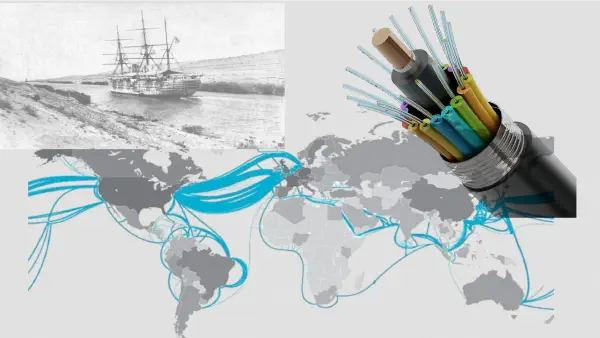
A few miles off the coast of Cornwall, where the Atlantic swells meet the English Channel, a fishing trawler snags its nets on something unseen. The object is not a wreck but a cable, sheathed in steel and polyethylene, no thicker than a fire-hose, carrying pulses of light between London and New York. Inside those pulses are bank transfers from the City of London, encrypted video calls from Whitehall, and the bedtime stories that a grandmother in Bristol reads to a granddaughter in Boston over a tablet app. If that cable were severed, the grandmother’s connection would be rerouted in milliseconds. But if enough cables were cut—by anchor, by sabotage, by a hostile state—the Atlantic would go dark. The financial arteries of the West would seize. The cost, measured in halted transactions, would reach $10 trillion in a day.
These submarine cables are the planet’s central nervous system. They carry 95% of intercontinental data traffic. Yet the map of who owns them has changed beyond recognition in a decade. The cables were once laid and managed by consortia of national telecom operators—creatures of the state, subject to its laws and strategic priorities. Today, the ocean floor belongs to a handful of American technology firms. Google, Meta, Microsoft, and Amazon together control an estimated 71% of global undersea cable capacity. The new landlords have not only inherited the infrastructure but are building the next generation of it almost entirely on their own terms, with their own money, and for their own purposes. The Westphalian state, which once guarded these underwater frontiers as matters of national security, has become a bystander.
The anatomy of a cable grab#
Start with the numbers. The Big Four U.S. firms now own or lease capacity on more than two-thirds of the world’s submarine bandwidth. The scale is best illustrated with a single horizontal bar.
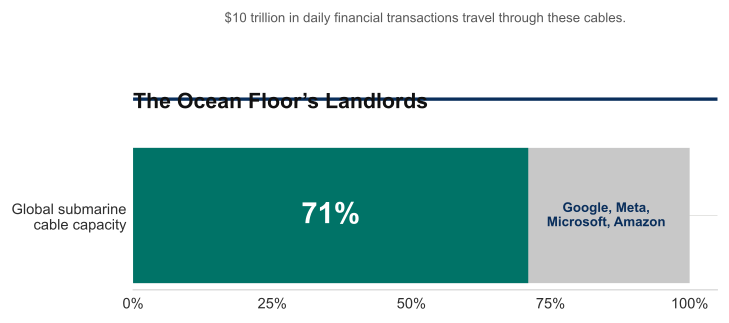
The chart is brutal in its simplicity: 71% in teal belongs to Google, Meta, Microsoft, and Amazon; the remaining 29%—fragmented among dozens of legacy carriers, national operators, and regional consortia—is the grey remnant. To put this in perspective, a decade ago the proportions were nearly reversed. The great cable systems of the early internet era—TAT-14, Apollo, SEA-ME-WE 3—were collaborations between the likes of BT, France Telecom, AT&T, and SingTel. They were not purely sovereign assets, but they were subject to a balance of national interests. No single company could dictate the terms.
That model has been swept away by economics. A modern transoceanic cable costs between $250 million and $500 million to build. For a national telecom, that is a major capital project. For a tech giant with a market capitalisation in the trillions, it is a line item. Google alone has invested in more than 20 cable systems, bearing names that conjure the old age of exploration: Curie, Dunant, Grace Hopper, Equiano. Each cable serves the company’s insatiable demand for low-latency connectivity between its data centres. When Google owns the entire cable, it does not have to share bandwidth with anyone else. It can prioritise its own traffic—search queries, YouTube videos, AI training runs—over the public internet.
Meta, not to be outdone, is planning Waterworth, a 40,000-kilometre cable that will circumnavigate the globe and be wholly owned by the company. The projected cost is several billion dollars, and the cable will link every continent, with landing points chosen by Meta alone. In the 19th century, such an undertaking would have been a joint venture of empires. Today, it is an asset on a corporate balance sheet.
The investment surge is accelerating. According to TeleGeography, projected global submarine-cable spending between 2025 and 2027 will reach $13 billion, nearly double the level of the previous three years. The bars below show the leap.
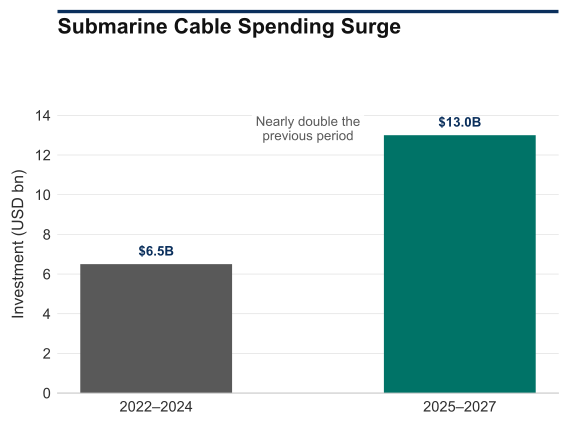
The increase is not driven by a sudden explosion in public demand. It is driven by the Big Four’s need to connect their own server farms, to lock in capacity, and to avoid paying transit fees to rivals. The result is a physical layer of the internet that is being privatised at a speed that regulators and states have barely registered.
From copper to code: the loss of sovereign control#
Why does ownership of a cable matter? Data is data; it moves regardless of who holds the title. The answer lies in surveillance, security, and the quiet application of jurisdiction. A cable owned by a U.S. corporation is subject to U.S. law. Under the CLOUD Act, American intelligence and law-enforcement agencies can compel a U.S. company to hand over data that flows through its infrastructure, irrespective of where the cable lands or who sent the packet. The same executive order or national-security letter that applies to a server in Virginia applies to a cable at the bottom of the South China Sea, provided the owner is incorporated in Delaware.
Furthermore, submarine cables are physically vulnerable. They can be tapped—optical splitters can siphon off signals without detection if the cable owner does not operate robust encryption and monitoring. A hostile power could cut a cable, as was repeatedly threatened in the Baltic in 2024–25. But a hostile power could also gain access through a commercial arrangement. If a foreign government buys a stake in a cable consortium, or if it pressures a private owner to grant it access to the landing station, it can place its surveillance equipment directly on the trunk. The state that controls the cable landing station often has the de facto ability to intercept all traffic flowing through it. And as the Big Four build more cables, they naturally land them where it is commercially convenient—often in jurisdictions with lax oversight or where the host government’s relationship with Washington makes American legal reach seamless.
The traditional countermeasure—encryption—is not a complete answer. While most internet traffic is encrypted end-to-end, metadata—the “who, when, where, and for how long” of communication—is frequently exposed. A cable owner with the right taps can map the social network of an entire government’s diplomatic corps, trace the communication patterns of a defence ministry, or identify which servers handle classified material. In the wrong hands, metadata is an intelligence goldmine.
The geopolitical blind spot#
Governments have been slow to wake up. The North Atlantic Treaty Organisation (NATO) has a “cable security” working group that meets sporadically. The European Union’s 2024 “submarine cable resilience” directive urges member states to map vulnerabilities but mandates no ownership changes. The United Kingdom, whose geography makes it the natural landing point for transatlantic cables, has allowed nearly all new cables to be privately owned by U.S. companies, with minimal security conditions. The assumption, shared by most Western democracies, is that American corporate ownership is an unalloyed good—that it aligns with the strategic interests of the alliance. But the CLOUD Act applies to American companies irrespective of the ally in question. The United States can, and sometimes does, conduct surveillance on allied governments through commercial conduits. The former German chancellor Angela Merkel’s mobile phone was reportedly tapped not by a spy on the ground but via signals intelligence that exploited the American-controlled communications backbone. The cables are not neutral; they are instruments of the jurisdiction that controls them.
China, for its part, has drawn a different lesson. It restricts foreign ownership of its landing stations. It is building its own Digital Silk Road of cables, often routed through friendly states, and is developing satellite and terrestrial alternatives. But for the rest of the world, the choice is increasingly binary: use American-owned cables or use nothing. The "nothing" option means digital isolation, which no economy can afford. The "American-owned" option means accepting that the nervous system of one’s economy and government runs through a corporate entity that answers to a foreign sovereign.
The rentier’s silent harvest#
Submarine cables, like cloud servers and satellite constellations, are a rentier’s delight. Once laid, a cable lasts for 25 years. The owner charges fees to other operators, recoups the initial investment many times over, and enjoys a near-permanent monopoly on a route. The barriers to entry—environmental permits, specialised ships, the difficulty of coordinating dozens of national regulators—are so high that new competitors rarely emerge. The Big Four did not invent submarine cables, but they have captured the asset class at precisely the moment when the world’s dependence on it has become absolute.
In the summer of 2025, a joint naval exercise in the North Sea simulated the coordinated cutting of undersea cables by hostile forces. The scenario was treated as a top-tier national-security crisis. But as the admirals gamed out the response, one uncomfortable question kept surfacing: who actually owns the cables that needed defending? The answer, in most cases, was not a government. It was a company whose primary concern was its quarterly earnings report. The physical defence of the digital commons now depends on the commercial interests of a handful of American tech giants. That is not an alliance; it is a dependency.
The ghosts of Suez have travelled far. The British fleet that seized the canal in 1882 understood that control of a chokepoint confers power. Today’s chokepoints are not dug through sand but laid beneath it. And the power they confer is not wielded by admirals but by the invisible hand of the cloud-and-cable oligopoly. In the next article, we will bring the layers together and examine what it means when an entire state—from its tax system to its defence communications—operates as a tenant on this rented infrastructure.