
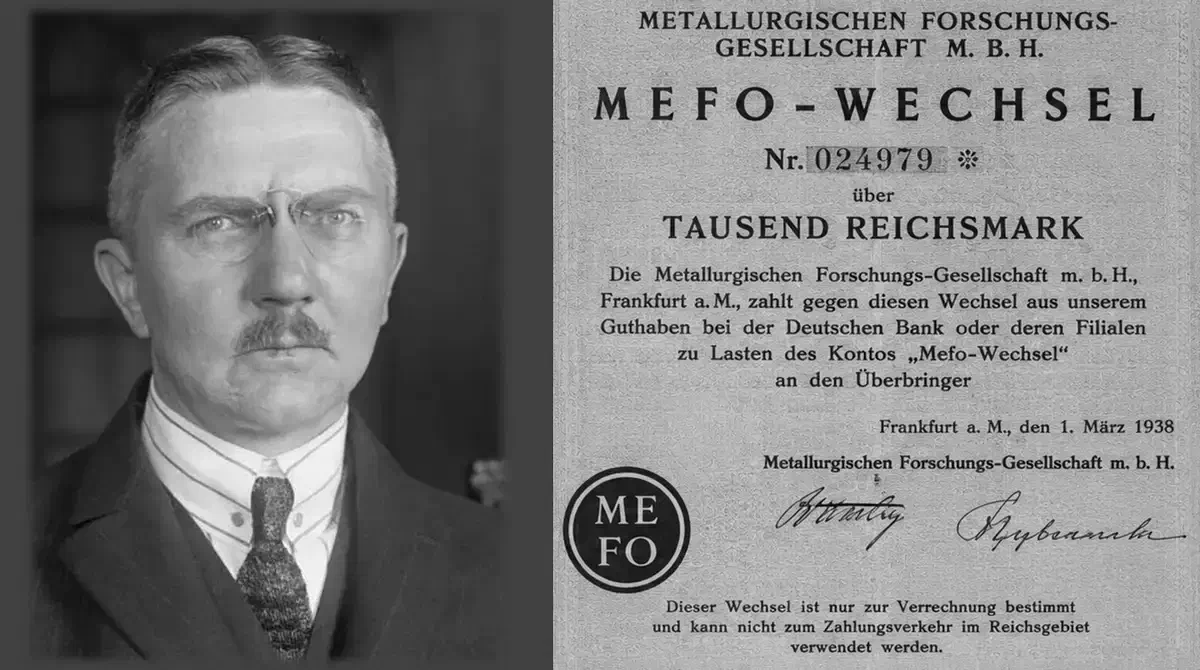
The Metallurgische Forschungsgesellschaft — the Metallurgical Research Corporation — was a fiction with a balance sheet. Capitalised at one million Reichsmarks by four defence contractors including Krupp and Siemens, it existed for a single purpose: to stand between the German state and its creditors. When the Wehrmacht needed artillery shells, it did not pay the manufacturer directly. Instead, MEFO issued a bill of exchange — a formal promise to pay in four years. The contractor discounted that bill at a commercial bank; the bank rediscounted it at the Reichsbank. New money entered the economy. No budget line recorded the transaction. No foreign observer could easily trace it.
The device worked because it exploited the gap between legal classification and economic function. A bill of exchange is, formally, a private commercial instrument. What Schacht created was sovereign debt wearing a different suit. The Reichsbank, as ultimate backstop, was doing what central banks always do when they buy assets: expanding its balance sheet by crediting new reserves into existence. Germany rearmed on conjured money, and for several years, nobody outside the government knew precisely how much.
The mechanics of monetary concealment#
To understand why the scheme worked, it helps to trace a single transaction. Krupp delivers one million Reichsmarks' worth of steel forgings to the army. MEFO issues a bill promising repayment in four years. Krupp, needing wages next week, sells that bill to a commercial bank at a discount — receiving perhaps 960,000 marks immediately. The bank, holding a paper asset backed by nothing more tangible than the German state's implied word, takes it to the Reichsbank and receives newly created reserves in return. The Reichsbank's balance sheet grows: one asset (the MEFO bill), one liability (the bank's reserve account). The entry is simultaneous. The money did not come from anywhere. It was created at the moment the asset was purchased.
"The legal fiction was a private commercial instrument. The economic reality was sovereign money creation — and inflation deferred is not inflation cancelled."
This is not unusual. It is how central banks operate. What made MEFO distinctive was the concealment layer and the scale. By 1938, outstanding MEFO liabilities totalled roughly 12 billion Reichsmarks — equivalent to more than half of Germany's annual government revenue. The instrument had financed the Luftwaffe, the Panzer divisions, and the logistical infrastructure for a continental war, all without appearing as public debt.
The MEFO Mechanism — Step by Step#
| Stage | Actor | Transaction | Outcome |
|---|---|---|---|
| 1. Delivery | Krupp | Delivers weapons to Wehrmacht | Government owes payment |
| 2. Bill issuance | MEFO (shell co.) | Issues 4-year bill of exchange to Krupp | Debt created off government books |
| 3. Discounting | Commercial bank | Buys bill from Krupp at small discount | Krupp receives immediate cash |
| 4. Rediscounting | Reichsbank | Buys bill from commercial bank; credits new reserves | New money created; balance sheet expands |
| 5. Deferred cost | German economy | Excess money meets full-employment economy post-1936 | Repressed inflation; price controls imposed |
graph TD;
MEFO[MEFO Bills]-->Reichsbank[Reichsbank];
Reichsbank-->CommercialBanks[Commercial Banks];
CommercialBanks-->Krupp[Krupp];
Krupp-->Wehrmacht[Wehrmacht];
The inflationary consequence did not vanish. It was displaced. Through 1935, Germany had enough idle workers and factories that new money activated real output rather than bidding up prices. Unemployment fell from six million to near zero in four years — a genuine achievement, whatever its purpose. But by 1936, that buffer was gone. Schacht himself warned Hitler that the economy could not sustain the trajectory. Price and wage controls were imposed, suppressing the signal while leaving the cause intact. Shortages, black markets, and deteriorating quality expressed the same imbalance through other channels. The bill had not been cancelled. It had been hidden in a different drawer.
America's open secret#
The United States does not need a shell company. It has something more durable: a currency the world cannot yet do without.
The mechanics are structurally similar to MEFO, if more visible. Congress authorises spending beyond tax revenues. The Treasury issues bonds to cover the deficit. The Federal Reserve, particularly since 2008, purchases those bonds on the secondary market — crediting the selling banks with newly created reserves. The Fed's balance sheet expanded from roughly $900 billion before the financial crisis to $9 trillion by early 2022. Each expansion followed the same logic: an asset purchased, a liability created, money conjured at the moment of transaction.
The critical difference is that America's liabilities are globally desired. Dollar-denominated assets are the world's reserve instrument — held by foreign central banks, sovereign wealth funds, and private institutions not because they are compelled to, but because the alternative does not yet exist at comparable scale, liquidity, or security. This is the exorbitant privilege that Valéry Giscard d'Estaing named in 1965 and that has persisted, in modified form, ever since. Germany in 1938 could not roll over its debt into willing foreign hands. America has done so continuously for eight decades.
The result is that the inflationary and fiscal constraints that bind other states are, for America, softer rather than absent. The 2021–22 inflation episode demonstrated that the constraint is real — when money creation substantially outpaced productive capacity, prices rose at the fastest rate in forty years. But the exchange rate did not collapse, foreign creditors did not flee, and the dollar's reserve share declined only marginally. The buffer proved wide.
Empire as credit instrument#
Where the parallel sharpens is not in the monetary mechanism but in the strategic logic it enables. MEFO bills financed rearmament that Germany's visible fiscal position could not justify. Dollar hegemony finances a military and strategic posture that America's domestic tax base, considered alone, would struggle to sustain. The United States spends more on defence than the next ten countries combined. It maintains forward bases in more than seventy countries. It can impose financial sanctions — effectively weaponising the dollar clearing system — against any state that conducts significant international trade. No coalition is required. No UN authorisation is sought. The institutional friction that constrains other actors is, for Washington, optional.
"You hide what you cannot yet defend openly. That Germany needed MEFO at all was a weakness signal. That America needs no cover is the operational definition of systemic primacy."
This is not hypocrisy in the ordinary sense. It is the structural condition of hegemony: the rule-setter is not subject to the rules in the same way as the rule-takers. Britain operated on identical logic for a century. What is notable is how openly this now operates. Military action without Security Council authorisation, tariff regimes imposed by executive decree, sanctions applied extraterritorially to third-country firms — each instance is less a violation of the order than a demonstration that the order exists to serve the hegemon's interests, and is adjusted accordingly.
The aging of empires#
The diagnostic question is not whether this is sustainable but how the unsustainability manifests and at what pace.
MEFO bills had a hard terminal date: four-year maturities, 12 billion marks outstanding, and no tax base or export earnings to redeem them. The menu Germany faced in 1938 was stark — fiscal contraction, inflation, or resource seizure. It chose the third. The US faces a softer version of the same arithmetic, stretched across decades rather than years.
1944
Bretton Woods establishes dollar as global reserve currency, tied to gold at $35 per ounce.1971
Nixon closes the gold window. Dollar becomes fiat reserve currency — backed by military and institutional power, not convertibility.1973–74
Petrodollar recycling begins. Oil priced in dollars; Gulf surpluses reinvested in US Treasuries. The reserve role deepens.2008–22
Fed balance sheet expands tenfold through successive QE rounds. Dollar share of global reserves falls from ~71% to ~58% — gradual erosion, not collapse.2022–present
US freezes Russian sovereign reserves. Secondary powers accelerate de-dollarisation efforts. The weaponisation of the system accelerates its own erosion.
The erosion is real but slow. Dollar share of global foreign exchange reserves has declined from roughly 71% in 2000 to around 58% today — a meaningful shift over a generation, not a crisis. China and Gulf states have incrementally reduced dollar concentration. Bilateral trade in non-dollar currencies has grown. The BRICS grouping has made reserve diversification an explicit policy objective, with limited but non-trivial results.
The deeper problem is structural rather than numerical. Each time the United States acts outside the institutional framework it constructed — the WTO, the UN, the international legal order — it signals to secondary powers that the rules are discretionary. That signal is rational for any single episode. Cumulatively, it degrades the legitimacy that makes others willing to hold dollars, accept US-led institutions, and pay the coalition tax that sustains American primacy. Unilateral action is simultaneously a display of maximum power and a consumption of it. The British Empire made the same calculation, consistently, until Suez demonstrated that the financial constraint had transferred to Washington.
The portable lesson#
Schacht's MEFO bills teach a principle that transcends their specific context: any credit instrument backed by a sovereign guarantor functions as money, regardless of its legal classification. The inflationary or fiscal pressure it generates is deferred, not cancelled. It accumulates in the liability structure until rollover becomes impossible or monetisation unavoidable.
Applied to dollar hegemony, the principle runs: America's reserve currency status is a credit instrument backed by the full weight of US military, institutional, and economic power. It allows the United States to run deficits that would destabilise any other state, to finance strategic commitments beyond its visible fiscal capacity, and to act without the institutional cover weaker states require. The liability is real — it accumulates in the gradual erosion of reserve share, allied credibility, and institutional legitimacy.
Germany's MEFO timeline ran six years from first issuance to war. America's timeline is longer by an order of magnitude, because the reserve currency buffer is immeasurably deeper. But the arithmetic is the same. Liabilities deferred are not liabilities discharged. Empires that spend credibility faster than they replenish it are not exempt from the bill. They are merely granted a longer interval before it arrives.
The bill, as always, comes due. The only open question is the denomination in which it is finally settled. ■
References#
- Tooze, A. (2006). The Wages of Destruction. Allen Lane.
- Eichengreen, B. (2011). Exorbitant Privilege. Oxford University Press.
- Kennedy, P. (1987). The Rise and Fall of the Great Powers. Random House.
- Federal Reserve statistical releases, 2008–2024.
- IMF COFER database, Q4 2023.