
Introduction: when supply chains become battlefields#
Modern defence procurement is no longer a matter of budgetary arithmetic alone. It is increasingly constrained by geology. Global military spending has climbed to levels last seen during the Cold War, a trend documented in successive annual reports from the Stockholm International Peace Research Institute (SIPRI) [1]. The more capital Western defence establishments commit, the more dependent they become on a narrow, fragile base of processed minerals and semiconductor inputs. The default assumption governing critical-material trade has shifted from a presumption of approval to a presumption of denial: states that control chokepoints in that supply chain increasingly treat export licensing as a policy instrument rather than a routine commercial matter.
A SIPRI dataset on world military spending, in billions of US dollars, offers a quantitative record of that shift. Over nearly four decades, global military spending traces an arc from the post-Cold War peace dividend to the high-intensity rearmament of the 2020s. What follows is a trend analysis broken into five strategic eras, each tied to the events that produced it.
1. The Great Divestment (1988–1999): the peace dividend and the "end of history"
- The data: Spending falls from a peak of $1,759.9bn in 1988 to a trough of $1,207.5bn in 1998 — a real-terms contraction of more than 31 per cent.
- The events: The fall of the Berlin Wall (1989) and the dissolution of the Soviet Union (1991) removed the peer threat that had underpinned NATO budgets. The Gulf War (1990–91) was brief and technologically one-sided, reinforcing an assumption of durable Western conventional superiority. The Balkan conflicts were treated as regional policing actions rather than systemic threats. Capitals redirected the resulting fiscal space toward domestic spending.
2. The counter-insurgency spike (2001–2009): the "war on terror" tax
- The data: A decade of stagnation ends with a climb from $1,228bn in 1999 to $1,980bn in 2009 — a 61 per cent increase in nominal terms.
- The events: The September 11 attacks rewired procurement priorities. The invasions of Afghanistan (2001) and Iraq (2003) shifted spending away from peer-to-peer naval and air capability and toward soldier-intensive counter-insurgency operations: armoured vehicles, surveillance drones, an expanded special-forces and intelligence apparatus. This was operations spending, not modernisation capital — a distinction the next era reverses.
3. The austerity plateau (2010–2017): financial-crisis fatigue
- The data: Spending flatlines, oscillating between $1,936bn and $2,016bn. The 2012 nominal peak is not exceeded until 2018.
- The events: The 2008 financial crisis and the European sovereign-debt crises that followed forced fiscal consolidation. The US budget sequester (2013) cut military readiness funding automatically. Western forces drew down from Iraq and began withdrawing from Afghanistan. Policymakers treated the "long war" as ending and China's economic rise as a commercial rather than military concern.
4. The great-power reassessment (2018–2021)
- The data: A decisive upward inflection. Spending rises from $1,982bn in 2017 to $2,227bn in 2021 — a 12 per cent increase over four years.
- The events: The 2018 US National Defense Strategy named great-power competition with China and Russia as the Pentagon's primary focus. The Trump administration pressed NATO allies toward the 2 per cent GDP spending target. China's naval expansion and hypersonic testing became harder to dismiss as catch-up. Russia's 2014 annexation of Crimea had been treated as a contained event; by 2021, troop build-ups on Ukraine's border signalled that territorial revisionism remained a live option in Europe. The Covid-19 pandemic produced a brief economic shock but did not reduce defence spending.
5. The hockey-stick rearmament (2022–2025): the attrition reality
- The data: The steepest incline in the dataset. Global spending reached $2,887bn in 2025 — the eleventh consecutive year of growth and a new high, a 41 per cent increase over the decade 2016–25 (SIPRI, April 2026 update) [1].
- The events: Russia's full-scale invasion of Ukraine (February 2022) ended the assumption of a stable post-Cold War security order in Europe. The war revealed the material appetite of industrial-scale attrition: millions of artillery shells, and increasingly, thousands of drones and microchips, consumed per month. Europe began its largest rearmament programme since the 1950s, including Germany's Zeitenwende. The United States passed large supplemental aid packages — though notably, US spending itself fell in 2025 as that supplemental funding lapsed, even as the global total kept rising on the strength of European and Asian increases. Japan, South Korea, and Taiwan accelerated indigenous arms production to deter China.
Critical observations
The real-value illusion. Nominal spending has reached $2.89 trillion, but real purchasing power has not kept pace. Between 2022 and 2025, inflation and supply-chain bottlenecks — particularly in semiconductors and critical minerals — eroded the dollar's unit-buying power. A given nominal sum now buys fewer aircraft and ships than the same sum bought in 1988. The claim is testable: inflation-adjusted unit costs for comparable platform classes should rise faster than the general price index. If they don't, the argument is wrong.
The shift from stock to flow. Spending spikes in the 1980s purchased durable platforms — carriers, strategic bombers — built to last 40 years. The 2022–2025 surge purchased expendable flow: drones, jamming pods, guided artillery shells consumed within weeks. This creates a continuous resupply requirement for minerals and chips, rather than a one-time capital outlay — which is what links this spending data to the gallium and germanium bottlenecks discussed below.
No peacetime dividend in sight. Unlike the 1990s drawdown, the post-2022 baseline shows no sign of receding. If the order has shifted from a unipolar "end of history" to a multipolar presumption of conflict, the $2.89 trillion figure for 2025 represents a new structural floor rather than a temporary surge — a claim a sustained multi-year decline in global spending, absent a major de-escalation event, would falsify.
The shift this implies is not only tactical; it is metallurgical. The "exquisite, low-volume" platform model — small batches at high unit cost — is giving way to a "high-volume, attritable" model, visible on the battlefields of Ukraine and Nagorno-Karabakh. Battlefield success increasingly depends less on the sophistication of a single airframe than on the reliability of the minerals-to-microchip pipeline sustaining production of millions of units. What follows examines that pipeline, and the risk material scarcity poses to it.
The spending surge: high-tech attrition comes at a price#
Per SIPRI's most recent figures, the increase is concentrated in Europe and Asia, with spending directed toward artificial intelligence, autonomous systems, and unmanned platforms. The result is what might be termed a hardware trap: capability gains require continuous resupply of inputs that Western economies do not themselves control.
Three drivers stand out. First, conflict-induced procurement: replenishing stockpiles depleted by the war in Ukraine. Second, technological rivalry: research-and-development spending directed at semiconductors and AI capable of matching Chinese advances. Third, a shift away from manned platforms toward mass-produced, expendable systems. A fourth factor compounds the first three: demand for integrated multi-domain networks, which require sensor-heavy communication nodes across land, sea, and space.
The turn toward mass production is exemplified by Ukraine, whose government has stated production capacity in the range of four to five million drones a year [2]. That scale creates a different kind of vulnerability than conventional procurement does. A mineral shortage in traditional procurement might delay a single multi-billion-dollar aircraft. In high-volume drone production, a shortage of processed gallium or germanium can halt an entire assembly line, because production runs are optimised for a specific chip architecture and substitution at scale is difficult. The implication is testable: output from a mass-drone programme should collapse, not merely slow, when a single critical input is interrupted — a sharper failure signature than the gradual cost overruns typical of conventional procurement shortages.
Gallium and germanium: the bottlenecks in high-frequency warfare#
Gallium — specifically gallium nitride, or GaN — and germanium underpin a specific set of military technologies: high-frequency radar, precision infrared guidance, and secure satellite communication. Dependence on a single supplier for either material is therefore dependence on a single supplier for those capabilities.
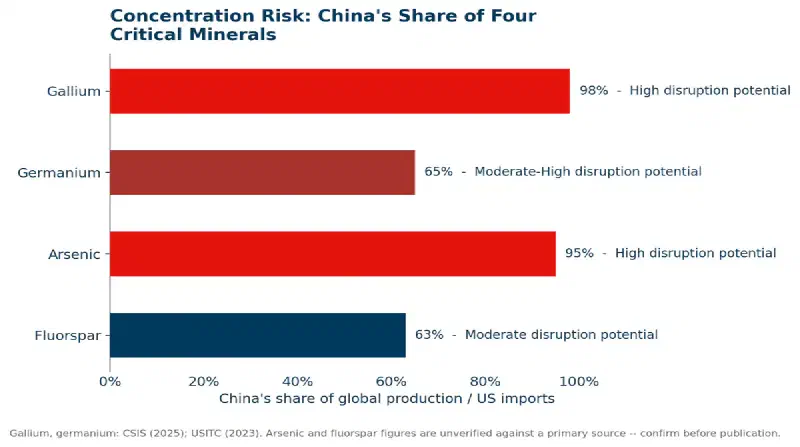
China accounts for an estimated 98 per cent of unprocessed gallium production and roughly 65 per cent of primary germanium production [3, 4]. The July 2023 licensing requirements on both materials function as a natural experiment in supply concentration: a single jurisdiction's administrative decision was sufficient to constrain a defence-relevant input for the rest of the world, without any change in underlying mineral scarcity. The mechanism generalises. Wherever production is this concentrated, the exporting jurisdiction's licensing policy — not global supply — becomes the binding constraint on importers' access, regardless of that jurisdiction's stated intent.
The disruption potential for defence systems is stark:
| Mineral | Defence application | China's market share | Disruption potential |
|---|---|---|---|
| Gallium | GaN radars, 5G comms, missile defence | 98% (unprocessed) | High |
| Arsenic | High-purity doping, GaAs wafers, LEDs | 95% (US imports) | High |
| Germanium | Infrared imaging, fibre optics, 3nm nodes | 65% (primary production) | Moderate to high |
| Fluorspar | Semiconductor etching, HF acid production | 63% (global supply) | Moderate |
[Editorial note — remove before publishing: gallium and germanium figures above are sourced to [3, 4]. The arsenic and fluorspar figures are carried over from the prior draft and have not been independently verified against a primary source.]
The implication generalises beyond this case: a state need not match a rival's aggregate military spending if it controls a concentrated input that rival's production depends on. The claim is falsifiable — it predicts that defence planners will increasingly prioritise input diversification over platform spending as a share of procurement budgets, a shift that should become visible in budget allocations over the coming decade.
Battlefield lessons: drone saturation and the myth of the formidable defence#
The wars in Nagorno-Karabakh and Ukraine exposed the limits of legacy air defence against massed, low-cost unmanned systems. Armenian ground forces, previously assessed as well-equipped, suffered heavy losses because their air-defence architecture lacked the mobility and sensor coverage the new electromagnetic environment required.
Three technical drivers explain the failure. First, an optimisation mismatch: older systems such as the S-300 and SA-6 were designed for large, fast targets; small drones were effectively invisible to their sensors. Second, a lack of "interception domes": forces lacked mobile, layered networks of electronic-warfare (EW) nodes capable of providing continuous cover for manoeuvring units. Third, limited mobility: systems such as the Tor were vulnerable the moment they folded their antennas for maintenance, underscoring the need for redundant, mineral-intensive mobile EW systems.
The pattern suggests air superiority is no longer a stable, theatre-wide condition; it is a localised and temporary advantage achieved in coverage gaps. Closing those gaps requires securing the mineral inputs for mobile EW nodes and interceptor drones. The portable principle: control over the vertical dimension of a battlespace increasingly tracks control over the supply chain for the sensors and jammers that contest it, not over platform numbers alone.
Policy interventions: the Section 232 framework and national security#
On January 14, 2026, President Trump issued Proclamation 11001 under Section 232 of the Trade Expansion Act, following a Commerce Department investigation into imports of Processed Critical Minerals and Their Derivative Products (PCMDPs) [5]. The proclamation concurred with Commerce's finding that PCMDP import dependence threatens national security, but it stopped short of imposing tariffs immediately. Instead, it directed the Secretary of Commerce and the US Trade Representative to negotiate supply agreements within 180 days, with a sectoral tariff held in reserve if those negotiations fail to produce results [6]. The structure is itself diagnostic: the administration judged negotiated supply commitments a faster route to security than immediate tariff-driven reshoring, at least in the first instance.
The investigation's findings: the United States is 100 per cent net-import reliant for 12 critical minerals and over 50 per cent reliant for 29 others [7]. Domestic mining alone offers limited protection if refining remains offshore — the United States is the world's second-largest producer of rare-earth ore but exports most of it to China for separation and magnet production [8]. Price volatility in mineral markets has historically deterred private investment in domestic processing capacity, leading to plant closures. And the concentration of Department of War [12] supply chains in a small number of foreign jurisdictions creates a structural vulnerability independent of those jurisdictions' intentions toward the United States.
The implication for strategy: mining a mineral domestically offers little protection if the Department of War still depends on a strategic competitor for the final processing step — converting ore into high-purity wafers or magnets. Extraction and processing are separable links in the chain and must be secured separately.
Strategic reorientation: the Western Hemisphere and "friend-shoring"#
An alternative to dependence on Chinese processing exists within the USMCA framework and broader Western Hemisphere partnerships — though it remains latent rather than realised.
Four steps follow for defence planners. First, incorporate Canadian and Mexican smelting and refining capacity into National Defense Stockpile (NDS) planning under the USMCA framework. Second, continue scaling the NDS: the 2025 One Big Beautiful Bill Act appropriation lifted the stockpile's transaction fund from under $1bn to roughly $3bn [10] — still a fraction of its Cold War-era peak, which exceeded $30bn in 2025 dollars [9]. Third, secure specific regional assets: germanium recovery from Teck Resources' Trail, BC operations [11], and fluorspar supply from Mexican producers such as the Las Cuevas mine, for semiconductor etching. Fourth, treat social and political risk as a variable, not a footnote: resource nationalism in Brazil and Argentina, and opposition to extractivism, bear directly on supply-chain reliability — a function the Minerals Security Partnership is intended to manage.
Treating these risks as exogenous to supply-chain reliability has a predictable failure mode: it pushes processing offshore, toward jurisdictions with lower environmental standards and, in some cases, higher strategic hostility to the United States. The pattern recurs across resource sectors and is not specific to critical minerals.
Conclusion: decoupling defence from geologic vulnerability#
Western defence modernisation depends on a mineral supply-chain architecture that has not yet been secured. As the transition to 3nm-and-below semiconductor nodes continues, demand for specialised inputs is likely to rise rather than fall: advanced lithography at these nodes requires lasers using neon and xenon, and etching requires high-purity fluorspar and hydrofluoric acid.
The presumption-of-approval era for these materials has ended for the states able to enforce that shift; for those that cannot, treating mineral access as a logistics footnote rather than a Tier-1 capability remains the residual risk. The claim this analysis makes is falsifiable: if processed-mineral access fails to function as a determinant of military capability over the coming decade, the framework above is wrong. On current evidence, it does. Geology has become a branch of grand strategy.
Infographic#
References#
- Liang, X., Tian, N., Lopes da Silva, D., Scarazzato, L., Karim, Z., & Guiberteau Ricard, J. (2026). Trends in world military expenditure, 2025 (SIPRI Fact Sheet). Stockholm International Peace Research Institute. https://doi.org/10.55163/ZLHQ1057
- Centre for Eastern Studies (OSW). (2025, October 14). Game of drones: The production and use of Ukrainian battlefield unmanned aerial vehicles (OSW Commentary). https://www.osw.waw.pl/en/publikacje/osw-commentary/2025-10-14/game-drones-production-and-use-ukrainian-battlefield-unmanned
- Center for Strategic and International Studies. (2025, July 17). Beyond rare earths: China's growing threat to gallium supply chains. https://www.csis.org/analysis/beyond-rare-earths-chinas-growing-threat-gallium-supply-chains
- U.S. International Trade Commission. (2023, December). Germanium and gallium: U.S. trade and Chinese export restrictions (Executive Briefing on Trade). https://www.usitc.gov/publications/332/executive_briefings/ebot_germanium_and_gallium.pdf
- Trump, D. J. (2026, January 14). Proclamation 11001—Adjusting imports of processed critical minerals and their derivative products into the United States. Federal Register, 91(12), 2439–2442. https://www.govinfo.gov/content/pkg/FR-2026-01-20/pdf/2026-01045.pdf
- White & Case LLP. (2026, January). President Trump orders critical minerals trade negotiations in Section 232 action. https://www.whitecase.com/insight-alert/president-trump-orders-critical-minerals-trade-negotiations-section-232-action
- Global Policy Watch. (2025, October 13). Made in America: The outlook for critical minerals. https://www.globalpolicywatch.com/2025/10/made-in-america-the-outlook-for-critical-minerals/
- U.S. Geological Survey. (2026). 2026 mineral commodity summaries: U.S. net import reliance dashboard. U.S. Department of the Interior. https://storymaps.arcgis.com/stories/404a3b288f20461a96a81229db41da64
- Hoover Institution, History Lab. (2025, August). A multilateral commercial stockpile for critical minerals (Working Paper). Stanford University. https://www.hoover.org/sites/default/files/research/docs/20250810%20-%20A%20Multilateral%20Commercial%20Stockpile%20for%20Critical%20Minerals%20-%20Hoover%20History%20Lab%20Working%20Paper.pdf
- Carnegie Endowment for International Peace. (2026, April 3). Securing America's critical minerals supply. https://carnegieendowment.org/research/2025/10/securing-americas-critical-minerals-supply?lang=en
- CIM Magazine. (2025, June 27). Weekly mining news recap for June 27. CIM Magazine. Canadian Institute of Mining, Metallurgy and Petroleum. https://magazine.cim.org/en/news/2025/weekly-mining-news-recap-june-27/
- NPR. (2025, September 6). President Trump signs order to rename the Defense Department as the Department of War. https://www.npr.org/2025/09/04/nx-s1-5529420/trump-department-of-war-department-of-defense